

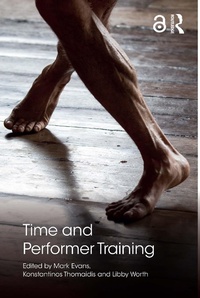
Time and Performer Training
1st Edition
Published on 8. February 2019
252 pages
978-1-351-18035-1 (ISBN)
Description

Time and Performer Training addresses the importance and centrality of time and temporality to the practices, processes and conceptual thinking of performer training. Notions of time are embedded in almost every aspect of performer training, and so contributors to this book look at:
age/aging and children in the training context
how training impacts over a lifetime
the duration of training and the impact of training regimes over time
concepts of timing and the 'right' time
how time is viewed from a range of international training perspectives
collectives, ensembles and fashions in training, their decay or endurance
Through focusing on time and the temporal in performer training, this book offers innovative ways of integrating research into studio practices. It also steps out beyond the more traditional places of training to open up time in relation to contested training practices that take place online, in festival spaces and in folk or amateur practices.
Ideal for both instructors and students, each section of this well-illustrated book follows a thematic structure and includes full-length chapters alongside shorter provocations. Featuring contributions from an international range of authors who draw on their backgrounds as artists, scholars and teachers, Time and Performer Training is a major step in our understanding of how time affects the preparation for performance.
Chapter 16 of this book is freely available as a downloadable Open Access PDF at http://www.taylorfrancis.com under a Creative Commons (CC-BY) 4.0 license.
age/aging and children in the training context
how training impacts over a lifetime
the duration of training and the impact of training regimes over time
concepts of timing and the 'right' time
how time is viewed from a range of international training perspectives
collectives, ensembles and fashions in training, their decay or endurance
Through focusing on time and the temporal in performer training, this book offers innovative ways of integrating research into studio practices. It also steps out beyond the more traditional places of training to open up time in relation to contested training practices that take place online, in festival spaces and in folk or amateur practices.
Ideal for both instructors and students, each section of this well-illustrated book follows a thematic structure and includes full-length chapters alongside shorter provocations. Featuring contributions from an international range of authors who draw on their backgrounds as artists, scholars and teachers, Time and Performer Training is a major step in our understanding of how time affects the preparation for performance.
Chapter 16 of this book is freely available as a downloadable Open Access PDF at http://www.taylorfrancis.com under a Creative Commons (CC-BY) 4.0 license.
Reviews / Votes
"Time and Performer Training offers an engaging exploration of diverse ways in which matters of time affect how performers train. This richly informative book offers a well-woven tapestry of practices that hinge on how time is viewed, felt, and fashioned in a broad array of training practices. The editors of this collection of essays took a deliberately wide approach to a topic that depends on a diversity of cultural traditions, personal preferences, methodological stances, and disciplinary contexts."Luis Arata, Review for KronoScope "Time and Performer Training offers an engaging exploration of diverse ways in which matters of time affect how performers train. This richly informative book offers a well-woven tapestry of practices that hinge on how time is viewed, felt, and fashioned in a broad array of training practices. The editors of this collection of essays took a deliberately wide approach to a topic that depends on a diversity of cultural traditions, personal preferences, methodological stances, and disciplinary contexts."
Luis Arata, Review for KronoScope
More details
Edition
1. Auflage
Language
English
Place of publication
London
United Kingdom
Publishing group
Taylor & Francis Ltd
Target group
College/higher education
Illustrations
38 Halftones, black and white; 39 Illustrations, black and white
File size
7,51 MB
ISBN-13
978-1-351-18035-1 (9781351180351)
Copyright in bibliographic data and cover images is held by Nielsen Book Services Limited or by the publishers or by their respective licensors: all rights reserved.
Schweitzer Classification
Other editions
Additional editions
Mark Evans | Konstantinos Thomaidis | Libby Worth
Time and Performer Training
Book
02/2019
1st Edition
Routledge
€206.50
Shipment within 15-20 days
Mark Evans | Konstantinos Thomaidis | Libby Worth
Time and Performer Training
Book
02/2019
1st Edition
Routledge
€61.30
Shipment within 15-20 days
Persons
MARK EVANS is Professor of Theatre Training at Coventry University. He trained with Jacques Lecoq in Paris and has published widely on performer training and physical theatre, including: Movement Training for the Modern Actor (2009), The Routledge Companion to Jacques Lecoq (2016) and Performance, Movement and the Body (2019).
KONSTANTINOS THOMAIDIS is Lecturer in Drama, Theatre & Performance at the University of Exeter and the Artistic Director of AdriftPM. He is founding co-editor of the Journal of Interdisciplinary Voice Studies and the Routledge Voice Studies series. His latest book is Theatre & Voice (2017).
LIBBY WORTH is Reader in Contemporary Performance at Royal Holloway. She trained with Anna Halprin and in the Feldenkrais Method. She is co-editor of the journal Theatre, Dance and Performance Training and her most recent book is Jasmin Vardimon's Dance Theatre: Movement, Memory and Metaphor (2017).
KONSTANTINOS THOMAIDIS is Lecturer in Drama, Theatre & Performance at the University of Exeter and the Artistic Director of AdriftPM. He is founding co-editor of the Journal of Interdisciplinary Voice Studies and the Routledge Voice Studies series. His latest book is Theatre & Voice (2017).
LIBBY WORTH is Reader in Contemporary Performance at Royal Holloway. She trained with Anna Halprin and in the Feldenkrais Method. She is co-editor of the journal Theatre, Dance and Performance Training and her most recent book is Jasmin Vardimon's Dance Theatre: Movement, Memory and Metaphor (2017).
Content
List of figures
List of tables
List of contributors
Acknowledgments
Section I: (Re)Introducing time
Section II: About time: narratives of time
Section III: On time: temporalizing time through technique
Section IV: Over time: age, duration, longevity
Section V: Out of time: beyond presence and the present
Section VI: From time to times: expansive temporalities
Index
List of tables
List of contributors
Acknowledgments
Section I: (Re)Introducing time
Section II: About time: narratives of time
Section III: On time: temporalizing time through technique
Section IV: Over time: age, duration, longevity
Section V: Out of time: beyond presence and the present
Section VI: From time to times: expansive temporalities
Index
