

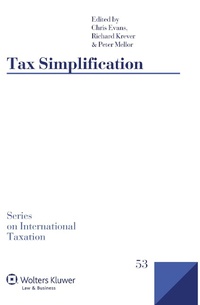
Tax Simplification
Published on 10. August 2015
384 pages
978-90-411-6585-5 (ISBN)
Description

Why are tax systems so complex? What are the causes of tax law complexity? What are the consequences? Why is tax simplification so difficult to achieve? These, and related questions, lie at the core of this volume on tax simplification featuring chapters by leading tax experts around the world. The quest for simplicity è^' or at least some move towards simplification è^' has been a fixation of governments and others for many years, but little appears to have been achieved. Tax simplification is the most widely quoted but the least widely observed of the usually stated goals of policy (equity and efficiency being the others). It has been used (and abused) as a primary justification for tax reform over the last century, and typically it is seen as è^-a good thingè^- è^' to say that one is in favour of tax simplification is tantamount to stating that one is in favour of good as opposed to evil.
More details
Other editions
Additional editions
Chris Evans | Richard Krever
Tax Simplification
Book
08/2015
1st Edition
Kluwer Law International
€264.43
Shipment within 10-20 days
Content
- Cover
- Half Title Page
- Editorial Board
- Title Page
- Copyright Page
- Editors
- Contributors
- Table of Contents
- Preface and Acknowledgements
- List of Figures
- List of Tables
- CHAPTER 1 Why'd You Have to Go and Make Things So Complicated?
- §1.01 INTRODUCTION
- §1.02 MEASURING COMPLEXITY
- §1.03 WHY SO COMPLEX?
- §1.04 CONSEQUENCES OF COMPLEXITY
- §1.05 WHY IS IT SO HARD TO SIMPLIFY?
- §1.06 CONCLUSION
- CHAPTER 2 A Contemporary Approach to Tax Complexity: Polycentrism in an Increasingly International Tax Environment
- §2.01 INTRODUCTION
- §2.02 NOTIONS OF TAX COMPLEXITY
- §2.03 THE CONCEPT OF HYPERCOMPLEXITY
- [A] Complexity
- [B] Differentiation and Complexity Management
- [C] Society's Development Away from Anthropocentrism and toward Polycentrism
- §2.04 IN THE MIDST OF A PERIOD OF TRANSITION
- [A] 'Ought to Know'
- [B] Procedural Leeway
- [C] Tax in 'the Complexity of Complexity'
- §2.05 CONCLUSION
- CHAPTER 3 Tax Complexity and Symbolic Power
- §3.01 INTRODUCTION
- §3.02 DIMENSIONS OF TAX COMPLEXITY
- [A] Code Complexity
- [1] Language of Legislation: Type and Number of Words
- [2] Anti-avoidance Rules
- [3] Rules or Principles
- [B] Structural Complexity
- [1] Number of Rates
- [2] Number of Provisions
- [C] Policy (System) Complexity
- [1] Socio-Economic Imperatives
- [2] Tax Expenditures
- [3] Political Goals
- [D] Administration and Compliance Complexity
- [1] Compliance Complexity
- [2] Administrative Complexity
- §3.03 BOURDIEU'S THEORY OF SOCIAL PRACTICE
- §3.04 THE TAX FIELD
- §3.05 SYMBOLIC POWER
- §3.06 VESTED INTERESTS AND SYMBOLIC POWER
- §3.07 CONCLUSION
- CHAPTER 4 Measuring Tax Complexity
- §4.01 INTRODUCTION
- §4.02 WHAT IS TAX COMPLEXITY?
- [A] Design Complexity
- [B] Operational Complexity
- §4.03 WHAT ARE THE COSTS/CONSEQUENCES OF TAX COMPLEXITY?
- §4.04 MEASURING TAX COMPLEXITY
- [A] What to Measure
- [B] Why Measure?
- §4.05 ASSESSING ONE PARTICULAR MEASURE
- CHAPTER 5 An Integrated Approach to the Economic Measurement of the Costs of Tax Complexity
- §5.01 INTRODUCTION
- §5.02 THE RELATIVE NEGLECT OF TAX SIMPLICITY/COMPLEXITY
- §5.03 REVIEW OF TAX COMPLEXITY
- [A] Meaning of Tax Complexity and Tax Simplification
- [B] Causes of Tax Complexity
- [1] Within the Direct Control of Government
- [2] Partly within the Direct Control of Government
- [3] Outside the Direct Control of Government
- [C] Indicators of Tax Complexity
- §5.04 COSTS OF TAX COMPLEXITY
- [A] A Simple Model of Tax Compliance
- [B] Direct Costs
- [C] Indirect Costs
- [D] Macroeconomic Costs
- §5.05 CONCLUSION
- CHAPTER 6 Paying Taxes: The Global Picture: An Index to Encourage Tax Reform and the Development of Good Tax Systems
- §6.01 INTRODUCTION
- [A] Doing Business and the Paying Taxes Indicator
- [B] The Paying Taxes Report
- §6.02 METHODOLOGY
- [A] The Case Study Company
- [B] Some Definitions
- [1] 'Taxes Borne' and 'Taxes Collected'
- [2] The Types of Tax
- [C] Sub-indicators
- [1] Tax Cost: 'Total Tax Rate'
- [2] Compliance Sub-indicators: 'Number of Payments' and 'Time to Comply'
- [a] 'Number of Payments'
- [b] 'Time to Comply' (Hours)
- [D] Rankings
- [E] Data Collection, Contributors and Annual Process
- §6.03 KEY MESSAGES AND TRENDS: 2004-2013 (PT2006 TO PT2015)
- [A] Total Tax Rate
- [B] Time to Comply
- [C] Number of Payments
- §6.04 ECONOMIC ANALYSIS (TAXATION, ECONOMIC GROWTH AND INVESTMENT)
- [A] How Can a Government Create a More 'Business-Friendly' Tax Environment?
- [B] Hypotheses
- [C] Results
- [1] Economic Growth
- [2] Foreign Direct Investment
- §6.05 SUMMARY OF EVIDENCE
- §6.06 WHAT PAYING TAXES TELLS US ABOUT COMPLEXITY
- APPENDIX: FINANCIAL STATEMENT PARAMETERS OF THE CASE STUDY COMPANY
- CHAPTER 7 The Paying Taxes Report: Will It Guide Tax System Simplification?
- §7.01 INTRODUCTION
- §7.02 METHODOLOGY USED
- §7.03 FINDINGS OF THE STUDY
- §7.04 CRITICISM/LIMITATIONS OF THE STUDY
- [A] Case Study Firm
- [B] The Total Tax Rate (TTR)
- [C] 'Number of Payments'
- [D] Time Taken to Complete Tax Returns ('Time to Comply')
- [E] Overview of the Above Indicators
- [F] Data and Data Collection
- [1] Data Time Periods
- [2] Data Collection Procedures
- [3] Contributors
- [4] Data and Adjustments to the Data
- [G] Aggregate Rankings
- §7.05 SUCCESSES AND STRENGTHS OF THE STUDY
- §7.06 RECOMMENDATIONS
- §7.07 CONCLUSION
- CHAPTER 8 Measuring Tax Compliance Costs: Evidence from Australia
- §8.01 INTRODUCTION
- §8.02 SOME CONCEPTUAL ISSUES
- §8.03 METHODOLOGY
- §8.04 PERSONAL (NON-BUSINESS) TAXPAYERS
- §8.05 SMALL AND MEDIUM ENTERPRISES
- §8.06 LARGE BUSINESSES
- §8.07 SUMMARY AND CONCLUSIONS
- CHAPTER 9 Measuring Tax Complexity: Analytical Framework and Evidence for Individual Income Tax Preferences for Canada
- §9.01 INTRODUCTION
- §9.02 LITERATURE REVIEW
- §9.03 TAX PREFERENCES AND DATA USED
- [A] Tax Preferences
- [B] Data
- [C] Use of Tax Preferences
- §9.04 DETERMINANTS OF THE TCC OF TAX PREFERENCES
- [A] Variables
- [B] TCC Estimations
- §9.05 TCC, TAX COMPLEXITY AND PUBLIC POLICY
- §9.06 CONCLUSION
- CHAPTER 10 Administering Tax Complexity versus Simplicity
- §10.01 INTRODUCTION
- §10.02 THE NATURE AND SCOPE OF US TAX SYSTEM COMPLEXITY
- §10.03 IMPLICATIONS FOR TAX ADMINISTRATION AND JUDICIAL REVIEW
- [A] General Administrative Law Premises
- [B] Tax Administrative Practice Premises
- [C] The Consequences of Tax Complexity
- §10.04 CONCLUSION
- CHAPTER 11 Tax Complexity: A Necessary Evil?
- §11.01 INTRODUCTION
- §11.02 TAX COMPLEXITY: ITS MEANING AND CONSEQUENCES
- §11.03 TAX MINIMIZATION: THE RECENT 'BROUHAHA'
- [A] The Starbucks Corporation Arrangement
- [B] The Google Arrangement
- [C] The Apple Arrangement
- §11.04 THE EFFECT OF TAX AVOIDANCE ON COMPLEXITY
- §11.05 NECESSARY COMPLEXITY
- §11.06 COMPLEXITY AS A CAUSE OF MINIMIZATION
- §11.07 SIMPLICITY AS A CAUSE OF MINIMIZATION
- §11.08 COMPLEXITY CAN BE DESIRABLE AND NECESSARY
- CHAPTER 12 Exploring Individual Taxpayers' Perceptions of Tax Complexity: A Pilot Study
- §12.01 INTRODUCTION
- §12.02 REVIEW OF RELATED LITERATURE
- [A] Perspective of Complexity
- [B] Taxpayer Perceptions
- §12.03 METHODOLOGY
- §12.04 RESULTS AND DISCUSSION
- [A] Is the South African Tax System Complex? 'Yes'
- [1] Tax Legislation
- [2] Tax Compliance
- [3] Knowledge
- [4] Perception of Others
- [B] Is the South African Tax System Complex? 'No'
- [1] Tax Compliance
- [2] Tax Legislation
- [3] Knowledge
- [4] Perception of Others
- [C] Is the South African Tax System Complex? 'Not Sure' or 'Do Not Know'
- [1] Tax Compliance
- [2] Knowledge
- [D] Does the Complexity of the Tax System Affect the Tax Burden?
- [1] Compliance Cost
- [2] Number of Taxes
- [3] Fairness
- [E] How Can the South African Tax System Be Simplified?
- [1] Tax Reform
- [2] Education
- [3] Administrative Support
- [4] Efficiency and Transparency in Revenue Use
- §12.05 CONCLUSION
- CHAPTER 13 Six Degrees of Graduation: Law and Economics of Variable Sanctions
- §13.01 INTRODUCTION
- §13.02 SIX DEGREES OF SANCTIONS GRADUATION
- §13.03 EVALUATING GRADUATED SANCTIONS
- [A] Aggressiveness: Critical in Law
- Overlooked in Economics
- [B] Magnitude: Clear Insights, Attainable Improvements
- [C] Culpability: A Long-Standing Challenge
- [D] Effort: Some Findings, Few Clear Results
- [E] Detection: A Continuing Inquiry
- [F] History: A Persistent Puzzle
- §13.04 CONCLUSION
- CHAPTER 14 Some Cautions Regarding Tax Simplification
- §14.01 INTRODUCTION
- §14.02 SIMPLIFICATION IS NOT ALWAYS GOOD
- §14.03 COMMENTS ON THE BALANCING PROCESS
- §14.04 CONCLUSION
- CHAPTER 15 The Office of Tax Simplification and Its Complexity Index
- §15.01 INTRODUCTION: THE OFFICE OF TAX SIMPLIFICATION
- [A] What Does the OTS Do?
- [B] What Have We Looked At So Far?
- [C] What Have We Learned So Far?
- §15.02 THE OTS COMPLEXITY PROJECT AND THE COMPLEXITY INDEX
- [A] The Purpose of the Index
- [B] How Would the Index Be Used in Practice?
- [C] A Definition of Complexity for the Index
- [D] Indicators
- [1] Underlying Complexity
- [a] Policy Complexity
- [b] Legislative Complexity
- [c] Operational Complexity
- [2] Impact of Complexity
- [E] Aggregating the Indicators
- [F] Necessary and Unnecessary Complexity
- [G] Structure of the Tax Index
- §15.03 CONCLUSION
- APPENDIX: ILLUSTRATIVE EXAMPLE OF COMPLEXITY INDEX
- CHAPTER 16 Managing Tax Complexity: The Institutional Framework for Tax Policy-Making and Oversight
- §16.01 INTRODUCTION: THE INEVITABILITY OF COMPLEXITY
- §16.02 SIMPLIFICATION OF TAX SYSTEMS
- [A] Simplification Cannot Be the Only, or Even the Main, Driver of Reform
- [B] Attempts at Simplification May Create Complexity
- [C] Managing the Tax System
- §16.03 INSTITUTIONAL APPROACHES
- [A] Variety of Institutions Needed
- [B] Tax Policy-Making
- [C] Scrutiny of Implementation and Administration
- §16.04 THE UK INSTITUTIONAL APPROACH
- [A] Tax Policy-Making in the UK
- [1] The Revenue Authorities: Role, Experience, 'Absorption' of Advice and Consultation
- [2] Office of Tax Simplification (OTS)
- [3] An Office of Tax Policy and New Joint Parliamentary Select Committee on Taxation?
- [B] Scrutiny of Implementation and Administration in the UK
- [1] Parliamentary Committees
- [2] The GAAR Panel and Other New Institutions
- §16.05 CONCLUSION
- CHAPTER 17 Oversight Mechanisms and Administrative Responses to Tax Complexity in the United States
- §17.01 INTRODUCTION
- §17.02 HOW US TAX LAWS ARE MADE AND ADMINISTERED
- [A] How Tax Laws Are Made in the US
- [B] Administrative Sources of Law
- [C] Judicial Sources of US Tax Law
- [D] IRS Administrative Structure
- §17.03 TAXES (AND THE FUNDING OF THEIR COLLECTION) IS 'POLITICAL'
- [A] The 'Tea Party Scandal'
- [B] IRS Budget
- §17.04 INTERNAL ADMINISTRATIVE OVERSIGHT
- [A] Taxpayer Communications
- [B] IRS Research Conferences and Measurement of Compliance Costs
- [C] IRS Committees
- [1] IRS Advisory Council
- [2] Electronic Tax Administration Advisory Committee
- [3] Information Reporting Program Advisory Committee
- §17.05 EXTERNAL ADMINISTRATIVE OVERSIGHT
- [A] Taxpayer Advocate Service
- [B] IRS Oversight Board
- [C] Government Accountability Office
- [D] Treasury Inspector General for Tax Administration
- §17.06 CONCLUDING REMARKS
- CHAPTER 18 Pathways for Tax Policy and Administration: Institutions and Simplicity - An Australian Perspective
- §18.01 INTRODUCTION
- §18.02 EQUITY, EFFICIENCY AND SIMPLICITY
- §18.03 WHOSE ROLE IS IT TO 'MAKE THE CALL' ON TAX POLICY?
- §18.04 WHAT IS AT THE HEART OF TAX COMPLEXITY?
- §18.05 THE WORLD IS COMPLEX AND THERE MAY BE NO PANACEA
- §18.06 NEW INSTITUTIONS: 'PROGRESS OR CONFUSION?'
- §18.07 THE PROS AND CONS OF INDEPENDENCE AND CONSULTATION
- §18.08 THE ROLE OF AN ELECTED GOVERNMENT
- §18.09 COMPLEXITY AND ADMINISTRATION
- §18.10 RESOURCING ISSUES
- §18.11 DANGERS IN EXAGGERATED CRITICISM
- §18.12 EXTERNAL OVERSIGHT AND REVIEW BODIES
- §18.13 CONCLUSION
- CHAPTER 19 Simplified Small Business Tax Regimes in Developing Countries: Empirical Evidence of Use and Abuse
- §19.01 INTRODUCTION
- §19.02 USE AND ABUSE OF PRESUMPTIVE REGIMES
- §19.03 SIMPLIFIED TAX REGIMES IN YEMEN, 2007
- §19.04 SIMPLIFIED TAX REGIMES IN UKRAINE, 2007
- §19.05 SIMPLIFIED TAX REGIMES IN BURUNDI, 2010
- §19.06 SIMPLIFIED TAX REGIMES IN ALBANIA, 2012
- §19.07 SIMPLIFIED TAX REGIME IN NEPAL, 2011
- §19.08 SIMPLIFIED TAX REGIME IN SOUTH AFRICA, 2011
- §19.09 CONCLUSIONS
- Index
- Back Cover
