

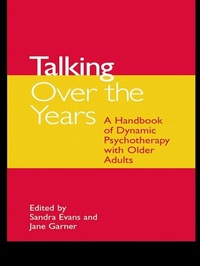
Talking Over the Years
A Handbook of Dynamic Psychotherapy with Older Adults
1st Edition
Published on 2. June 2004
304 pages
978-1-135-48092-9 (ISBN)
Description

How can we work effectively with older people?
What contribution can be made by the field of psychodynamics?
It is now recognised that older adults can benefit from psychodynamic therapy and that psychodynamic concepts can help to illuminate the thorny issues of aging and the complications of later life.
Talking Over the Years begins by examining how ideas of old age are represented by the key psychodynamic theorists of the twentieth century including Freud, Jung, Klein and Winnicott. Contributors go on to draw on their own experiences in a range of settings to demonstrate the value of psychodynamic concepts in clinical practice, covering subjects such as:
brief and long-term work with individuals, couples and groups
the expressive therapies: art, music, dance and movement
ethical considerations
training, supervision and support
sexuality.
Illustrated by a wealth of clinical material, Talking Over the Years increases psychodynamic awareness, helping practitioners become more sensitive to their patients' needs to the benefit of both the patient and the professional.
What contribution can be made by the field of psychodynamics?
It is now recognised that older adults can benefit from psychodynamic therapy and that psychodynamic concepts can help to illuminate the thorny issues of aging and the complications of later life.
Talking Over the Years begins by examining how ideas of old age are represented by the key psychodynamic theorists of the twentieth century including Freud, Jung, Klein and Winnicott. Contributors go on to draw on their own experiences in a range of settings to demonstrate the value of psychodynamic concepts in clinical practice, covering subjects such as:
brief and long-term work with individuals, couples and groups
the expressive therapies: art, music, dance and movement
ethical considerations
training, supervision and support
sexuality.
Illustrated by a wealth of clinical material, Talking Over the Years increases psychodynamic awareness, helping practitioners become more sensitive to their patients' needs to the benefit of both the patient and the professional.
Reviews / Votes
"Talking Over the Years is a comprehensive and clearly written overview of psychodynamic psychotherapy in relation to older people. Its clinical relevance is emphasised throughout case vignettes... anyone involved with the clinical care of older people with mental health problems would benefit from reading this book, and from applying some of the concepts to their day-to-day work." - Jonathan Hillam, Old Age Psychiatrist, 2005"This is a pot-pourri of writings that will stimulate the reader to reconsider issues they encounter in their everyday work. It provides useful summaries of the thinking of emminent psychodynamic psychotherapists. Among many richs, the chapter on loneliness from a kleinian perspective is a good example, and later in the book there is a fascinating material about Kohut's thinking on Narcissism... this book will provoke readers to think with curiosity about their patients, themselves and their teams." - Jan R. Oyebode, British Journal of Psychiatry
"A unified volume on the theory and practice of psychodynamic psychotherapy in old age... a solid and useful overview of psychotherapeutic approaches in settings devoted to the health and social care of older people. The authors provide clear and succinct accounts of the traditional approaches developed by the founding fathers. These are supplemented by many and quite often extended clinical examples that enable the reader to share the various therapeutic journeys. The authors' evident enthusiasm is conveyed, and should interest a broad audience and extend the practice of psychotherapy across the lifespan." - Chris Gilleard, Ageing and Society
"The book is a real resource, rich in theoretical and clinical material... For me the book felt like a little oasis in what can seem like the desert of theoretical and clinical discussion about working with older people... I would urge them to consider a second volume." - Jane Burns, Queen Margaret University Edinburgh, UK, INSCAPE, June, 2007 "Talking Over the Years is a comprehensive and clearly written overview of psychodynamic psychotherapy in relation to older people. Its clinical relevance is emphasised throughout case vignettes... anyone involved with the clinical care of older people with mental health problems would benefit from reading this book, and from applying some of the concepts to their day-to-day work." - Jonathan Hillam, Old Age Psychiatrist, 2005
"This is a pot-pourri of writings that will stimulate the reader to reconsider issues they encounter in their everyday work. It provides useful summaries of the thinking of emminent psychodynamic psychotherapists. Among many richs, the chapter on loneliness from a kleinian perspective is a good example, and later in the book there is a fascinating material about Kohut's thinking on Narcissism... this book will provoke readers to think with curiosity about their patients, themselves and their teams." - Jan R. Oyebode, British Journal of Psychiatry
"A unified volume on the theory and practice of psychodynamic psychotherapy in old age... a solid and useful overview of psychotherapeutic approaches in settings devoted to the health and social care of older people. The authors provide clear and succinct accounts of the traditional approaches developed by the founding fathers. These are supplemented by many and quite often extended clinical examples that enable the reader to share the various therapeutic journeys. The authors' evident enthusiasm is conveyed, and should interest a broad audience and extend the practice of psychotherapy across the lifespan." - Chris Gilleard, Ageing and Society
"The book is a real resource, rich in theoretical and clinical material... For me the book felt like a little oasis in what can seem like the desert of theoretical and clinical discussion about working with older people... I would urge them to consider a second volume." - Jane Burns, Queen Margaret University Edinburgh, UK, INSCAPE, June, 2007
More details
Language
English
Place of publication
London
United Kingdom
Publishing group
Taylor & Francis Ltd
Target group
College/higher education
Professional and scholarly
File size
2,89 MB
ISBN-13
978-1-135-48092-9 (9781135480929)
Copyright in bibliographic data and cover images is held by Nielsen Book Services Limited or by the publishers or by their respective licensors: all rights reserved.
Schweitzer Classification
Other editions
Additional editions
Sandra Evans | Jane Garner
Talking Over the Years
A Handbook of Dynamic Psychotherapy with Older Adults
Book
07/2004
Brunner-Routledge
€106.79
Article exhausted; check different version
Sandra Evans | Jane Garner
Talking Over the Years
A Handbook of Dynamic Psychotherapy with Older Adults
Book
07/2004
Brunner-Routledge
€55.90
Shipment within 3-4 weeks
Persons
Sandra Evans is a psychiatrist working with older adults at the Homerton Hospital and St Bartholomew's Hospital in London; she is also an analyst.
Jane Garner is a consultant psychiatrist leading an old age psychiatry service at Chase Farm Hospital in London.
Jane Garner is a consultant psychiatrist leading an old age psychiatry service at Chase Farm Hospital in London.
Content
Part 1: Theoretical Frameworks. Rachael Davenhill, Old and New: Freud and Others. Noel Hess, Loneliness in Old Age: Klein and Others. Lorenzo Bacelle, On Becoming an Old Man: Jung and Others. Sandra Evans, Attachment in Old Age: Bowlby and Others. Sandra Evans, The Old Self: Kohut, Winnicott and Others. Jane Garner, Growing into Old Age: Erikson and Others. Sandra Evans, Group Psychotherapy: Foulkes, Yalom, Bion. Roger Wesby, Inpatient Dynamics: Thinking, Feeling and Understanding. Mark Ardern, Ethical Considerations. Part 2: Clinical Applications. Joan Reggiori, Long Term Analytic Treatment. Sian Critchley-Robbins, Brief Therapy. Kimberley Smith, Death or Glory: Art Therapy in Old Age. Rachel Darnley-Smith, Music Therapy. Marion Violets-Gibson, Movement and Dance Therapy. Jane Garner, Dementia. Sandra Evans, Elderly Couples and their Families. Jane Garner, Lorenzo Bacelle, Sexuality. Rosamund Oliver, Erdinch Suleiman, Bereavement Work.
