

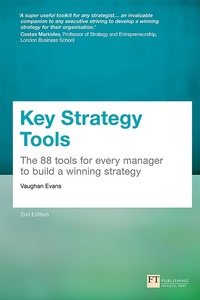
Key Strategy Tools
88 Tools For Every Manager To Build A Winning Strategy
2nd Edition
Published on 24. August 2020
416 pages
978-1-292-32834-8 (ISBN)
Description

Key Strategy Tools empowers managers with 88 strategic tools to help build sustainable competitive advantage and ensure long-term success for your business.
Within the structure of a straight forward strategy process, the Strategy Pyramid, the book gives you classic strategy models such as Porter's Five Forces or Kim and Mauborgnes Blue Ocean Strategy, as well as broader strategic techniques like rating your competitive position or making strategic investment decisions.
This edition introduces you to recent leading strategic thinking such as Markidess Fast Second, McGraths Discovery-driven Growth, Blank and Riess Lean Start-ups and Martins Integrative Thinking.
The book describes each tool succinctly and guides you on how and when to apply them and when to be wary.
Within the structure of a straight forward strategy process, the Strategy Pyramid, the book gives you classic strategy models such as Porter's Five Forces or Kim and Mauborgnes Blue Ocean Strategy, as well as broader strategic techniques like rating your competitive position or making strategic investment decisions.
This edition introduces you to recent leading strategic thinking such as Markidess Fast Second, McGraths Discovery-driven Growth, Blank and Riess Lean Start-ups and Martins Integrative Thinking.
The book describes each tool succinctly and guides you on how and when to apply them and when to be wary.
More details
Series
Edition
2nd edition
Language
English
Place of publication
United Kingdom
Target group
Professional and scholarly
ISBN-13
978-1-292-32834-8 (9781292328348)
Copyright in bibliographic data and cover images is held by Nielsen Book Services Limited or by the publishers or by their respective licensors: all rights reserved.
Schweitzer Classification
Other editions
Additional editions
Book
08/2020
2nd Edition
FT Publishing International
€42.50
Shipment within 10-20 days
Person
Vaughan Evans has been a strategy consultant since the mid-1980s, working with a broad range of corporate clients, from small firms to global giants, and with over 50 financier clients, both structured lenders and private equity. For the last ten years he has been independent, specialising in business strategy, business planning and strategic due diligence. Vaughan is a graduate of Downing College, Cambridge and a Sloan Fellow with distinction of London Business School. He has written four previous books including the bestseller The Financial Times Essential Guide to Writing a Business Plan.
Content
1 Identifying key segments
2 Issue analysis (Minto)
3 The 80/20 principle (Pareto)
4 The segmentation mincer (Koch)
5 5C situation analysis
6 SWOT analysis (Andrews)
7 Setting long-term goals
8 Setting SMART objectives
9 Maximising shareholder value
10 Balancing stakeholder interests (corporate social responsibility)
11 Creating shared value (Porter and Kramer)
12 Economic value added (Stern Stewart)
13 Balanced scorecard and strategy map (Kaplan and Norton)
14 Core ideology (Collins and Porras)
15 Obliquity (Kay)
16 Business as a community (Handy)
17 Sizing the market and marketcrafting (Evans)
18 The HOOF approach to demand forecasting (Evans)
19 Income elasticity of demand
20 The five forces (Porter)
21 Assessing customer purchasing criteria
22 Deriving key success factors
23 Weighing economies of scale
24 Corporate environment as a sixth force
25 Complements as a sixth force (Brandenburger and Nalebuff)
26 PESTEL analysis
27 Rating competitive position
28 The resource and capability strengths/importance matrix (Grant)
29 The value chain (Porter)
30 The product/market matrix (Ansoff)
31 The attractiveness/advantage matrix (GE/McKinsey)
32 The growth/share matrix (BCG)
33 Profiling the ideal player
34 Identifying the capability gap
35 The strategic condition matrix (Arthur D. Little)
36 The 7S framework (McKinsey)
37 The opportunity/vulnerability matrix (Bain/L.E.K.)
38 Value proposition design (Ostervalder and Pigneur)
39 Three generic strategies (Porter) and the fatal bias (Goddard)
40 The experience curve (BCG)
41 Strategic repositioning and shaping profit growth options
42 Making the strategic investment decision
43 Blue ocean strategy (Kim and Mauborgne)
44 Fast second (Markides)
45 Beating the commodity trap (d'Aveni)
46 Discovery-driven growth (McGrath)
47 Lean startups (Blank and Ries)
48 The tipping point (Gladwell)
49 The price elasticity of demand (Marshall)
50 The strategic triangle (Ohmae)
51 The 4Ps marketing mix (McCarthy) and the purple cow (Godin)
52 Product quality and satisfaction (Kano)
53 The hierarchy of needs (Maslow)
54 The bottom of the pyramid (Prahalad and Leiberthal)
55 Reverse innovation (Govindarajan)
56 Business process redesign (Hammer and Champy)
57 Outsourcing
58 Optimising the corporate portfolio
59 Creating value from mergers, acquisitions and alliances
60 The corporate restructuring hexagon (McKinsey)
61 Creating parenting value (Goold, Campbell and Alexander)
62 Core competences (Hamel and Prahalad)
63 Strategically valuable resources (Collis and Montgomery)
64 Strategically distinctive resources (Barney)
65 Distinctive capabilities (Kay)
66 Distinctive competences (Snow and Hrebiniak)
67 Dynamic capabilities (Teece, Pisano and Shuen)
68 Deliberate and emergent strategy (Mintzberg)
69 Integrative thinking (Martin)
70 Stick to the knitting (Peters and Waterman)
71 Profit from the core (Zook)
72 The market-driven organisation (Day)
2 Issue analysis (Minto)
3 The 80/20 principle (Pareto)
4 The segmentation mincer (Koch)
5 5C situation analysis
6 SWOT analysis (Andrews)
7 Setting long-term goals
8 Setting SMART objectives
9 Maximising shareholder value
10 Balancing stakeholder interests (corporate social responsibility)
11 Creating shared value (Porter and Kramer)
12 Economic value added (Stern Stewart)
13 Balanced scorecard and strategy map (Kaplan and Norton)
14 Core ideology (Collins and Porras)
15 Obliquity (Kay)
16 Business as a community (Handy)
17 Sizing the market and marketcrafting (Evans)
18 The HOOF approach to demand forecasting (Evans)
19 Income elasticity of demand
20 The five forces (Porter)
21 Assessing customer purchasing criteria
22 Deriving key success factors
23 Weighing economies of scale
24 Corporate environment as a sixth force
25 Complements as a sixth force (Brandenburger and Nalebuff)
26 PESTEL analysis
27 Rating competitive position
28 The resource and capability strengths/importance matrix (Grant)
29 The value chain (Porter)
30 The product/market matrix (Ansoff)
31 The attractiveness/advantage matrix (GE/McKinsey)
32 The growth/share matrix (BCG)
33 Profiling the ideal player
34 Identifying the capability gap
35 The strategic condition matrix (Arthur D. Little)
36 The 7S framework (McKinsey)
37 The opportunity/vulnerability matrix (Bain/L.E.K.)
38 Value proposition design (Ostervalder and Pigneur)
39 Three generic strategies (Porter) and the fatal bias (Goddard)
40 The experience curve (BCG)
41 Strategic repositioning and shaping profit growth options
42 Making the strategic investment decision
43 Blue ocean strategy (Kim and Mauborgne)
44 Fast second (Markides)
45 Beating the commodity trap (d'Aveni)
46 Discovery-driven growth (McGrath)
47 Lean startups (Blank and Ries)
48 The tipping point (Gladwell)
49 The price elasticity of demand (Marshall)
50 The strategic triangle (Ohmae)
51 The 4Ps marketing mix (McCarthy) and the purple cow (Godin)
52 Product quality and satisfaction (Kano)
53 The hierarchy of needs (Maslow)
54 The bottom of the pyramid (Prahalad and Leiberthal)
55 Reverse innovation (Govindarajan)
56 Business process redesign (Hammer and Champy)
57 Outsourcing
58 Optimising the corporate portfolio
59 Creating value from mergers, acquisitions and alliances
60 The corporate restructuring hexagon (McKinsey)
61 Creating parenting value (Goold, Campbell and Alexander)
62 Core competences (Hamel and Prahalad)
63 Strategically valuable resources (Collis and Montgomery)
64 Strategically distinctive resources (Barney)
65 Distinctive capabilities (Kay)
66 Distinctive competences (Snow and Hrebiniak)
67 Dynamic capabilities (Teece, Pisano and Shuen)
68 Deliberate and emergent strategy (Mintzberg)
69 Integrative thinking (Martin)
70 Stick to the knitting (Peters and Waterman)
71 Profit from the core (Zook)
72 The market-driven organisation (Day)
