

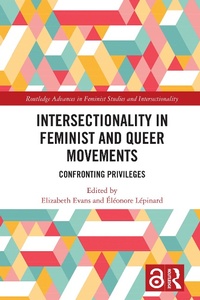
Intersectionality in Feminist and Queer Movements
Confronting Privileges
1st Edition
Published on 26. November 2019
312 pages
978-1-000-74740-9 (ISBN)
Description

Examining the ways in which feminist and queer activists confront privilege through the use of intersectionality, this edited collection presents empirical case studies from around the world to consider how intersectionality has been taken up (or indeed contested) by activists in order to expose and resist privilege.
The volume sets out three key ways in which intersectionality operates within feminist and queer movements: it is used as a collective identity, as a strategy for forming coalitions, and as a repertoire for inclusivity. The case studies presented in this book then evaluate the extent to which some, or all, of these types of intersectional activism are used to confront manifestations of privilege. Drawing upon a wide range of cases from across time and space, this volume explores the difficulties with which activists often grapple when it comes to translating the desire for intersectionality into a praxis which confronts privilege.
Addressing inter-related and politically relevant questions concerning how we apply and theorise intersectionality in our studies of feminist and queer movements, this timely edited collection will be of interest to students and scholars from across the social sciences and humanities with an interest in gender and feminism, LGBT+ and queer studies, and social movement studies.
The volume sets out three key ways in which intersectionality operates within feminist and queer movements: it is used as a collective identity, as a strategy for forming coalitions, and as a repertoire for inclusivity. The case studies presented in this book then evaluate the extent to which some, or all, of these types of intersectional activism are used to confront manifestations of privilege. Drawing upon a wide range of cases from across time and space, this volume explores the difficulties with which activists often grapple when it comes to translating the desire for intersectionality into a praxis which confronts privilege.
Addressing inter-related and politically relevant questions concerning how we apply and theorise intersectionality in our studies of feminist and queer movements, this timely edited collection will be of interest to students and scholars from across the social sciences and humanities with an interest in gender and feminism, LGBT+ and queer studies, and social movement studies.
More details
Series
Edition
1. Auflage
Language
English
Place of publication
London
United Kingdom
Publishing group
Taylor & Francis Ltd
Target group
College/higher education
Illustrations
1 Tables, black and white
File size
1,71 MB
ISBN-13
978-1-000-74740-9 (9781000747409)
Copyright in bibliographic data and cover images is held by Nielsen Book Services Limited or by the publishers or by their respective licensors: all rights reserved.
Schweitzer Classification
Other editions
Additional editions
Elizabeth Evans | Eleonore Lepinard
Intersectionality in Feminist and Queer Movements
Confronting Privileges
Book
06/2021
1st Edition
Routledge
€65.80
Shipment within 10-20 days
Elizabeth Evans | Eleonore Lepinard
Intersectionality in Feminist and Queer Movements
Confronting Privileges
Book
12/2019
1st Edition
Routledge
€206.90
Shipment within 15-20 days
Intersectionality in Feminist and Queer Movements
Confronting Privileges
Book
12/2019
Routledge
Unfortunately, price unknown
Available (delivery time upon request)
Persons
Elizabeth Evans is Reader in Politics at Goldsmiths, University of London. She researches feminist activism, intersectionality and political representation and is the author of two books, the most recent compares third-wave feminisms in Britain and the US.
Eleonore Lepinard is Associate Professor in Gender Studies at the University of Lausanne. Her research focuses on feminist movements and theory, gender and law, intersectionality and gender and political representation.
Eleonore Lepinard is Associate Professor in Gender Studies at the University of Lausanne. Her research focuses on feminist movements and theory, gender and law, intersectionality and gender and political representation.
Content
Confronting Privileges in Feminist and Queer Movements; Section One: Thinking through Differences in Feminist and Queer Movements; 1. Borders, Boundaries and Brokers: The unintended consequences of strategic essentialism in transnational feminist networks; 2. Location Matters: The 2017 Women's Marches as Intersectional Imaginary; 3. Changing Core Business? Institutionalised Feminisms and Intersectionality in Belgium and Germany; 4. Intersectional Complexities in Gender-Based Violence Politics; 5. Organising as Intersectional Feminists in the Global South: Birth and Mode of Action of a Post-2011 Feminist Groups in Morocco; 6. Intersectionality or Unity? Attempts to Address Privilege in the Contemporary Self-Help Movement; Section Two: Intersectionality and Social Movement Organising; 7. Disability and Intersectionality: Patterns of Ableism in the Women's Movement; 8. Difficult Intersections: Nation(alism) and the LGBTIQ Movement in Cyprus; 9. Feminist Whiteness: Resisting Intersectionality in France; 10. Intersectional Praxis from Within and Without: Challenging Whiteness in Quebec's LGBTQ Movement; 11. Paradoxes of Intersectional Practice: Race and Class in the Chicago Anti-Violence Movement; 12. Intersectional Politics on Domestic Workers' Rights: The Cases of Ecuador and Colombia; 13. Queer Muslims, Autonomous Organising and the UK LGBT+ Movement; 14. Generational Conflict and the Politics of Inclusion in Two Feminist Events; Privileges Confronted?.
