

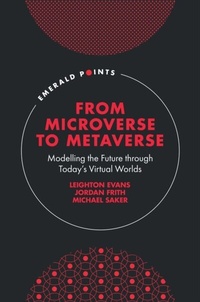
From Microverse to Metaverse
Modelling the Future through Today's Virtual Worlds
1st Edition
Published on 12. October 2022
152 pages
978-1-80455-021-2 (ISBN)
Description

While the metaverse is often marketed as a future utopia, the vision of the metaverse represents an attempt for private corporations to control the code of the real. In the hands of companies that established and maintain the surveillance capitalism model, the ability to build a persistent, all-compassing environment means all activity in that world can be metricized and commodified, making the metaverse worthy of critical examination.
Significant parts of life are already conducted in a digital place that combines various aspects of digital culture. Likewise, digital worlds for socializing already exist, and in a form akin to the VR metaverse, just as VR worlds based on play now coexist with online worlds of user generated content. These discreet private "microverses", as we refer to them, are spaces which can model the tensions that would be inherent in the metaverse.
From Microverse to Metaverse: Modelling the Future through Today's Virtual Worlds examines the place attachments, world-feeling and dwelling of several "microverses" to assess the possibilities of the metaverse as a realistic proposition. Critically analyzing the phenomenological feeling of place, the political economy of emerging tech, the mechanisms of identity and self along with the behavioral constraints involved, the authors map what a metaverse might be like, whether it can happen, and just why some companies seem so determined to make it happen.
Significant parts of life are already conducted in a digital place that combines various aspects of digital culture. Likewise, digital worlds for socializing already exist, and in a form akin to the VR metaverse, just as VR worlds based on play now coexist with online worlds of user generated content. These discreet private "microverses", as we refer to them, are spaces which can model the tensions that would be inherent in the metaverse.
From Microverse to Metaverse: Modelling the Future through Today's Virtual Worlds examines the place attachments, world-feeling and dwelling of several "microverses" to assess the possibilities of the metaverse as a realistic proposition. Critically analyzing the phenomenological feeling of place, the political economy of emerging tech, the mechanisms of identity and self along with the behavioral constraints involved, the authors map what a metaverse might be like, whether it can happen, and just why some companies seem so determined to make it happen.
More details
Series
Language
English
Place of publication
Bingley
United Kingdom
Target group
Professional and scholarly
File size
1,77 MB
ISBN-13
978-1-80455-021-2 (9781804550212)
Copyright in bibliographic data and cover images is held by Nielsen Book Services Limited or by the publishers or by their respective licensors: all rights reserved.
Schweitzer Classification
Persons
Leighton Evans is Senior Lecturer in Media Theory at Swansea University and Undergraduate Programme Director for Media and Communications.
Jordan Frith is Endowed Chair: Pearce Professor of Professional Communication at Clemson University.
Michael Saker is Senior Lecturer in Media and Communications at City, University of London.
Jordan Frith is Endowed Chair: Pearce Professor of Professional Communication at Clemson University.
Michael Saker is Senior Lecturer in Media and Communications at City, University of London.
Content
Chapter 1. Introduction
Chapter 2. The Roots of the Metaverse
Chapter 3. Social worlds
Chapter 4. Gaming worlds
Chapter 5. User generated worlds
Chapter 6. Worlds of Commerce
Chapter 7. Worlds of Desire
Chapter 8. Entertainment Worlds
Chapter 9. Fitness Worlds
Chapter 10. Conclusion - Building the world we want to build
Chapter 2. The Roots of the Metaverse
Chapter 3. Social worlds
Chapter 4. Gaming worlds
Chapter 5. User generated worlds
Chapter 6. Worlds of Commerce
Chapter 7. Worlds of Desire
Chapter 8. Entertainment Worlds
Chapter 9. Fitness Worlds
Chapter 10. Conclusion - Building the world we want to build
