

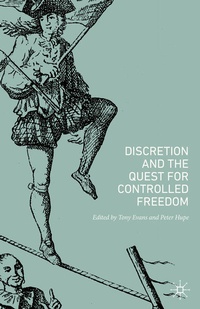
Discretion and the Quest for Controlled Freedom
Description

Looking at discretion broadly as the exercise of controlled freedom, this edited volume introduces insights from a range of social sciences perspectives. Traditionally, discussions of discretion have drawn on legal notions of the appropriate exercise of legitimate authority specified by legislators. However, empirical and theoretical studies in the social sciences have extended our understanding of discretion, moving us beyond a narrow legal view. Contributors from a range of disciplines explore the idea of discretion and related notions of freedom and control across social and political practices and in different contexts. As this complex and important topic is discussed and examined, both total control and unconstrained freedom appear to be illusions.
Reviews / Votes
"[This book] achieve a wide arrays of objectives: providing valuable analytical lenses to investigate administrative phenomena . inspiring both new research by scholars and novel ways for practitioners to conceive of their role; and, last but not least, reminding us how fascinating administrative studies can be, and how much better, more informed and insightful, public debates would be if these issues were to become part and parcel of an informed discussion. [This book] . will contribute potently to the field of public administration." (Edoardo Ongaro, International Review of Public Administration, November 25, 2020)
More details
Other editions
Additional editions
Persons
Tony Evans is Professor of Social Work at Royal Holloway, University of London, UK. His research interests focus on professional practice and policy work in adult social care.
Peter Hupe is Visiting Professor at the Public Governance Institute, KU Leuven, Belgium. He is also Honorary Senior Research Fellow in the College of Social Sciences, University of Birmingham, UK. His research focuses on the theoretical-empirical study of public policy processes, particularly policy implementation and street-level bureaucracy.
Content
1 Conceptualizing Discretion (Tony Evans, Peter Hupe).- Part I. Discretion in Context.- 2 Discretion in Context: An Introduction (Peter Hupe, Tony Evans).- 3 Discretion and Blame Avoidance (Christopher Hood).- 4 Discretion in the Surveillance State (Mark Hardy).- 5 Discretion in the Welfare State (Evelyn Brodkin).- 6 Discretion and Welfare Rights in a British Context (Michael Hill).- 7 Discretion and Empowerment (Greg Marston, Danielle Davidson).- Part II. Perspectives on Discretion.- 8 Perspectives on Discretion: An Introduction (Tony Evans, Peter Hupe).- 9 Discretion from a Legal Perspective (Peter Mascini).- 10 Discretion from an Economic Perspective (Dirk Wolfson).- 11 Discretion from a Psychological Perspective (Lars Tummers, Victor Bekkers).- 12 Discretion from a Sociological Perspective (Zachary Oberfield).- 13 Discretion from a Critical Perspective (Hannah Jobling).- Part III. Discretion in Governance.- 14 Discretion in Governance: An Introduction (Peter Hupe, Tony Evans).-15 Discretion and Bureaucracy (Paul du Gay, Kirstine Zinck Pedersen).- 16 Discretion in the Policy Process (Peter Hupe, Michael Hill).- 17 Discretion and Street-Level Practice (Hendrik Wagenaar).- 18 Organized Discretion (Suzanne Rutz, Antoinette de Bont).- 19 Managerial Discretion (Catherine Needham).- 20 Automated Discretion (Stavros Zouridis, Marlies van Eck, Mark Bovens).- Part IV. Practising Freedom and Control.- 21 Practising Freedom and Control: An Introduction (Tony Evans, Peter Hupe).- 22 Expertise and the Space for Discretion (Michael Luntley).- 23 Discretion and Professional Work (Tony Evans).- 24 The Art of Discretion (Tony Evans).- 25 Discretion as Ethical Practice (Gideon Calder).- 26 Controlled Freedom: Dealing with Discretion (Peter Hupe, Tony Evans).
