

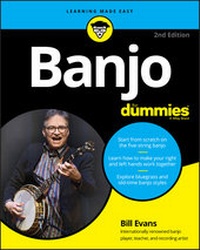
Banjo For Dummies
Book + Online Video and Audio Instruction
2nd Edition
Published on 18. September 2020
384 pages
978-1-119-73139-9 (ISBN)
Description

Here's the quick way to get pickin' with the best of 'em
The banjo is both a staple of old-time music and an instrument that makes frequent cameos in today's chart toppers. Whatever your musical leanings, Banjo For Dummies will show you how to pick your way around your instrument, even if you have zero musical background! With a little practice--and the easy-to-follow instructions in this book--you can learn your way around the banjo, try out various musical styles, and discover what banjo culture is all about.
Think of this For Dummies guide as your personal banjo tutor, as you learn how to buy, tune, hold, play, and have fun with your five-string. You can also go beyond the book with online video lessons and audio files that will get you picking even faster. Follow the guidance of respected banjo performer Bill Evans and soon you may find yourself jamming with a band or rubbing elbows with the pros at your local bluegrass festival.
* Learn the basics of banjo: how to strum chords, pick notes, and read tablature
* Add new styles to your repertoire, including clawhammer, three-finger styles, vamping, and classic banjo
* Play bluegrass music and learn how to network at festivals
* Choose the banjo and accessories that work for you, and discover how to keep them in good shape
Banjo For Dummies is for anyone who want to learn to play the five-string banjo or brush up on banjo-playing skills. No experience required!
The banjo is both a staple of old-time music and an instrument that makes frequent cameos in today's chart toppers. Whatever your musical leanings, Banjo For Dummies will show you how to pick your way around your instrument, even if you have zero musical background! With a little practice--and the easy-to-follow instructions in this book--you can learn your way around the banjo, try out various musical styles, and discover what banjo culture is all about.
Think of this For Dummies guide as your personal banjo tutor, as you learn how to buy, tune, hold, play, and have fun with your five-string. You can also go beyond the book with online video lessons and audio files that will get you picking even faster. Follow the guidance of respected banjo performer Bill Evans and soon you may find yourself jamming with a band or rubbing elbows with the pros at your local bluegrass festival.
* Learn the basics of banjo: how to strum chords, pick notes, and read tablature
* Add new styles to your repertoire, including clawhammer, three-finger styles, vamping, and classic banjo
* Play bluegrass music and learn how to network at festivals
* Choose the banjo and accessories that work for you, and discover how to keep them in good shape
Banjo For Dummies is for anyone who want to learn to play the five-string banjo or brush up on banjo-playing skills. No experience required!
More details
Other editions
Additional editions
Book
11/2020
2nd Edition
Wiley
€27.50
Shipment within 15-20 days
Person
Bill Evans is an internationally celebrated five-string banjo player, teacher, historian, and recording artist, who has helped thousands of banjo players globally get the most out of their instruments. He's also performed throughout the world and his CDs have topped both folk and bluegrass charts.
Content
- Intro
- Title Page
- Copyright Page
- Table of Contents
- Introduction
- About This Book
- Foolish Assumptions
- Icons Used in This Book
- Beyond the Book
- Where to Go from Here
- Part 1 The Amazing Five-String Banjo
- Chapter 1 You Want to Play What?: Banjo Basics
- Getting into Banjo
- Loving that amazing sound
- Becoming a true believer
- Identifying Different Kinds of Banjos
- Five-string banjo: The subject of this book
- Tenor and plectrum banjos: Look for another book
- Knowing the Parts of a Banjo
- Looking at the neck
- Checking out the pot
- Picking up string vibrations
- Becoming a Banjo Player
- Making wise purchase choices
- Tuning and holding your banjo
- Fretting chords with the left hand
- Playing authentic right- and left-hand patterns
- Practicing some real tunes
- Jamming in good company
- Meeting other banjo lovers
- Keeping your banjo sounding great
- Chapter 2 Tuning Your Banjo
- G Tuning: Getting Your Strings in Order
- Relative Tuning: Tuning the Banjo to Itself
- Reference Tuning: Getting a Little Outside Help
- Using an electronic tuner
- Tuning with an electronic tuner at a jam session
- Using another instrument as a reference
- Chapter 3 Starting to Play: Fretting and Strumming
- Talking Banjo Talk
- Positioning Body and Banjo
- Strapping on your banjo
- Sitting down to play
- Standing with your banjo
- Fretting with the Left Hand
- Fingering G, D7, and C Chords
- The G chord: Real easy
- The D7 chord: A little harder
- The C chord: More challenging still
- Checking Out Chord Diagrams
- Reading a chord diagram
- Interpreting up-the-neck chord diagrams
- Chord Progressions: Playing Your First Song
- Chapter 4 Playing by the Rules: Songs and Tablature
- Breaking Down the Parts of a Song
- Feeling the rhythm
- Finding the melody
- Reading Tablature
- Finding notes
- Tracking down the rhythm
- Playing Pinch Patterns
- Being a Great Team Player
- Lead playing: Shining the spotlight on yourself
- Backup playing: Allowing others to stand out
- Part 2 Let's Pick! Basic Banjo Techniques
- Chapter 5 Getting Right with the Right Hand
- Clawhammer and Bluegrass: Down-Picking and Up-Picking
- Clawhammer Right-Hand Basics
- Finding a good right-hand position
- Playing your first clawhammer notes
- Using clawhammer banjo as accompaniment
- Bluegrass Right-Hand Basics
- Choosing and fitting thumbpicks and fingerpicks
- Acquiring a good right-hand position
- Playing roll patterns
- Alternating thumb roll
- The forward-reverse roll
- The forward roll
- Using bluegrass rolls as accompaniment
- Chapter 6 Sliding, Hammering, and Pulling: Adding the Left Hand
- Slipping into the Slide
- Getting down the slide: The basics
- Trying 3rd-string slides
- Undertaking 4th-string slides
- Focusing on 1st-string slides
- Nailing the Hammer-On
- Playing open-string hammer-ons
- Giving fretted hammer-ons a chance
- Pulling Off the Pull-Off
- Digging into open-string pull-offs
- Mastering fretted pull-offs
- Sizing up special clawhammer pull-offs
- Bending the Chokes
- Playing the Foggy Mountain choke
- Experimenting with choke variations
- Putting Your Hands Together
- Making sure your clawhammer right hand is ready
- Double-checking your bluegrass right-hand skills
- Joining forces: Using both hands in clawhammer banjo
- Clawhammer slides
- Clawhammer hammer-ons
- Clawhammer pull-offs
- Clawhammer choke
- Keeping both hands busy in bluegrass banjo
- Bluegrass slides
- Bluegrass hammer-ons
- Bluegrass pull-offs
- Bluegrass chokes
- Chapter 7 Working Up Your First Tunes: Clawhammer and Bluegrass
- Stylin' It: Playing Real Banjo Music
- Starting with the right hand
- Adding the left hand
- Tackling a Few More Tunes
- Part 3 Playing Styles Past, Present, and Future
- Chapter 8 Playing the Old-Time Way: Clawhammer and Traditional Styles
- Digging Deeper into Clawhammer Banjo
- Fretting 1st-string clawhammer pull-offs
- Stretching out with double thumbing
- Discovering Four Clawhammer Classics
- Playing "Old Joe Clark"
- Turning on to double C tuning
- Playing "Soldier's Joy"
- Moving into modal tuning
- Playing "Cluck Old Hen"
- Playing "Last Chance"
- Discovering Pete Seeger-Style Banjo
- Syncing with the Seeger stroke
- Playing "Swing Low" and "Little Birdie" with the Seeger stroke
- Fingerpicking the Old-Time Way
- Exploring Dock Boggs's style with "Pretty Polly"
- Picking "Coal Creek March"
- Chapter 9 Playing Three-Finger Styles: Scruggs, Melodic, and Single String
- Playing Scruggs-Style Banjo
- Flowing with the rolls
- Making your music hot with some licks
- Progressing to Scruggs-style songs
- Making Music with Melodic Banjo
- Discovering how to play melodic scales
- Getting a feel for melodic banjo songs
- Playing Single-String Banjo
- Using the right hand
- Taking a crack at single-string scales
- Exercising single-string techniques in songs
- Combining Three-Finger Techniques
- Chapter 10 Playing Up-the-Neck Backup: Chords and Vamping
- Playing Movable Major Chords
- The barre shape
- The F shape
- The D shape
- Moving from the F shape to the D shape
- Playing Movable Minor Chords
- Converting F-shape major chords
- Converting D-shape major chords
- Converting barre-shape major chords
- Using Vamping in Backup Playing
- Working out the mechanics of vamping
- Using F and D shapes with vamping
- Knowing When to Use Vamping
- Chapter 11 Playing Historical Styles: African, Minstrel, and Classic Banjo
- Exploring African-American Banjo Roots
- Converging Cultures: The World of Minstrel Banjo
- Uncovering the historical background
- Getting into minstrel banjo
- Discovering drop-C tuning
- Mastering minstrel technique
- Trying some minstrel tunes
- Branching Out with Classic Banjo
- Understanding classic banjo technique
- Introducing yourself to the classics
- Chapter 12 Networking into Banjo Culture
- Taking Private Lessons
- Overcoming lesson anxiety
- Finding the right teacher
- Playing Music with Others
- Finding a good jam
- Getting ready for a jam session
- Joining in a jam
- Observing good jamming etiquette
- Attending Workshops and Camps
- Workshops: Fine-tuning your techniques
- Banjo, bluegrass, and old-time camps: Rubbing elbows with the pros
- Heading to a Bluegrass Festival
- Discovering what festivals are all about
- Finding a festival that's right for you
- Part 4 Buying a Banjo and Keeping It in Good Shape
- Chapter 13 Finding Your Banjo Bliss: A Buyer's Guide
- Establishing Your Banjo Boundaries
- Making the Leap: Resonator or Open-Back?
- Pumping up the volume: Resonator banjos
- Going the old-time way: Open-back banjos
- Finding a Great Beginner's Banjo
- Knowing what's in the pot
- Getting good string action
- Finding bridge height
- Measuring string spacing
- Checking the tuners
- Taking the plunge
- Stepping Up to a Better Banjo
- Budgeting for a quality banjo
- Knowing a quality banjo when you see it
- Plugging in: Electric banjos
- Going vintage
- Finding the Right Music Store
- Buying from an acoustic specialty store
- Buying online
- Getting you started: A banjo store directory
- Chapter 14 Getting the Right Stuff: Banjo Gear
- Picking Up the Stuff You Really Need
- Cases: Becoming King of the Road
- Strings: You can't pick without 'em
- Picks: Giving your fingers playing power
- Straps: Take a load off!
- Capos: Playing easily in different keys
- The 5th-string capo and spikes: Going along for the ride
- Electronic tuners: Getting by with a little help
- Collecting More Cool Tools to Help Your Playing
- Metronomes and drum machines
- Your computer and the banjo
- Chapter 15 Taking Care of Your Baby: String Changing and Basic Maintenance
- Replacing Banjo Strings
- Deciding when your strings need a changin'
- Changing strings 1 through 4: A step-by-step guide
- Replacing the 5th string
- Setting the Bridge
- Discovering harmonics
- Using harmonics to set the bridge
- Adjusting Head Tension
- Relating head tension to banjo tone
- Tightening the head
- Keeping Your Banjo Looking Its Best
- Knowing When to Consult a Professional
- Part 5 The Part of Tens
- Chapter 16 Ten Tips to Make Practicing More Fun
- Practice Regularly
- Set Goals
- Warm Up
- Use Tablature Sparingly
- Get the Right Hand First
- Gradually Increase Your Speed
- Take Songs One Measure at a Time
- Play the Right Repertoire
- Listen Actively
- Keep Track of Your Progress
- Chapter 17 Ten Great Banjo Players You Need to Hear
- Earl Scruggs (1924-2012)
- Pete Seeger (1919-2014)
- Béla Fleck (b. 1958)
- Bill Keith (1939-2015)
- Mike Seeger (1933-2009)
- Don Reno (1927-1984)
- J. D. Crowe (b. 1937)
- Tony Trischka (b. 1949)
- Alison Brown (b. 1962)
- Jens Kruger (b. 1962)
- Part 6 Appendixes
- Appendix A Banjo Chords and Notes
- Chords
- Notes on the Banjo in G Tuning
- Appendix B Audio Tracks and Video Clips
- Discovering What's on the Audio Tracks
- Looking at What's in the Video Clips
- Customer Care
- Index
- EULA
