

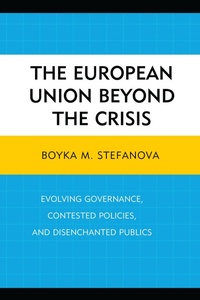
The European Union beyond the Crisis
Evolving Governance, Contested Policies, and Disenchanted Publics
Lexington Books (Publisher)
1st Edition
Published on 14. November 2014
356 pages
979-8-216-34723-1 (ISBN)
Description

This volume explores institutional and policy developments in the EU and its member states in a parallel examination of citizens' views of the effectiveness of crisis response reflected in public trust, output legitimacy, and satisfaction with democracy. Our approach to understanding the crisis posits EU-level governance and institutional change, national-level policymaking, and domestic politics as interrelated, interdependent domains of political action and public spheres that collectively shape the political landscape of post-crisis Europe. The volume sheds new light on the relationship among the institutional, policy, and polity consequences of the crisis.
The book has two fundamental aims. The first is to demonstrate the interconnected nature of European governance, domestic reform, and democratic politics. The unprecedented complexity of the financial, sovereign debt, economic, and social crises in Europe has led to a political crisis that reflects the struggle to effectively address its various causes and effects.
The second objective is to present a theoretically informed assessment of the consequences of the European crises for state-society relations and democratic legitimacy. Our analysis of the crisis in a variety of national contexts and European governance highlights the difficulties faced by political decision-makers. We find that the domestic policy process is selectively affected or disconnected from the process of rule-making at the EU level, that public opinion still matters in the process of policy formation and EU crisis response, and that the salience of the EU agenda in the domestic public sphere increasingly depends on the preferences of political actors. Public response to the crisis has become increasingly complex as well, ranging from declining trust in the political institutions, emerging national stereotypes, changing expectations of the EU level of crisis response, growing disconnect between political parties and voters, and evolving intra-regional distinctions across the EU's east-west divide.
The book has two fundamental aims. The first is to demonstrate the interconnected nature of European governance, domestic reform, and democratic politics. The unprecedented complexity of the financial, sovereign debt, economic, and social crises in Europe has led to a political crisis that reflects the struggle to effectively address its various causes and effects.
The second objective is to present a theoretically informed assessment of the consequences of the European crises for state-society relations and democratic legitimacy. Our analysis of the crisis in a variety of national contexts and European governance highlights the difficulties faced by political decision-makers. We find that the domestic policy process is selectively affected or disconnected from the process of rule-making at the EU level, that public opinion still matters in the process of policy formation and EU crisis response, and that the salience of the EU agenda in the domestic public sphere increasingly depends on the preferences of political actors. Public response to the crisis has become increasingly complex as well, ranging from declining trust in the political institutions, emerging national stereotypes, changing expectations of the EU level of crisis response, growing disconnect between political parties and voters, and evolving intra-regional distinctions across the EU's east-west divide.
More details
Edition
1. Auflage
Language
English
Place of publication
United States
Publishing group
Bloomsbury Publishing Plc
Target group
Professional and scholarly
Illustrations
31 tables; 15 graphs; 10 charts
ISBN-13
979-8-216-34723-1 (9798216347231)
Copyright in bibliographic data and cover images is held by Nielsen Book Services Limited or by the publishers or by their respective licensors: all rights reserved.
Schweitzer Classification
Other editions
Additional editions
Boyka M. Stefanova
The European Union beyond the Crisis
Evolving Governance, Contested Policies, and Disenchanted Publics
Book
11/2014
Lexington Books
€166.40
Shipment within 15-20 days
Persons
Boyka Stefanova is associate professor in the Department of Political Science and Geography at the University of Texas at San Antonio.
Content
Chapter 1: Beyond the Crisis: Governance and Politics in the European Union between Crisis and Opportunity (Editor's Introduction)
Boyka Stefanova
Part I: European Governance in a Time of Crisis: Limitations and Prospects of The EU's Economic and Monetary Union
Chapter 2: Collaborative Federalism in the European Union: Intergovernmental Relations and the Allocation of Powers in the Economic and Monetary Union
Robert Csehi
Chapter 3: Trust and Currency: Functional Preconditions and Problems of the Euro
Jenny Preunkert
Chapter 4: European Monetary Union versus European Clearing Union: An Application of Keynes to Regional Monetary Systems
Ashley A.C. Hess
Chapter 5: Why the Euro Will Survive: The Institutionalization of Accepted Policies through Key Actors
Leif Johan Eliasson
Part II: The Politics of Crisis Response: European Governance Meets Public Policy
Chapter 6: The Sovereign Debt Crisis, Bailout Politics, and Fiscal Coordination in the European Union
Hilary Appel and Carissa Tudor Block
Chapter 7: A Discernible Impact? The Influence of Public Opinion on EU Policy-Making
Jennifer Boyle and Chris Hasselmann
Chapter 8: Informal Governance and the Eurozone Crisis
Alexandra Hennessy
Chapter 9: Coping with Financial Crisis: Crisis Response, Institutional Innovation, and the Variety of Finance Capitalism in Italy and Spain
Boyka Stefanova
Chapter 10: EU Affairs in Spanish Electoral Competition at the Height of the Euro Crisis
Cristina Ares Castro-Conde
Chapter 11: Testing the Resilience of Civil Society: The Euro Crisis, Portugal's Welfare State and the Third Sector
Miguel Glatzer
Part III: Democratic Politics in the Context of Crisis: a Citizens' Perspective
Chapter 12: Public Attitudes and Support for the EU in the Wake of the Financial Crisis
Jennifer Boyle and Chris Hasselmann
Chapter 13: Implications of the Greek Crisis: Nationalism, Enemy Stereotypes, and the European Union
Zinovia Lialiouti and Giorgos Bithymitris
Chapter 14: Identity and Economic Rationality: Explaining Attitudes towards the EU in a Time of Crisis
Simona Guerra and Fabio Serricchio
Chapter 15: Public Perceptions of the European Union and the Effect of the Crisis: A Persistent East-West Divide?
Borbala Göncz
Chapter 16: Satisfaction with Democracy in Times of Economic Crises
Evelyn Bytzek
Boyka Stefanova
Part I: European Governance in a Time of Crisis: Limitations and Prospects of The EU's Economic and Monetary Union
Chapter 2: Collaborative Federalism in the European Union: Intergovernmental Relations and the Allocation of Powers in the Economic and Monetary Union
Robert Csehi
Chapter 3: Trust and Currency: Functional Preconditions and Problems of the Euro
Jenny Preunkert
Chapter 4: European Monetary Union versus European Clearing Union: An Application of Keynes to Regional Monetary Systems
Ashley A.C. Hess
Chapter 5: Why the Euro Will Survive: The Institutionalization of Accepted Policies through Key Actors
Leif Johan Eliasson
Part II: The Politics of Crisis Response: European Governance Meets Public Policy
Chapter 6: The Sovereign Debt Crisis, Bailout Politics, and Fiscal Coordination in the European Union
Hilary Appel and Carissa Tudor Block
Chapter 7: A Discernible Impact? The Influence of Public Opinion on EU Policy-Making
Jennifer Boyle and Chris Hasselmann
Chapter 8: Informal Governance and the Eurozone Crisis
Alexandra Hennessy
Chapter 9: Coping with Financial Crisis: Crisis Response, Institutional Innovation, and the Variety of Finance Capitalism in Italy and Spain
Boyka Stefanova
Chapter 10: EU Affairs in Spanish Electoral Competition at the Height of the Euro Crisis
Cristina Ares Castro-Conde
Chapter 11: Testing the Resilience of Civil Society: The Euro Crisis, Portugal's Welfare State and the Third Sector
Miguel Glatzer
Part III: Democratic Politics in the Context of Crisis: a Citizens' Perspective
Chapter 12: Public Attitudes and Support for the EU in the Wake of the Financial Crisis
Jennifer Boyle and Chris Hasselmann
Chapter 13: Implications of the Greek Crisis: Nationalism, Enemy Stereotypes, and the European Union
Zinovia Lialiouti and Giorgos Bithymitris
Chapter 14: Identity and Economic Rationality: Explaining Attitudes towards the EU in a Time of Crisis
Simona Guerra and Fabio Serricchio
Chapter 15: Public Perceptions of the European Union and the Effect of the Crisis: A Persistent East-West Divide?
Borbala Göncz
Chapter 16: Satisfaction with Democracy in Times of Economic Crises
Evelyn Bytzek
