

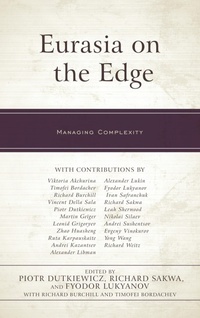
Eurasia on the Edge
Managing Complexity
Lexington Books (Publisher)
1st Edition
Published on 15. October 2018
324 pages
978-1-4985-6421-2 (ISBN)
Description

Eurasia, wherever one draws the boundaries, is very much at the centre of discussions about today's world. Security across Eurasia is a global concern and has been subject to a range of discussions and debate. However, the current tensions over security and world order, with the growing challenges from Eurasia and Asia, require more intense scrutiny. The goals of the book are to explore the challenges facing the region and to assess how to achieve economic, social and political stability in the Eurasian core.
The book's chapters are written by prominent experts in the field, and together contribute to the continuing debate by providing policy advice for managing crises in the region. Conflicts inevitably arise in the Eurasian space as global powers, regional powers and individual states jockey for positions and influence. These conflicts need not reach a crisis state provided the foundations of conflict, and the surrounding frameworks, can be better understood. To do this, it is necessary to examine the issue of security in Eurasia from a multi-dimensional perspective that challenges any and all assumptions about Eurasia and global order.
This volume has two overarching goals. The first is to come to a better understanding of key security threats in the Eurasian region from a multi-dimensional - social, political, economic and institutional - perspective. The second is to discuss policies directed to increase mutual security in and around the Eurasian core. Although the crisis of security affects the whole continent, the area covered by the former Soviet Union and its neighborhood is at the epicenter of the current crisis. On the one side, the Atlantic community is consolidating and extending. On the other, various 'greater Asia' ideas are in the making. All of Eurasia is in danger of becoming an extended shatter zone, a vast new, shaky 'borderland' trapped between two great systems of power and world order.
The book's chapters are written by prominent experts in the field, and together contribute to the continuing debate by providing policy advice for managing crises in the region. Conflicts inevitably arise in the Eurasian space as global powers, regional powers and individual states jockey for positions and influence. These conflicts need not reach a crisis state provided the foundations of conflict, and the surrounding frameworks, can be better understood. To do this, it is necessary to examine the issue of security in Eurasia from a multi-dimensional perspective that challenges any and all assumptions about Eurasia and global order.
This volume has two overarching goals. The first is to come to a better understanding of key security threats in the Eurasian region from a multi-dimensional - social, political, economic and institutional - perspective. The second is to discuss policies directed to increase mutual security in and around the Eurasian core. Although the crisis of security affects the whole continent, the area covered by the former Soviet Union and its neighborhood is at the epicenter of the current crisis. On the one side, the Atlantic community is consolidating and extending. On the other, various 'greater Asia' ideas are in the making. All of Eurasia is in danger of becoming an extended shatter zone, a vast new, shaky 'borderland' trapped between two great systems of power and world order.
More details
Series
Edition
1. Auflage
Language
English
Place of publication
New York
United States
Publishing group
Bloomsbury Publishing Plc
Target group
Professional and scholarly
Illustrations
15 Tables, 3 Graphs
ISBN-13
978-1-4985-6421-2 (9781498564212)
Copyright in bibliographic data and cover images is held by Nielsen Book Services Limited or by the publishers or by their respective licensors: all rights reserved.
Schweitzer Classification
Other editions
Additional editions
Book
10/2018
Lexington Books
€155.70
Shipment within 15-20 days
Persons
Piotr Dutkiewicz is professor of political science and the director of the Center for Governance and Public Policy, at Carleton University, Canada.
Richard Sakwa is professor of Russian and European politics at the University of Kent.
Fyodor Lukyanov is research director of the Foundation for Development and Support of the Valdai Discussion Club.
Richard Sakwa is professor of Russian and European politics at the University of Kent.
Fyodor Lukyanov is research director of the Foundation for Development and Support of the Valdai Discussion Club.
Content
1Introduction
Richard Burchill and Fyodor Lukyanov
2Strategic Security in Eurasia
Nikolai Silaev and Andrei Sushentsov
3 Regional Arrangements and Eurasian Security
Richard Burchill & Ruta Karpauskaite
4 Eurasian Integration and its Institutions: Possible Contributions to Security in Eurasia
Evgeny Vinokurov & Alexander Libman
5 Eurasian Security Constructs and Institutional Capacity
Leah Sherwood
6 Russia's Eurasia Moment: Politics, Economics, Business
Timofei Bordachev
7Eurasia: A View from China's Security Perspective
Zhao Huasheng
8 The European Union and Eurasia: Europe on the Edge
Vincent Della Sala
9. China's Belt and Road Initiative and Eurasian Security
Yong Wang
10 Security Issues in Eurasia
Richard Weitz
11Economic Security in the Eurasian Economic Union
Leonid Grigoryev
12Central Asian Regimes: Stability and Reform
Ivan Safranchuk
13 Interstate Relations in Central Asia
Andrei Kazantsev
14 Managing Eurasia's Borders: The European Union and International Organizations in Russia's 'Near Abroad'
Martin Geiger
15Borders and Waters: Compartmentalized Security in the Eurasian Heartland
Viktoria Akchurina
16Sino-Russia Strategic Understanding and the Changing International System
Alexander Lukin
17 Conclusion: Security in Eurasia - Further or Closer to the Edge?
Piotr Dutkiewicz and Richard Sakwa
Richard Burchill and Fyodor Lukyanov
2Strategic Security in Eurasia
Nikolai Silaev and Andrei Sushentsov
3 Regional Arrangements and Eurasian Security
Richard Burchill & Ruta Karpauskaite
4 Eurasian Integration and its Institutions: Possible Contributions to Security in Eurasia
Evgeny Vinokurov & Alexander Libman
5 Eurasian Security Constructs and Institutional Capacity
Leah Sherwood
6 Russia's Eurasia Moment: Politics, Economics, Business
Timofei Bordachev
7Eurasia: A View from China's Security Perspective
Zhao Huasheng
8 The European Union and Eurasia: Europe on the Edge
Vincent Della Sala
9. China's Belt and Road Initiative and Eurasian Security
Yong Wang
10 Security Issues in Eurasia
Richard Weitz
11Economic Security in the Eurasian Economic Union
Leonid Grigoryev
12Central Asian Regimes: Stability and Reform
Ivan Safranchuk
13 Interstate Relations in Central Asia
Andrei Kazantsev
14 Managing Eurasia's Borders: The European Union and International Organizations in Russia's 'Near Abroad'
Martin Geiger
15Borders and Waters: Compartmentalized Security in the Eurasian Heartland
Viktoria Akchurina
16Sino-Russia Strategic Understanding and the Changing International System
Alexander Lukin
17 Conclusion: Security in Eurasia - Further or Closer to the Edge?
Piotr Dutkiewicz and Richard Sakwa
