

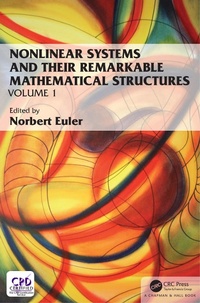
Nonlinear Systems and Their Remarkable Mathematical Structures
Volume 1
1st Edition
Published on 19. November 2018
598 pages
978-0-429-89381-0 (ISBN)
Description

Nonlinear Systems and Their Remarkable Mathematical Structures, Volume 1 aims to describe the recent progress in nonlinear differential equations and nonlinear dynamical systems (both continuous and discrete). Written by experts, each chapter is self-contained and aims to clearly illustrate some of the mathematical theories of nonlinear systems. The book should be suitable for some graduate and postgraduate students in mathematics, the natural sciences, and engineering sciences, as well as for researchers (both pure and applied) interested in nonlinear systems. The common theme throughout the book is on solvable and integrable nonlinear systems of equations and methods/theories that can be applied to analyze those systems. Some applications are also discussed.
Features:
Collects contributions on recent advances in the subject of nonlinear systems
Aims to make the advanced mathematical methods accessible to the non-expert in this field
Written to be accessible to some graduate and postgraduate students in mathematics and applied mathematics
Serves as a literature source in nonlinear systems
Features:
Collects contributions on recent advances in the subject of nonlinear systems
Aims to make the advanced mathematical methods accessible to the non-expert in this field
Written to be accessible to some graduate and postgraduate students in mathematics and applied mathematics
Serves as a literature source in nonlinear systems
Reviews / Votes
The theory of integrable systems studies remarkable equations of mathematical physics which are, in a sense, exactly solvable and possess regular behaviour. Such equations play a fundamental role in applications by providing approximations to various (non-integrable) physical models. Dating back to Newton, Euler and Jacobi, the theory of integrable systems plays nowadays a unifying role in mathematics bringing together algebra, geometry and analysis.This volume is a collection of invited contributions written by leading experts in the area of integrable dynamical systems and their applications. The content covers a wide range of topics, both classical and relatively recent. It provides a valuable source of information for both experts and the beginners. Various combinations of sections of the book would make excellent self-contained lecture courses.
This book will certainly be a valuable asset to any University library. Written by highly established and actively working researchers, it is quite unique in style due to the breath of the material covered. It will remain a valuable source of information for years to come.
-Evgeny Ferapontov, Loughborough University
The main purpose of the book Mathematica structures of nonlinear systems, first of a series, is to present the most recent and not widely known results on the mathematical tools necessary to construct solutions to nonlinear systems and their applications. All contributions present a long list of updated references which make the volume particularly useful also for beginners. The mathematical structures presented in this volume have universal applications in many fields of nature, a very limited number of which are presented in the final chapter. I found particularly interesting the presentations:
1. On the old problem of the integrability of nonlinear PDEs defined on half-lines by Fokas and Pelloni.
2. On the exact superposition formulae in bilinear form, ready for use, for the construction of sequences of exact solutions of many integrable nonlinear equations by Hu.
3. On the construction of nonlocal recursion operators for local symmetries of supersymmetric nonlinear equations by Kiselev, Krutov and Wolf.
4. On the role of nonlinearity in geostrophic ocean flow and its practical consequences by Constantin and Johnson.
-Decio Levi, Istituto Nazionale di Fisica Nucleare
More details
Edition
1. Auflage
Language
English
Place of publication
London
United Kingdom
Publishing group
Taylor & Francis Ltd
Target group
College/higher education
Illustrations
3 Tables, black and white; 11 Illustrations, color; 26 Illustrations, black and white
File size
9,06 MB
ISBN-13
978-0-429-89381-0 (9780429893810)
Copyright in bibliographic data and cover images is held by Nielsen Book Services Limited or by the publishers or by their respective licensors: all rights reserved.
Schweitzer Classification
Other editions
Additional editions
Book
12/2020
1st Edition
CRC Press
€119.40
Shipment within 15-20 days
Book
12/2018
1st Edition
CRC Press
€356.20
Shipment within 10-20 days
Person
Norbert Euler is a professor of mathematics at Lulea University of Technology in Sweden. He is teaching a wide variety of mathematics courses at both the undergraduate and postgraduate level and has done so at several universities worldwide for more than 25 years. He is an active researcher and has to date published over 70 peer reviewed research articles in the subject of nonlinear systems and he is a co-author of several books. He is also involved in editorial work for some international journals, and he is the Editor-in-Chief of the Journal of Nonlinear Mathematical Physics since 1997.
Content
Part A: Nonlinear Integrable Systems A1. Systems of nonlinearly-coupled differential equations solvable A2. Integrable nonlinear PDEs on the half-line A3. Detecting discrete integrability: the singularity approach A4. Elementary introduction to discrete soliton equations A5. New results on integrability of the Kahan-Hirota-Kimura discretizations Part B: Solution Methods and Solution Structures B1. Dynamical systems satisfied by special polynomials and related isospectral matrices defined in terms of their zeros B2. Singularity methods for meromorphic solutions of differential equations B3. Pfeiffer-Sato solutions of Buhl's problem and a Lagrange-D'Alembert principle for Heavenly equations B4. Superposition formulae for nonlinear integrable equations in bilinear form B5. Matrix solutions for equations of the AKNS system B6. Algebraic traveling waves for the generalized KdV-Burgers equation and the Kuramoto-Sivashinsky equation Part C: Symmetry Methods for Nonlinear Systems C1. Nonlocal invariance of the multipotentialisations of the Kupershmidt equation and its higher-order hierarchies C2. Geometry of normal forms for dynamical systems C3. Computing symmetries and recursion operators of evolutionary super-systems using the SsTools environment C4. Symmetries of It^o stochastic differential equations and their applications C5. Statistical symmetries of turbulence Part D: Nonlinear Systems in Applications D1. Integral transforms and ordinary differential equations of infinite order D2. The role of nonlinearity in geostrophic ocean flows on a sphere D3. Review of results on a system of type many predators - one prey D4. Ermakov-type systems in nonlinear physics and continuum mechanics
