

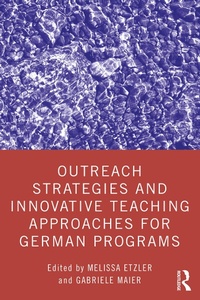
Outreach Strategies and Innovative Teaching Approaches for German Programs
1st Edition
Published on 28. December 2020
228 pages
978-1-000-28620-5 (ISBN)
Description

Outreach Strategies and Innovative Teaching Approaches for German Programs explores recruitment, curricular design and student retention in modern language instruction by sharing best practices and a wide variety of pragmatic initiatives from teacher-scholars who have been involved in the successful building of German programs.
With German programs facing dwindling grant monies as students across the country shift from the liberal arts into career-oriented fields, it is paramount to promote German programs vigorously, to offer courses that reflect and compel students' interest, to keep students engaged in extracurricular activities and to establish a community of like-minded language learners.
The combination of curriculum-based strategies coupled with innovative projects, and extracurricular and outreach activities is intended to serve as a guideline for teachers and scholars alike who are in need of best practices they can use to boost enrollment and attract and retain more students.
With German programs facing dwindling grant monies as students across the country shift from the liberal arts into career-oriented fields, it is paramount to promote German programs vigorously, to offer courses that reflect and compel students' interest, to keep students engaged in extracurricular activities and to establish a community of like-minded language learners.
The combination of curriculum-based strategies coupled with innovative projects, and extracurricular and outreach activities is intended to serve as a guideline for teachers and scholars alike who are in need of best practices they can use to boost enrollment and attract and retain more students.
More details
Edition
1. Auflage
Language
English
Place of publication
London
United Kingdom
Publishing group
Taylor & Francis Ltd
Target group
Professional and scholarly
Product notice
Reflowable
Illustrations
5 Tables, black and white; 21 Halftones, black and white; 21 Illustrations, black and white
ISBN-13
978-1-000-28620-5 (9781000286205)
Copyright in bibliographic data and cover images is held by Nielsen Book Services Limited or by the publishers or by their respective licensors: all rights reserved.
Schweitzer Classification
Other editions
Additional editions
Melissa Etzler | Gabriele Maier
Outreach Strategies and Innovative Teaching Approaches for German Programs
Book
12/2020
1st Edition
Routledge
€179.78
Shipment within 15-20 days
Melissa Etzler | Gabriele Maier
Outreach Strategies and Innovative Teaching Approaches for German Programs
Book
12/2020
1st Edition
Routledge
€55.10
Shipment within 15-20 days
Book
12/2020
Routledge
Unfortunately, price unknown
Available (delivery time upon request)
Persons
Melissa Etzler is a Lecturer of German and First Year Seminar at Butler University in Indianapolis. She has published book chapters related to her research on author W. G. Sebald and has recently shifted her focus to ecocritical readings of Gothic German texts and films, her most recent article appearing in German Quarterly. In addition to her regular coursework, she teaches in honors and coleads the annual short-term study abroad program Bulldogs in Berlin. She is the recipient of the AATG Indiana Post-Secondary Teacher of the Year Award (2018), the College of Liberal Arts and Sciences Outstanding Faculty Award for Excellence in Teaching (2018) and an Outstanding Professor of the Year Award for Teaching (2018-19).
Gabriele Maier is Associate Teaching Professor of German Studies and Director of the M.A. program in Global Communication and Applied Translation at Carnegie Mellon University (CMU) in Pittsburgh. Her research includes literature of the 20th and 21st century and focuses primarily on travel writing, questions of home and identity, transcultural writers and graphic novels. She has published on Christian Kracht, Hans-Ulrich Treichel and Christoph Ransmayr, among others; coedited an anthology on Heimat; and her textbook Deutschland im Zeitalter der Globalisierung came out in 2015. Lately, she has contributed an article to the MLA Handbook Strategies and Perspectives on Social Justice Work. She is a fellow of the "How Well?" project funded by the Center for the Arts in Society at CMU, where she works with various student groups to educate the public about food insecurity and how to improve well-being on the CMU campus.
Gabriele Maier is Associate Teaching Professor of German Studies and Director of the M.A. program in Global Communication and Applied Translation at Carnegie Mellon University (CMU) in Pittsburgh. Her research includes literature of the 20th and 21st century and focuses primarily on travel writing, questions of home and identity, transcultural writers and graphic novels. She has published on Christian Kracht, Hans-Ulrich Treichel and Christoph Ransmayr, among others; coedited an anthology on Heimat; and her textbook Deutschland im Zeitalter der Globalisierung came out in 2015. Lately, she has contributed an article to the MLA Handbook Strategies and Perspectives on Social Justice Work. She is a fellow of the "How Well?" project funded by the Center for the Arts in Society at CMU, where she works with various student groups to educate the public about food insecurity and how to improve well-being on the CMU campus.
Content
Table of Contents
Contributors
Introduction: When Global Citizenry Does Not Include Language Learning: The Challenges of Foreign Languages Departments in the 21st Century
Melissa Etzler and Gabriele Maier
1. Reinvigorating a Small Undergraduate German Program through an Integrated, Literacies-Based Curriculum
Jennifer Redmann
2. Bringing Global and Local Together: Program Building through ACTFL's "Community C"
Wendy Westphal
3. Learning German in and for the 21st Century
Birgit A. Jensen, Susanne Lenne Jones, David L. Smith and Jill E. Twark
4. Diversity Programming, Student Outreach and the Politics of Visible Inclusivity for Small German Programs
Ervin Malakaj
5. Southern Illinois University Carbondale: One Public University's Experience with International Studies in the Midwest
Mary A. Bricker
6. Designing a Language Lab that Encompasses Cultural and Interdisciplinary Experiences
Martina Wells
7. The Courage to Construct and Experiment: Initiatives in Updating the German Minor Program at Concordia University
Stefan Bronner and Regina Range
8. Strategies for Teaching 18th-Century German Texts in the Context of Program Building
Jeffrey L. High, Elena Pnevmonidou and Friederike von Schwerin-High
9. Technology-Enhanced Learning Approaches to Curriculum Development: Architecture Meets the Humanities
Gabriele Maier
10. Freundschaft, Motivationstraining und Maerchen: Learning by Living Life in the GDR
Andrea Meyertholen
11. Branching Out with STEM in the German Classroom
Melissa Etzler and Michelle Stigter-Hayden
12. The Deutsche Sommerschule am Pazifik: A Model and Asset to Small German Programs
Carrie Collenberg-Gonzalez
Conclusion: The Future is Now: Saving German Studies in a Brave New World
Mirko H. Hall
Index
Contributors
Introduction: When Global Citizenry Does Not Include Language Learning: The Challenges of Foreign Languages Departments in the 21st Century
Melissa Etzler and Gabriele Maier
1. Reinvigorating a Small Undergraduate German Program through an Integrated, Literacies-Based Curriculum
Jennifer Redmann
2. Bringing Global and Local Together: Program Building through ACTFL's "Community C"
Wendy Westphal
3. Learning German in and for the 21st Century
Birgit A. Jensen, Susanne Lenne Jones, David L. Smith and Jill E. Twark
4. Diversity Programming, Student Outreach and the Politics of Visible Inclusivity for Small German Programs
Ervin Malakaj
5. Southern Illinois University Carbondale: One Public University's Experience with International Studies in the Midwest
Mary A. Bricker
6. Designing a Language Lab that Encompasses Cultural and Interdisciplinary Experiences
Martina Wells
7. The Courage to Construct and Experiment: Initiatives in Updating the German Minor Program at Concordia University
Stefan Bronner and Regina Range
8. Strategies for Teaching 18th-Century German Texts in the Context of Program Building
Jeffrey L. High, Elena Pnevmonidou and Friederike von Schwerin-High
9. Technology-Enhanced Learning Approaches to Curriculum Development: Architecture Meets the Humanities
Gabriele Maier
10. Freundschaft, Motivationstraining und Maerchen: Learning by Living Life in the GDR
Andrea Meyertholen
11. Branching Out with STEM in the German Classroom
Melissa Etzler and Michelle Stigter-Hayden
12. The Deutsche Sommerschule am Pazifik: A Model and Asset to Small German Programs
Carrie Collenberg-Gonzalez
Conclusion: The Future is Now: Saving German Studies in a Brave New World
Mirko H. Hall
Index
