

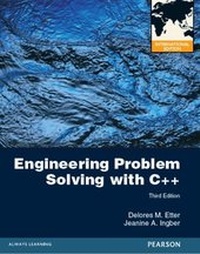
Engineering Problem Solving with C++ International Edition PDF eBook
International Edition
3rd Edition
Published on 18. November 2014
624 pages
978-1-292-01407-4 (ISBN)
Description

For one/two semester courses in Engineering and Computer Science at the freshman/sophomore level.
This text is a clear, concise introduction to problem solving and the C++ programming language. The authors' proven five-step problem solving methodology is presented and then incorporated in every chapter of the text. Outstanding engineering and scientific applications are used throughout; all applications are centered around the theme of engineering challenges in the 21st century.
All prices
More details
Edition
3rd edition
Language
English
Place of publication
Harlow
United Kingdom
Target group
Professional and scholarly
ISBN-13
978-1-292-01407-4 (9781292014074)
Copyright in bibliographic data and cover images is held by Nielsen Book Services Limited or by the publishers or by their respective licensors: all rights reserved.
Schweitzer Classification
Other editions
Additional editions
Delores Etter | Delores M. Etter | Jeanine A. Ingber
Engineering Problem Solving with C++
International Edition
Book
01/2012
3rd Edition
Pearson Education Limited
€106.99
Shipment within 10-20 days
Content
- Cover
- Contents
- Preface
- Chapter 1: Introduction to Computing and Engineering Problem Solving
- 1.1 Historical Perspective
- 1.2 Recent Engineering Achievements
- Changing Engineering Environment
- 1.3 Computing Systems
- Computer Hardware
- Computer Software
- 1.4 Data Representation and Storage
- Number Systems
- Data Types and Storage
- 1.5 An Engineering Problem-Solving Methodology
- Summary
- Chapter 2: Simple C++ Programs
- Engineering Challenge: Vehicle Performance
- 2.1 Program Structure
- 2.2 Constants and Variables
- Scientific Notation
- Numeric Data Types
- Boolean Data Type
- Character Data Type
- String Data
- Symbolic Constants
- 2.3 C++ Classes
- Class Declaration
- Class Implementation
- 2.4 C++ Operators
- Assignment Operator
- Arithmetic Operators
- Precedence of Operators
- Overflow and Underflow
- Increment and Decrement Operators
- Abbreviated Assignment Operators
- 2.5 Standard Input and Output
- The cout Object
- Stream Objects
- Manipulators
- The cin Object
- 2.6 Building C++ Solutions with IDEs: NetBeans
- NetBeans
- 2.7 Basic Functions Included in the C++ Standard Library
- Elementary Math Functions
- Trigonometric Functions
- Hyperbolic Functions
- Character Functions
- 2.8 Problem Solving Applied: Velocity Computation
- 2.9 System Limitations
- Summary
- Chapter 3: Control Structures: Selection
- Engineering Challenge: Global Change
- 3.1 Algorithm Development
- Top-Down Design
- 3.2 Structured Programming
- Pseudocode
- Evaluation of Alternative Solutions
- 3.3 Conditional Expressions
- Relational Operators
- Logical Operators
- Precedence and Associativity
- 3.4 Selection Statements: if Statement
- Simple if Statements
- if/else Statement
- 3.5 Numerical Technique: Linear Interpolation
- 3.6 Problem Solving Applied: Freezing Temperature of Seawater
- 3.7 Selection Statements: switch Statement
- 3.8 Building C++ Solutions with IDEs: NetBeans
- NetBeans
- 3.9 Defining Operators for Programmer-Defined Data Types
- Summary
- Chapter 4: Control Structures: Repetition
- Engineering Challenge: Data Collection
- 4.1 Algorithm Development
- Pseudocode and Flowchart Description
- 4.2 Repetition Structures
- while Loop
- do/while Loop
- for Loop
- 4.3 Problem Solving Applied: GPS
- 4.4 break and continue Statements
- 4.5 Structuring Input Loops
- Counter-Controlled Loops
- Sentinel-Controlled Loop
- End-Of-Data Loop
- 4.6 Problem Solving Applied: Weather Balloons
- 4.7 Building C++ Solutions with IDEs: Microsoft Visual C++
- Microsoft Visual C++
- Summary
- Chapter 5: Working with Data Files
- Engineering Challenge: Weather Prediction
- 5.1 Defining File Streams
- Stream Class Hierarchy
- ifstream Class
- ofstream Class
- 5.2 Reading Data Files
- Specified Number of Records
- Trailer or Sentinel Signals
- End-of-File
- 5.3 Generating a Data File
- 5.4 Problem Solving Applied: Data Filters.Modifying an HTML File
- 5.5 Error Checking
- The Stream State
- 5.6 Numerical Technique: Linear Modeling
- 5.7 Problem Solving Applied: Ozone Measurements
- Summary
- Chapter 6: Modular Programming with Functions
- Engineering Challenge: Simulation
- 6.1 Modularity
- 6.2 Programmer-Defined Functions
- Function Definition
- Solution 1
- Solution 2
- Function Prototype
- 6.3 Parameter Passing
- Pass by Value
- Pass by Reference
- Storage Class and Scope
- 6.4 Problem Solving Applied: Calculating a Center of Gravity
- 6.5 Random Numbers
- Integer Sequences
- Floating-Point Sequences
- 6.6 Problem Solving Applied: Instrumentation Reliability
- 6.7 Defining Class Methods
- Public Interface
- Accessor Methods
- Mutator Methods
- 6.8 Problem Solving Applied: Design of Composite Materials
- Solution 1
- Solution 2
- 6.9 Numerical Technique: Roots of Polynomials
- Polynomial Roots
- Incremental-Search Technique
- 6.10 Problem Solving Applied: System Stability
- Newton-Raphson Method
- 6.11 Numerical Technique: Integration
- Integration Using the Trapezoidal Rule
- Summary
- Chapter 7: One-Dimensional Arrays
- Engineering Challenge: Tsunami Warning Systems
- 7.1 Arrays
- Definition and Initialization
- Pseudocode
- Computation and Output
- Function Arguments
- 7.2 Problem Solving Applied: Hurricane Categories
- 7.3 Statistical Measurements
- Simple Analysis
- Variance and Standard Deviation
- Custom Header Files
- 7.4 Problem Solving Applied: Speech Signal Analysis
- 7.5 Sorting and Searching Algorithms
- Selection Sort
- Search Algorithms
- Unordered Lists
- Ordered Lists
- 7.6 Problem Solving Applied: Tsunami Warning Systems
- 7.7 Character Strings
- C Style String Definition and I/O
- String Functions
- 7.8 The string Class
- 7.9 The vector class
- Parameter Passing
- 7.10 Problem Solving Applied: Calculating Probabilities
- Summary
- Chapter 8: Two-Dimensional Arrays
- Engineering Challenge: Terrain Navigation
- 8.1 Two-Dimensional Arrays
- Declaration and Initialization
- Computations and Output
- Function Arguments
- 8.2 Problem Solving Applied: Terrain Navigation
- 8.3 Two-Dimensional Arrays and the vector class
- Function Arguments
- 8.4 Matrices
- Determinant
- Transpose
- Matrix Addition and Subtraction
- Matrix Multiplication
- 8.5 Numerical Technique: Solution to Simultaneous Equations
- Graphical Interpretation
- Gauss Elimination
- 8.6 Problem Solving Applied: Electrical Circuit Analysis
- 8.7 Higher Dimensional Arrays
- Summary
- Chapter 9: An Introduction to Pointers
- Engineering Challenge: Weather Patterns
- 9.1 Addresses and Pointers
- Address Operator
- Pointer Assignment
- Pointer Arithmetic
- 9.2 Pointers to Array Elements
- One-Dimensional Arrays
- Character Strings
- Pointers as Function Arguments
- 9.3 Problem Solving Applied: El Nino-Southern Oscillation Data
- 9.4 Dynamic Memory Allocation
- The new Operator
- Dynamically Allocated Arrays
- The delete Operator
- 9.5 Problem Solving Applied: Seismic Event Detection
- 9.6 Common Errors Using new and delete
- 9.7 Linked Data Structures
- Linked Lists
- Stacks
- Queue
- 9.8 The C++ Standard Template Library
- The list class
- The stack class
- The queue class
- 9.9 Problem Solving Applied: Concordance of a Text File
- Summary
- Chapter 10: Advanced Topics
- Engineering Challenge: Artificial Intelligence
- 10.1 Generic Programming
- Function Templates
- 10.2 Data Abstraction
- Overloading Operators
- The Pixel class
- Arithmetic Operators
- friend Functions
- Validating Objects
- Bitwise Operators
- 10.3 Problem Solving Applied: Color Image Processing
- 10.4 Recursion
- Factorial Function
- Fibonacci Sequence
- The BinaryTree class
- 10.5 Class Templates
- 10.6 Inheritance
- The Rectangle class
- The Square class
- The Cube class
- 10.7 virtual Methods
- 10.8 Problem Solving Applied: Iterated Prisoner's Dilemma
- Summary
- Appendix A: C++ Standard Library
- Appendix B: ASCII Character Codes
- Appendix C: Using MATLAB to Plot Data from ASCII Files
- C++ Program to Generate a Data File
- ASCII Data File Generated by the C++ Program
- Generating a Plot with MATLAB
- Appendix D: References
- Appendix E: Practice! Solutions
- Index
