

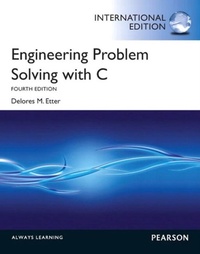
Engineering Problem Solving with C: International Edition
International Edition
1st Edition
Published on 20. March 2013
484 pages
978-0-273-77575-1 (ISBN)
Description

This introductory-level C programming book is designed primarily for engineering students required to learn how to program. In Engineering Problem Solving with C, 4e, best-selling author, Delores Etter, uses real-world engineering and scientific examples and problems throughout the text. Solutions to the problems are developed using the language C and the author's signature five-step problem solving process. Since learning any new skill requires practice at a number of different levels of difficulty, four types of exercises are presented to develop problem-solving skills - Practice! problems, Modify! problems, Short-Answer problems, and Programming problems. The author's clear and precise style creates a highly accessible and readable text for students of all levels.
More details
Other editions
Additional editions
Book
05/2012
4th Edition
Pearson Education Limited
€104.49
Shipment within 10-20 days
Content
- Cover
- Contents
- 1 Engineering Problem Solving
- Crime Scene Investigation
- 1.1 Engineering in the 21[sup(st)] Century
- Recent Engineering Achievements
- Changing Engineering Environment
- 1.2 Computing Systems: Hardware and Software
- Computer Hardware
- Computer Software
- Operating Systems
- Software Tools
- Computer Languages
- Executing a Computer Program
- Software Life Cycle
- 1.3 An Engineering Problem-Solving Methodology
- Summary
- Key Terms
- Problems
- 2 Simple C Programs
- Crime Scene Investigation: Forensic Anthropology
- 2.1 Program Structure
- 2.2 Constants and Variables
- Scientific Notation
- Numeric Data Types
- Character Data
- Symbolic Constants
- 2.3 Assignment Statements
- Arithmetic Operators
- Priority of Operators
- Overflow and Underflow
- Increment and Decrement Operators
- Abbreviated Assignment Operators
- 2.4 Standard Input and Output
- Printf Function
- Scanf Function
- 2.5 Problem Solving Applied: Estimating Height from Bone Lengths
- 2.6 Numerical Technique: Linear Interpolation
- 2.7 Problem Solving Applied: Freezing Temperature of Seawater
- 2.8 Mathematical Functions
- Elementary Math Functions
- Trigonometric Functions
- Hyperbolic Functions
- 2.9 Character Functions
- Character I/O
- Character Comparisons
- 2.10 Problem Solving Applied: Velocity Computation
- 2.11 System Limitations
- Summary
- Key Terms
- C Statement Summary
- Style: Notes
- Debugging Notes
- Problems
- 3 Control Structures and Data Files
- Crime Scene Investigation: Face Recognition and Surveillance Video
- 3.1 Algorithm Development
- Top-Down Design
- Decomposition Outline
- Refinement with Pseudocode and Flowcharts
- Structured Programming
- Sequence
- Selection
- Repetition
- Evaluation of Alternative Solutions
- Error Conditions
- Generation of Test Data
- 3.2 Conditional Expressions
- Relational Operators
- Logical Operators
- Precedence and Associativity
- 3.3 Selection Statements
- Simple if Statement
- If/else Statement
- Switch Statement
- 3.4 Problem Solving Applied: Face Recognition
- 3.5 Loop Structures
- While Loop
- Do/while Loop
- For Loop
- Break and continue Statements
- 3.6 Problem Solving Applied: Wave Interaction
- 3.7 Data Files
- I/O Statements
- Reading Data Files
- Specified Number of Records
- Trailer or Sentinel Signals
- End-of-File
- Generating a Data File
- 3.8 Numerical Technique: Linear Modeling*
- 3.9 Problem Solving Applied: Ozone Measurements*
- Summary
- Key Terms
- C Statement Summary
- Style: Notes
- Debugging Notes
- Problems
- 4 Modular Programming with Functions
- Crime Scene Investigation: Iris Recognition
- 4.1 Modularity
- 4.2 Programmer-Defined Functions
- Function Example
- Function Definition
- Function Prototype
- Parameter List
- Storage Class and Scope
- 4.3 Problem Solving Applied: Computing the Boundaries of the Iris
- 4.4 Problem Solving Applied: Iceberg Tracking
- 4.5 Random Numbers
- Integer Sequences
- Floating-Point Sequences
- 4.6 Problem Solving Applied: Instrumentation Reliability
- 4.7 Numerical Technique: Roots of Polynomials*
- Polynomial Roots
- Incremental-Search Technique
- 4.8 Problem Solving Applied: System Stability*
- 4.9 Macros*
- 4.10 Recursion*
- Factorial Computation
- Fibonacci Sequence
- Summary
- Key Terms
- C Statement Summary
- Style: Notes
- Debugging Notes
- Problems
- 5 Arrays and Matrices
- Crime Scene Investigation: Speech Analysis and Speech Recognition
- 5.1 One-Dimensional Arrays
- Definition and Initialization
- Computations and Output
- Function Arguments
- 5.2 Problem Solving Applied: Hurricane Categories
- 5.3 Problem Solving Applied: Molecular Weights
- 5.4 Statistical Measurements
- Simple Analysis
- Maximum and Minimum
- Average
- Median
- Variance and Standard Deviation
- Custom Header File
- 5.5 Problem Solving Applied: Speech Signal Analysis
- 5.6 Sorting Algorithms
- 5.7 Search Algorithms
- Unordered List
- Ordered List
- 5.8 Two-Dimensional Arrays
- Definition and Initialization
- Computations and Output
- Function Arguments
- 5.9 Problem Solving Applied: Terrain Navigation
- 5.10 Matrices and Vectors*
- Dot Product
- Determinant
- Transpose
- Matrix Addition and Subtraction
- Matrix Multiplication
- 5.11 Numerical Technique: Solution to Simultaneous Equations*
- Graphical Interpretation
- Gauss Elimination
- 5.12 Problem Solving Applied: Electrical Circuit Analysis*
- 5.13 Higher Dimensional Arrays*
- Summary
- Key Terms
- C Statement Summary
- Style: Notes
- Debugging Notes
- Problems
- 6 Programming with Pointers
- Crime Scene Investigation:DNA Analysis
- 6.1 Addresses and Pointers
- Address Operator
- Pointer Assignment
- Address Arithmetic
- 6.2 Pointers to Array Elements
- One-Dimensional Arrays
- Two-Dimensional Arrays
- 6.3 Problem Solving Applied: E1 Niño-Southern Oscillation Data
- 6.4 Pointers in Function References
- 6.5 Problem Solving Applied: Seismic Event Detection
- 6.6 Character Strings
- String Definition and I/O
- String Functions
- 6.7 Problem Solving Applied: DNA Sequencing
- 6.8 Dynamic Memory Allocation*
- 6.9 A Quicksort Algorithm*
- Summary
- Key Terms
- C Statement Summary
- Style: Notes
- Debugging Notes
- Problems
- 7 Programming with Structures
- Crime Scene Investigation: Fingerprint Recognition
- 7.1 Structures
- Definition and Initialization
- Input and Output
- Computations
- 7.2 Using Functions with Structures
- Structures as Function Arguments
- Functions that Return Structures
- 7.3 Problem Solving Applied: Fingerprint Analysis
- 7.4 Arrays of Structures
- 7.5 Problem Solving Applied: Tsunami Analysis
- 7.6 Dynamic Data Structures*
- Additional Dynamic Data Structures
- Circularly Linked List
- Doubly Linked List
- Stack
- Queue
- Binary Tree
- Summary
- Key Terms
- C Statement Summary
- Style: Notes
- Debugging Notes
- Problems
- 8 An Introduction to C++
- Crime Scene Investigation: Hand Recognition
- 8.1 Object-Oriented Programming
- 8.2 C++ Program Structure
- 8.3 Input and Output
- The cout Object
- Stream Functions
- The cin Object
- Defining File Streams
- 8.4 C++ Program Examples
- Simple Computations
- Loops
- Functions, One-Dimensional Arrays, and Data Files
- 8.5 Problem Solving Applied: Hand Recognition
- 8.6 Problem Solving Applied: Surface Wind Directions
- 8.7 Classes
- Defining a Class Data Type
- Constructor Functions
- Class Operators
- 8.8 Numerical Technique: Complex Roots
- Complex Class Definition
- Complex Roots for Quadratic Equations
- Summary
- Key Terms
- C++ Statement Summary
- Style: Notes
- Debugging Notes
- Problems
- Appendices
- A: ANSI C Standard Library
- &assert.h&
- &ctype.h&
- &errno.h&
- &float.h&
- &limits.h&
- &locale.h&
- &math.h&
- &setjmp.h&
- &signal.h&
- &stdarg.h&
- &stddef.h&
- &stdio.h&
- &stdlib.h&
- &string.h&
- &time.h&
- B: ASCII Character Codes
- C: Using MATLAB to Plot Data from Text Files
- Complete Solutions to Practice! Problems
- Selected Solutions to Modify! Problems
- Complete Solutions to End-of-Chapter Short-Answer Problems
- Selected Solutions to End-of-Chapter Programming Problems
- Glossary
- A
- B
- C
- D
- E
- F
- G
- H
- I
- K
- L
- M
- N
- O
- P
- Q
- R
- S
- T
- U
- V
- W
- Z
- Index
- A
- B
- C
- D
- E
- F
- G
- H
- I
- J
- K
- L
- M
- N
- O
- P
- Q
- R
- S
- T
- U
- V
- W
- Z
