

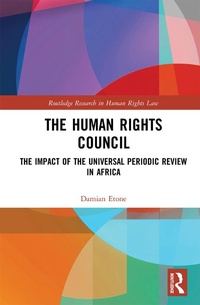
The Human Rights Council
The Impact of the Universal Periodic Review in Africa
1st Edition
Published on 27. January 2020
232 pages
978-0-429-59434-2 (ISBN)
Description

This book examines the engagement of African states with the United Nations Human Rights Council's Universal Periodic Review (UPR) mechanism. This human rights mechanism is known for its pacific and non-confrontational approach to monitoring state human rights implementation. Coming at the end of the first three cycles of the UPR, the work offers a detailed analysis of the effectiveness of African states' engagement and its potential impact. It develops a framework which comprehensively evaluates aspects of states' UPR engagement, such as the pre-review national consultation process and implementation of UPR recommendations which, until recently, have received little attention. The book considers the potential for acculturation in engagement with the UPR and unpacks the impact of politics, regionalism, cultural relativism, rights ritualism and civil society.
The work provides a useful guide for policymakers and international human rights law practitioners, as well as a valuable resource for international legal and international relations academics and researchers.
The work provides a useful guide for policymakers and international human rights law practitioners, as well as a valuable resource for international legal and international relations academics and researchers.
Reviews / Votes
`This book tackles an important question for international human rights law: how effective is the United Nations Human Rights Council's Universal Periodic Review (UPR) mechanism? It does so in the context of in-depth studies of African states: Nigeria, Kenya, The Gambia, and South Africa. The book finds that overall the UPR is effective as a non-confrontational system to encourage states to improve their implementation of their international human rights commitments. It also acknowledges many of the limitations and weaknesses of the UPR in practice. The book is a valuable contribution to the literature on the UPR. Its strength lies in its careful analysis and the detail in the case studies. The author has engaged in an impressively close analysis of the way that African states have engaged in the UPR process over its three cycles and the way in which they have responded to UPR recommendations. The author has built on existing methodologies and extended them. The Figures presented in the case studies were very effective. A fascinating observation in the book relates to the role of regionalism in the UPR. The author points to the fact that regionalism operates strongly in the African context, with African states much more willing to accept UPR recommendations from other African states. He notes that some scholars have criticised this feature of the UPR, but observes perceptively that the regionalism can also facilitate acculturation to human rights standards. The author displays an excellent knowledge of the relevant literature and he has gone well beyond the legal literature to draw upon studies in international relations, sociology and psychology.' - Professor Hilary Charlesworth, Melbourne Laureate Professor at Melbourne Law School and Distinguished Professor at the Australian National UniversityMore details
Series
Edition
1. Auflage
Language
English
Place of publication
London
United Kingdom
Publishing group
Taylor & Francis Ltd
Target group
College/higher education
Product notice
Reflowable
Illustrations
6 Tables, black and white; 27 Line drawings, black and white
ISBN-13
978-0-429-59434-2 (9780429594342)
Copyright in bibliographic data and cover images is held by Nielsen Book Services Limited or by the publishers or by their respective licensors: all rights reserved.
Schweitzer Classification
Other editions
Additional editions
Book
09/2021
1st Edition
Routledge
€65.20
Shipment within 10-20 days
Book
04/2020
Taylor & Francis
Unfortunately, price unknown
Available (delivery time upon request)
Book
01/2020
1st Edition
Routledge
€179.81
Shipment within 15-20 days
Person
Damian Etone is a Lecturer at the Division of Law and Philosophy, University of Stirling, United Kingdom.
Content
1 The establishment and operation of the Universal Periodic Review (UPR)
2 Theoretical understanding of the UPR: a case for acculturation?
3 Compliance, implementation and effectiveness: clarifying the basis for assessing state UPR engagement
4 Nigeria's engagement with the HRC's UPR: potential for acculturation or risk of regression?
5 Kenya and the UPR: the impact of effective NGO engagement
6 NGOs versus state recommendations and the relationship between the UPR and other human rights mechanisms: the case of Kenya
7 The effectiveness of South Africa's engagement with the UPR: potential for ritualism
8 The Gambia and the UPR: rhetoric, inaction and the effect of regime change
2 Theoretical understanding of the UPR: a case for acculturation?
3 Compliance, implementation and effectiveness: clarifying the basis for assessing state UPR engagement
4 Nigeria's engagement with the HRC's UPR: potential for acculturation or risk of regression?
5 Kenya and the UPR: the impact of effective NGO engagement
6 NGOs versus state recommendations and the relationship between the UPR and other human rights mechanisms: the case of Kenya
7 The effectiveness of South Africa's engagement with the UPR: potential for ritualism
8 The Gambia and the UPR: rhetoric, inaction and the effect of regime change
