

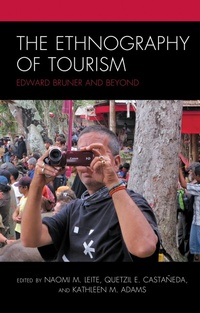
The Ethnography of Tourism
Edward Bruner and Beyond
Lexington Books (Publisher)
1st Edition
Published on 11. October 2019
1 pages
978-1-9787-8891-6 (ISBN)
Description

**Winner of the 2020 Edward M. Bruner Book Award from the Anthropology of Tourism Interest Group**
"Leite, Castaneda, and Adams's volume is a beautiful retrospective of the enduring importance of Ed Bruner's work and legacy in our field, and we have no doubt that it will be used as a central historical, theoretical, and teaching text by many." - Prize Committee
What does it mean to study tourism ethnographically? How has the ethnography of tourism changed from the 1970s to today? What theories, themes, and concepts drive contemporary research? Thirteen leading anthropologists of tourism address these questions and provide a critical introduction to the state of the art. Focusing on the experience-near, interpretive-humanistic approach to tourism studies widely associated with anthropologist Edward Bruner, the contributors draw on their fieldwork to illustrate and build upon key concepts in tourism ethnography, from experience, encounter, and emergent culture to authenticity, narrative, contested sites, the borderzone, embodiment, identity, and mobility. With its comprehensive introductory chapter, keyword-based organization, and engaging style, The Ethnography of Tourism will appeal to anthropology and tourism studies students, as well as to scholars in both fields and beyond.
For more information, check out A Conversation with the Editors of the Ethnography of Tourism: Edward M. Bruner and Beyond and In Memoriam: Ed Bruner.
"Leite, Castaneda, and Adams's volume is a beautiful retrospective of the enduring importance of Ed Bruner's work and legacy in our field, and we have no doubt that it will be used as a central historical, theoretical, and teaching text by many." - Prize Committee
What does it mean to study tourism ethnographically? How has the ethnography of tourism changed from the 1970s to today? What theories, themes, and concepts drive contemporary research? Thirteen leading anthropologists of tourism address these questions and provide a critical introduction to the state of the art. Focusing on the experience-near, interpretive-humanistic approach to tourism studies widely associated with anthropologist Edward Bruner, the contributors draw on their fieldwork to illustrate and build upon key concepts in tourism ethnography, from experience, encounter, and emergent culture to authenticity, narrative, contested sites, the borderzone, embodiment, identity, and mobility. With its comprehensive introductory chapter, keyword-based organization, and engaging style, The Ethnography of Tourism will appeal to anthropology and tourism studies students, as well as to scholars in both fields and beyond.
For more information, check out A Conversation with the Editors of the Ethnography of Tourism: Edward M. Bruner and Beyond and In Memoriam: Ed Bruner.
More details
Series
Edition
1. Auflage
Language
English
Place of publication
United States
Publishing group
Bloomsbury Publishing Plc
Target group
Professional and scholarly
Illustrations
14 b/w photos;
ISBN-13
978-1-9787-8891-6 (9781978788916)
Copyright in bibliographic data and cover images is held by Nielsen Book Services Limited or by the publishers or by their respective licensors: all rights reserved.
Schweitzer Classification
Other editions
Additional editions
Naomi M. Leite | Quetzil E. Castaneda | Kathleen M. Adams
The Ethnography of Tourism
Edward Bruner and Beyond
Book
10/2021
Lexington Books
€57.80
Shipment within 15-20 days
Persons
Naomi M. Leite is assistant professor of anthropology at SOAS, University of London.
Quetzil E. Castañeda is senior lecturer of Latin American and Caribbean studies at Indiana University.
Kathleen M. Adams is professor of anthropology at Loyola University Chicago.
Quetzil E. Castañeda is senior lecturer of Latin American and Caribbean studies at Indiana University.
Kathleen M. Adams is professor of anthropology at Loyola University Chicago.
Content
PART I: ORIENTATION
Introduction. The Ethnography of Tourism: Encounter, Experience, Emergent Culture.
Naomi M. Leite, Quetzil E. Castañeda, and Kathleen M. Adams
PART II: POINTS OF DEPARTURE
1. {Formation} Always in Process: Edward Bruner, American Anthropology, and the Study of Tourism.
Nelson Graburn and Naomi M. Leite
2. {Genealogies} On the Emergence of Identity and Borderzones as Key Concepts.
Kathleen M. Adams
3. {Influence} "So in Effect I Was Studying Myself": Knowing (Our) Tourist Stories.
Julia Harrison
PART III: EXPLORATIONS: CONCEPTS AND DEBATES
4. {Authenticity} "Whatever We Weave Is Authentic": Coproducing Authenticity in Guatemalan Tourism Textile Markets.
Walter E. Little
5. {The Borderzone} Living in and Reaching beyond the Touristic Borderzone: A View from Cuba.
Valerio Simoni
6. {Constructivism} "I Can Feel Them Now, Even as I Write": Hiking Yosemite Falls with the Emergent Subjects of Tourism.
Sally Ann Ness
PART IV: FURTHER A
Introduction. The Ethnography of Tourism: Encounter, Experience, Emergent Culture.
Naomi M. Leite, Quetzil E. Castañeda, and Kathleen M. Adams
PART II: POINTS OF DEPARTURE
1. {Formation} Always in Process: Edward Bruner, American Anthropology, and the Study of Tourism.
Nelson Graburn and Naomi M. Leite
2. {Genealogies} On the Emergence of Identity and Borderzones as Key Concepts.
Kathleen M. Adams
3. {Influence} "So in Effect I Was Studying Myself": Knowing (Our) Tourist Stories.
Julia Harrison
PART III: EXPLORATIONS: CONCEPTS AND DEBATES
4. {Authenticity} "Whatever We Weave Is Authentic": Coproducing Authenticity in Guatemalan Tourism Textile Markets.
Walter E. Little
5. {The Borderzone} Living in and Reaching beyond the Touristic Borderzone: A View from Cuba.
Valerio Simoni
6. {Constructivism} "I Can Feel Them Now, Even as I Write": Hiking Yosemite Falls with the Emergent Subjects of Tourism.
Sally Ann Ness
PART IV: FURTHER A
