

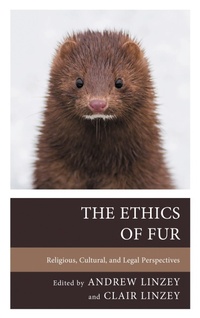
The Ethics of Fur
Religious, Cultural, and Legal Perspectives
Lexington Books (Publisher)
1st Edition
Published on 24. July 2023
1 pages
978-1-9787-7337-0 (ISBN)
Description

This is the first multidisciplinary book that addresses the ethics of fur. Whatever might have been true of the past, the production of fur is now morally problematic in terms of both necessity and suffering. There is no necessity in killing animals for nonessential purposes, such as adornment, fashion, or vanity. The argument for utility simply doesn't hold up. Alternative clothing is now readily available, enduring, and less costly. Worse still, since we know that the animals exploited are sentient, causing them suffering or making animals liable to suffering is arguably intrinsically wrong.
The purpose of this volume is to open up and advance further the ethical, political, and specifically legislative endeavors now moving at pace and to encourage the anti-fur movement. That said, there is much to learn from this book about the history, culture, and political arguments for and against fur that should interest scholars and students, as well as those engaged on either side of the debate. It is not common for academics to engage with pressing and contentious moral issues, and we pay tribute to our eighteen contributors for leading the way.
The purpose of this volume is to open up and advance further the ethical, political, and specifically legislative endeavors now moving at pace and to encourage the anti-fur movement. That said, there is much to learn from this book about the history, culture, and political arguments for and against fur that should interest scholars and students, as well as those engaged on either side of the debate. It is not common for academics to engage with pressing and contentious moral issues, and we pay tribute to our eighteen contributors for leading the way.
More details
Edition
1. Auflage
Language
English
Place of publication
United States
Publishing group
Bloomsbury Publishing Plc
Target group
Professional and scholarly
Illustrations
1 b/w photos; 4 tables;
ISBN-13
978-1-9787-7337-0 (9781978773370)
Copyright in bibliographic data and cover images is held by Nielsen Book Services Limited or by the publishers or by their respective licensors: all rights reserved.
Schweitzer Classification
Other editions
Additional editions

Book
07/2023
Lexington Books
€114.70
Shipment within 3-4 weeks
Persons
Andrew Linzey is director of the Oxford Centre for Animal Ethics and has been a member of the faculty of theology in the University of Oxford for twenty-eight years.
Clair Linzey is deputy director of the Oxford Centre for Animal Ethics and professor of animal theology at the Graduate Theological Foundation.
Clair Linzey is deputy director of the Oxford Centre for Animal Ethics and professor of animal theology at the Graduate Theological Foundation.
Content
Introduction: Increasing Ethical Sensitivity around Fur
Andrew Linzey and Clair Linzey
Part I: Historical and Religious Perspectives
Chapter 1: From the Pleistocene to COVID-19: A Brief History of Fur
Adam Bridgen
Chapter 2: "Thou Shalt Not Use the Skins of Any Living Creature": The Original Anti-Fur Activist, Thomas Tryon (1634-1703)
Adam Bridgen
Chapter 3: The New England Fur Trade: The Ethics of Puritan Dress in a Portrait of Lieutenant Governor William Stoughton
Linda M. Johnson
Chapter 4: The Nineteenth-Century Boycott against Feathered Hats
Robyn Hederman
Chapter 5: Corpse "Contamination" as a Religious Approach to Fur
Sidney Blankenship
Chapter 6: Of Ermines, Cats, and "the Best-Dressed Pontiff Ever": The Ethics of Fur-Trimmed Clerical Garb
Kurt Remele
Part II: Ethical and Cultural Perspectives
Chapter 7: A Case of Wrongful Use: An Ethical Analysis of the Use of Animal Fur
Frances M. C. Robinson
Chapter 8: If a Fox Could Talk: Wittgenstein and the Calculated Silencing of Anima
Andrew Linzey and Clair Linzey
Part I: Historical and Religious Perspectives
Chapter 1: From the Pleistocene to COVID-19: A Brief History of Fur
Adam Bridgen
Chapter 2: "Thou Shalt Not Use the Skins of Any Living Creature": The Original Anti-Fur Activist, Thomas Tryon (1634-1703)
Adam Bridgen
Chapter 3: The New England Fur Trade: The Ethics of Puritan Dress in a Portrait of Lieutenant Governor William Stoughton
Linda M. Johnson
Chapter 4: The Nineteenth-Century Boycott against Feathered Hats
Robyn Hederman
Chapter 5: Corpse "Contamination" as a Religious Approach to Fur
Sidney Blankenship
Chapter 6: Of Ermines, Cats, and "the Best-Dressed Pontiff Ever": The Ethics of Fur-Trimmed Clerical Garb
Kurt Remele
Part II: Ethical and Cultural Perspectives
Chapter 7: A Case of Wrongful Use: An Ethical Analysis of the Use of Animal Fur
Frances M. C. Robinson
Chapter 8: If a Fox Could Talk: Wittgenstein and the Calculated Silencing of Anima
