

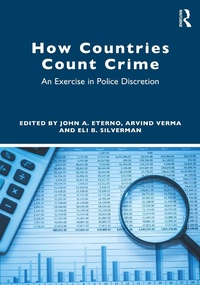
How Countries Count Crime
An Exercise in Police Discretion
1st Edition
Published on 30. September 2022
254 pages
978-1-000-63428-0 (ISBN)
Description

This edited collection illuminates the weaknesses and strengths of crime reporting across a wide range of countries, with a focus on democratic countries in which the police bear some accountability to citizens. In one compendium, for the first time, this book documents how different countries record (or fail to record) crimes. With chapters written by native authors who are experts on the practices of their respective countries, the book explores practices in 15 different countries across the globe.
Organized with a parallel, country-by-country approach, the book describes and analyzes methods police use to record crimes, with the awareness that the counting of crimes is not only an issue of empirical measurement, but also one of social construction. Crime reporting practices vary widely by country. In some cases, reports are not taken, and in others, reports are carefully based on preliminary investigations. Willful manipulation of crime reports can and does occur, and the book explores related factors such as political pressure, personal ambition, community safety, and more. Discussion questions at the end of each chapter help the reader evaluate the significant issues influencing each country. The editors conclude by suggesting best practices for crime reporting and the collection of crime data. A unique addition to this book is a foreword by Tofiq Murshudlu, the Head of Drugs and Crime for the United Nations in Vienna.
The book is intended for a wide range of audiences, including policing scholars, law enforcement and community leaders, and students of criminal justice.
Organized with a parallel, country-by-country approach, the book describes and analyzes methods police use to record crimes, with the awareness that the counting of crimes is not only an issue of empirical measurement, but also one of social construction. Crime reporting practices vary widely by country. In some cases, reports are not taken, and in others, reports are carefully based on preliminary investigations. Willful manipulation of crime reports can and does occur, and the book explores related factors such as political pressure, personal ambition, community safety, and more. Discussion questions at the end of each chapter help the reader evaluate the significant issues influencing each country. The editors conclude by suggesting best practices for crime reporting and the collection of crime data. A unique addition to this book is a foreword by Tofiq Murshudlu, the Head of Drugs and Crime for the United Nations in Vienna.
The book is intended for a wide range of audiences, including policing scholars, law enforcement and community leaders, and students of criminal justice.
More details
Edition
1. Auflage
Language
English
Place of publication
London
United Kingdom
Publishing group
Taylor & Francis Ltd
Product notice
Reflowable
Illustrations
13 Tables, black and white; 25 Line drawings, black and white; 25 Illustrations, black and white
ISBN-13
978-1-000-63428-0 (9781000634280)
Copyright in bibliographic data and cover images is held by Nielsen Book Services Limited or by the publishers or by their respective licensors: all rights reserved.
Schweitzer Classification
Other editions
Additional editions
John A. Eterno | Arvind Verma | Eli B. Silverman
How Countries Count Crime
An Exercise in Police Discretion
Book
09/2022
1st Edition
Routledge
€240.50
Shipment within 15-20 days
John A. Eterno | Arvind Verma | Eli B. Silverman
How Countries Count Crime
An Exercise in Police Discretion
Book
09/2022
1st Edition
Routledge
€74.60
Shipment within 15-20 days
Persons
John A. Eterno, PhD, is a Professor and Associate Dean of Criminal Justice at Molloy University in New York. Dr. Eterno is a retired captain for the New York City police. His career included serving as an officer and supervisor on patrol, doing extensive research for the department, and training officers. He has done the research for the United States Attorney's office for the Eastern District of New York and National Development Research Institutes and is recognized and testified as an expert on police in the federal courts. Dr. Eterno is a representative to the United Nations for the International Police Executive Symposium. Dr. Eterno's recent books include The Crime Numbers Game: Management by Manipulation (with Eli B. Silverman), The Detective's Handbook (with Cliff Roberson), and The New York City Police Department: The Impact of Its Policies and Practices. He is also widely published and quoted in peer-reviewed and media outlets.
Arvind Verma, PhD, is an Associate Professor in the Department of Criminal Justice and Associate Director of the India Studies Program at Indiana University, Bloomington (USA). His research interests are in Policing; Criminal Justice Policy Issues, Indian Police, Research Methods, Mathematical Modeling, and Geographical Information Systems. He is the Managing Editor of Police Practice and Research: An International Journal and consultant to the Bureau of Police Research and Development, Government of India. His recent publications (some jointly) include Police Mission: Challenges and Responses published by Scarecrow Press; "Technological Applications for the Police" Indian Police Journal; "Consolidation of the Raj: Notes from a Police Station in British India: 1865-1928" Criminal Justice History; "Teaching Police Officers Human Rights: Some Observations" International Journal of Human Rights, and "A Topological Representation of the Criminal Event" Western Criminology Review. His current projects include Policing of Elections in India; Measuring Police Performance through Data Envelopment Analysis, and a book titled Indian Police: A Critical Review.
Eli B. Silverman, PhD, is a Professor Emeritus at John Jay College of Criminal Justice and the Graduate Center of the City University of New York. He has previously served with the U.S. Department of Justice and the National Academy of Public Administration in Washington, DC and was Visiting Exchange Professor at the Police Staff College in Bramshill, England. He has lectured, consulted with, and trained numerous law enforcement agencies in the United States, United Kingdom, Canada, Mexico, Europe, Asia, and Australia. His research and testimony were cited in 2013 by Floyd et al. v. City of New York. His recent publications include: The Crime Numbers Game: Management by Manipulation, with John Eterno, 2012; "NYPD's Compstat: Compare Statistics or Compose Statistics?" with John A. Eterno, International Journal of Police Science and Management, 2010; NYPD Battles Crime: Innovative Strategies in Policing; and "Forcible Stops: Police and Citizens Speak Out" with John Eterno and Christine Barrow, Public Administration Review, 2016.
Arvind Verma, PhD, is an Associate Professor in the Department of Criminal Justice and Associate Director of the India Studies Program at Indiana University, Bloomington (USA). His research interests are in Policing; Criminal Justice Policy Issues, Indian Police, Research Methods, Mathematical Modeling, and Geographical Information Systems. He is the Managing Editor of Police Practice and Research: An International Journal and consultant to the Bureau of Police Research and Development, Government of India. His recent publications (some jointly) include Police Mission: Challenges and Responses published by Scarecrow Press; "Technological Applications for the Police" Indian Police Journal; "Consolidation of the Raj: Notes from a Police Station in British India: 1865-1928" Criminal Justice History; "Teaching Police Officers Human Rights: Some Observations" International Journal of Human Rights, and "A Topological Representation of the Criminal Event" Western Criminology Review. His current projects include Policing of Elections in India; Measuring Police Performance through Data Envelopment Analysis, and a book titled Indian Police: A Critical Review.
Eli B. Silverman, PhD, is a Professor Emeritus at John Jay College of Criminal Justice and the Graduate Center of the City University of New York. He has previously served with the U.S. Department of Justice and the National Academy of Public Administration in Washington, DC and was Visiting Exchange Professor at the Police Staff College in Bramshill, England. He has lectured, consulted with, and trained numerous law enforcement agencies in the United States, United Kingdom, Canada, Mexico, Europe, Asia, and Australia. His research and testimony were cited in 2013 by Floyd et al. v. City of New York. His recent publications include: The Crime Numbers Game: Management by Manipulation, with John Eterno, 2012; "NYPD's Compstat: Compare Statistics or Compose Statistics?" with John A. Eterno, International Journal of Police Science and Management, 2010; NYPD Battles Crime: Innovative Strategies in Policing; and "Forcible Stops: Police and Citizens Speak Out" with John Eterno and Christine Barrow, Public Administration Review, 2016.
Content
Foreword
Contributors
Introduction
John A. Eterno, Arvind Verma, and Eli B. Silverman
Chapter 1: Collecting Police-Recorded Data in Austria: A Review of the Current State of Play
Stefanie Meyer
Chapter 2: How France Counts Crime: A Shared Interest in Bad Accounts
Christian Mouhanna
Chapter 3: Counting Crime in the Isle of Spice: A Review of the Royal Grenada Police Force
Christine Sharon Barrow
Chapter 4: Counting Crime: An Exercise in Police Discretion Report from India
Arvind Verma and Asim Arun
Chapter 5: Role of Police in the Compilation of Crime Data in Mexico
Elena Azaola and Cliff Roberson
Chapter 6: Crime Statistics: To Measure Is to Know, but Do More with Less
Peter Versteegh and Rene Hesseling
Chapter 7: The Challenges of Police Discretion and Crime Statistics in Nigeria
Abdulrahman Dambazau
Chapter 8: How Portugal Counts Crime: An Exercise in Police Discretion
Goncalo de Melo Bandeira and Paulo Teixeira
Chapter 9: The State and Trends of Crime in Modern Russia
Yakov Gilinskiy
Chapter 10: Counting Crime in South Africa
Gareth Newham
Chapter 11: Police Data in Spain: Still a Grey Landscape
Francesc Guillen Lasierra and Santiago Herrero Blanco
Chapter 12: Crime Reporting in Sweden
Stefan Holgersson
Chapter 13: Measuring Crime and Victimization Rates in Tanzania
Simeon P. Sungi
Chapter 14: A Web of Deceit: Police Crime Statistics of England and Wales
Rodger Patrick
Chapter 15: Crime Reporting in the United States: Truth or Consequences
John A. Eterno and Eli B. Silverman
Index
Contributors
Introduction
John A. Eterno, Arvind Verma, and Eli B. Silverman
Chapter 1: Collecting Police-Recorded Data in Austria: A Review of the Current State of Play
Stefanie Meyer
Chapter 2: How France Counts Crime: A Shared Interest in Bad Accounts
Christian Mouhanna
Chapter 3: Counting Crime in the Isle of Spice: A Review of the Royal Grenada Police Force
Christine Sharon Barrow
Chapter 4: Counting Crime: An Exercise in Police Discretion Report from India
Arvind Verma and Asim Arun
Chapter 5: Role of Police in the Compilation of Crime Data in Mexico
Elena Azaola and Cliff Roberson
Chapter 6: Crime Statistics: To Measure Is to Know, but Do More with Less
Peter Versteegh and Rene Hesseling
Chapter 7: The Challenges of Police Discretion and Crime Statistics in Nigeria
Abdulrahman Dambazau
Chapter 8: How Portugal Counts Crime: An Exercise in Police Discretion
Goncalo de Melo Bandeira and Paulo Teixeira
Chapter 9: The State and Trends of Crime in Modern Russia
Yakov Gilinskiy
Chapter 10: Counting Crime in South Africa
Gareth Newham
Chapter 11: Police Data in Spain: Still a Grey Landscape
Francesc Guillen Lasierra and Santiago Herrero Blanco
Chapter 12: Crime Reporting in Sweden
Stefan Holgersson
Chapter 13: Measuring Crime and Victimization Rates in Tanzania
Simeon P. Sungi
Chapter 14: A Web of Deceit: Police Crime Statistics of England and Wales
Rodger Patrick
Chapter 15: Crime Reporting in the United States: Truth or Consequences
John A. Eterno and Eli B. Silverman
Index
