

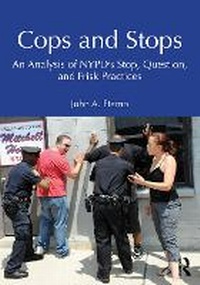
Cops and Stops
An Analysis of NYPD's Stop, Question, and Frisk Practices
Will be published approx. on 12. August 2026
166 pages
E-Book
978-1-040-54858-5 (ISBN)
Description

This book focuses on the controversial aggressive police practices employed to control crime by the New York City Police Department (NYPD) and the harm that has resulted and may further be produced if not checked. Informed by the author's personal experience as a retired NYPD Captain, as well as by his research in the field, this book explains the broad influence of stop and frisk as well as other aggressive policies.
In the mid-1990s, with the election of Mayor Rudolph Giuliani, a new era of aggressive policing began in New York City. While apparently helping lead to a decline in crime, the side effects of tactics such as stop and frisk led to powerful repercussions. A new Inspector General was appointed, the department came under federal review for racist and unconstitutional stops, and officers were required to record almost every citizen interaction. Names of individuals affected by these tactics, including Amadou Diallo, Eric Garner, and Abner Louima, among others, remain in the public consciousness. Practices such as stop and frisk in part fueled social justice movements like Black Lives Matter, and their use erodes public trust in the police, with many calling for increased scrutiny of police power, reduced police budgets, and even abolishment.
Designed for students in criminal justice programs as well as recruits in police training, this book explains and critiques stop and frisk and related tactics and recommends paths to a better future.
In the mid-1990s, with the election of Mayor Rudolph Giuliani, a new era of aggressive policing began in New York City. While apparently helping lead to a decline in crime, the side effects of tactics such as stop and frisk led to powerful repercussions. A new Inspector General was appointed, the department came under federal review for racist and unconstitutional stops, and officers were required to record almost every citizen interaction. Names of individuals affected by these tactics, including Amadou Diallo, Eric Garner, and Abner Louima, among others, remain in the public consciousness. Practices such as stop and frisk in part fueled social justice movements like Black Lives Matter, and their use erodes public trust in the police, with many calling for increased scrutiny of police power, reduced police budgets, and even abolishment.
Designed for students in criminal justice programs as well as recruits in police training, this book explains and critiques stop and frisk and related tactics and recommends paths to a better future.
Reviews / Votes
The book by John Eterno discusses a root problem in our contemporary world: how is it possible to police a democratic society? It has been the subject of extensive debate in academia, the practitioners' field, and public opinion. Departing from the Stop and Frisk at the New York Police Department, the book traces the contextual factors that led to its implementation, the political injunctions that underpinned its measures, and its questionable results. It stresses the fine balance between protecting the community and respecting human rights, and how miscalculation can lead to negative outcomes. Despite its focus on the New York experience, the book provides an insightful perspective for all those interested in democratic police reform in distinct contexts across the globe.Vicente Riccio - Law and Graduate Program - Federal University of Juiz de Fora, Brazil - Visiting Scholar at the Professional Graduate Program on Human Rights, Citizenship, and Public Security at the State University of Amazonas, Brazil.
Cops and Stops is an important resource for leaders committed to reform-oriented,It is a constructive contribution to contemporary policing debates, supporting informed, lawful, and sustainable approaches to crime control in democratic societies.
Drawing on decades of scholarship, judicial analysis, and empirical evidence, John A. Eterno illuminates how police stop practices-particularly stop-and-frisk-can simultaneously reduce crime and erode constitutional rights, legitimacy, and community trust. With exceptional clarity, the book traces the evolution of aggressive policing strategies, performance management systems, and their unintended consequences, situating the New York City experience within a broader global and comparative framework. This work is not an argument against policing, but a compelling call for evidence-based, rights-respecting, and legitimacy-centered law enforcement. Essential reading for scholars, police leaders, policymakers, and students of criminal justice, Cops and Stops sets a benchmark for thoughtful, data-driven reflection on the future of democratic policing.
- Prof. (Dr.) Richa Mishra
Parul University, India
Policing in democracies demands a delicate balance between reducing crime and upholding civil rights. This book traces how New York City's policing strategies-from community policing, problem-oriented policing, to CompStat and the rise of stop and frisk-reshaped police culture, often at the expense of legitimacy and public trust. Through landmark court cases, shifting political leadership, and global comparisons, it reveals how aggressive, numbers driven tactics resulted in dramatic crime drops and deep constitutional concerns. Examining racial disparities, oversight efforts, and international practices, the book offers a clear-eyed roadmap for democratic policing, grounded in accountability, data, and respect for the communities officers serve.
Gorazd Mesko
Professor of Criminology
University of Maribor, Slovenia
Eterno provides a unique and expert analysis of the origins, variations, dimensions and dilemmas of police stops in a democratic society. As such, this study could not be more pertinent to policing in the United States today as it explores the ramifications of this practice in terms of racial/ethnic disparity, police legitimacy, large scale top-down management and the proper role and practice of policing
The value of this volume exceeds all others in exploring the multi dimensions of stop and frisks since the author possesses a unique blending of extensive high ranking police experience and incisive academic research of this practice. While the bulk of this work centers on the NYPD, Eterno's familiarity with and research of other democracies provides a much-needed context in examining the key dimensions of stops and frisks.
"Cos andp Stops" is a "Must Read" Book
Eli B. Silverman, Ph.D. Professor Emeritus, John Jay College of Criminal Justice and Graduate Center, City University of New York; co-author, The Crime Number Game: Management by Manipulation .
More details
Language
English
Place of publication
London
United Kingdom
Publishing group
Taylor & Francis Ltd
Target group
College/higher education
Professional and scholarly
Illustrations
5 Tables, black and white; 2 Halftones, black and white; 2 Illustrations, black and white
ISBN-13
978-1-040-54858-5 (9781040548585)
Copyright in bibliographic data and cover images is held by Nielsen Book Services Limited or by the publishers or by their respective licensors: all rights reserved.
Schweitzer Classification
Other editions
Additional editions
Book
approx. 08/2026
1st Edition
Routledge
€191.50
Not yet published
Book
approx. 08/2026
1st Edition
Routledge
€52.50
Not yet published
Person
John A. Eterno, Ph.D., is Professor and Chair of the Criminal Justice and Legal Studies Department at Molloy University. He is also Director of Graduate Studies in Criminal Justice and a retired NYPD Captain. He is a Fulbright scholar and President of the American Academy for Law Enforcement, Long Island. He has penned numerous books, chapters, articles, and editorials on various criminal justice topics. His research has appeared on the front page of The New York Times and op-eds published in The New York Times, The Atlantic, and The Guardian. Among his books is The Crime Numbers Game: Management by Manipulation (with Eli Silverman).
Content
1. Policing in Democracies 2. The Community Policing Era-1980s to Early 1990s 3. William Bratton I-1994-1996 4. Howard Safir and Bernard Kerik, 1996-2002: The Troubles Take Root 5. The Safest Big City in America? But Criminal Suspects Are Everywhere 6. New Mayor, New Police Commissioners 7. Worldwide Influence of the NYPD: An International Movement Against Police 8. Implications for the Future
