

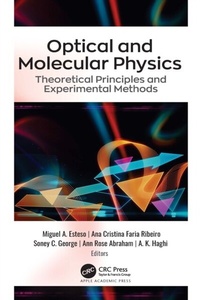
Optical and Molecular Physics
Theoretical Principles and Experimental Methods
1st Edition
Published on 30. September 2021
518 pages
978-1-000-35134-7 (ISBN)
Description

Optical and Molecular Physics: Theoretical Principles and Experimental Methods addresses many important applications and advances in the field. This book is divided into 5 sections:
Plasmonics and carbon dots physics with applications
Optical films, fibers, and materials
Optical properties of advanced materials
Molecular physics and diffusion
Macromolecular physics
Weaving together science and engineering, this new volume addresses important applications and advances in optical and molecular physics. It covers plasmonics and carbon dots physics with applications; optical films, fibers, and materials; optical properties of advanced materials; molecular physics and diffusion; and macromolecular physics.
This book looks at optical materials in the development of composite materials for the functionalization of glass, ceramic, and polymeric substrates to interact with electromagnetic radiation and presents state-of-the-art research in preparation methods, optical characterization, and usage of optical materials and devices in various photonic fields. The authors discuss devices and technologies used by the electronics, magnetics, and photonics industries and offer perspectives on the manufacturing technologies used in device fabrication.
Plasmonics and carbon dots physics with applications
Optical films, fibers, and materials
Optical properties of advanced materials
Molecular physics and diffusion
Macromolecular physics
Weaving together science and engineering, this new volume addresses important applications and advances in optical and molecular physics. It covers plasmonics and carbon dots physics with applications; optical films, fibers, and materials; optical properties of advanced materials; molecular physics and diffusion; and macromolecular physics.
This book looks at optical materials in the development of composite materials for the functionalization of glass, ceramic, and polymeric substrates to interact with electromagnetic radiation and presents state-of-the-art research in preparation methods, optical characterization, and usage of optical materials and devices in various photonic fields. The authors discuss devices and technologies used by the electronics, magnetics, and photonics industries and offer perspectives on the manufacturing technologies used in device fabrication.
More details
Edition
1. Auflage
Language
English
Place of publication
London
United Kingdom
Publishing group
Taylor & Francis Ltd
Target group
Professional and scholarly
Product notice
Reflowable
Illustrations
25 Tables, black and white; 70 Line drawings, black and white; 31 Halftones, black and white; 101 Illustrations, black and white
ISBN-13
978-1-000-35134-7 (9781000351347)
Copyright in bibliographic data and cover images is held by Nielsen Book Services Limited or by the publishers or by their respective licensors: all rights reserved.
Schweitzer Classification
Other editions
Additional editions
Miguel A. Esteso | Ana Cristina Faria Ribeiro | Soney C. George
Optical and Molecular Physics
Theoretical Principles and Experimental Methods
Book
09/2023
1st Edition
Apple Academic Press Inc.
€108.40
Shipment within 3-4 weeks
Miguel A. Esteso | Ana Cristina Faria Ribeiro | Soney C. George
Optical and Molecular Physics
Theoretical Principles and Experimental Methods
Book
09/2021
1st Edition
Apple Academic Press Inc.
€242.70
Shipment within 3-4 weeks
Optical and Molecular Physics
Theoretical Principles and Experimental Methods
Book
08/2021
Apple Academic Press
Unfortunately, price unknown
Available (delivery time upon request)
Persons
Miguel A. Esteso, PhD, is Emeritus Professor in Physical Chemistry at the University of Alcala, Spain. He is the author of over 300 published papers in several journals and conference proceedings, as well as chapters in specialized books. He has supervised several PhD and master degree theses. He is a member of the International Society of Electrochemistry (ISE), the Ibero-American Society of Electrochemistry (SIBAE), the Portuguese Society of Electrochemistry (SPE), and the Biophysics Spanish Society (SEB). He is on the editorial boards of various international journals. His research activity is focused on electrochemical thermodynamics. He developed his postdoctoral work at the Imperial College of London (UK) and has made several research-stays at different universities and research centers, including the University of Regensburg, Germany; CITEFA (Institute of Scientific and Technical Research for the Armed Forces), Argentina; Theoretical and Applied Physicochemical Research Institute, La Plata, Argentina; Pontifical Catholic University of Chile, Chile; University of Zulia, Venezuela; University of Antioquia, Colombia; National University of Colombia, Bogota, Colombia; University of Coimbra, Portugal; and University of Ljubljana, Slovenia.
Ana Cristina Faria Ribeiro, PhD, is a researcher in the Department of Chemistry at the University of Coimbra, Portugal. Her area of scientific activity is physical chemistry and electrochemistry. Her main areas of research interest are transport properties of ionic and non-ionic components in aqueous solutions. Dr. Ribeiro has supervised master degree theses as well as some PhD theses, and has been a theses jury member. She has been a referee for various journals as well an expert evaluator of some of the research programs funded by the Romanian government through the National Council for Scientific Research. She has been a member of the organizing committee of scientific conferences, and she is an editorial member of several journals. She is a member of the Research Chemistry Centre, Coimbra, Portugal.
Soney C. George, PhD, is Dean of Research and Director of the Amal Jyothi Centre for Nanoscience and Technology, Kerala, India. He is a Fellow of the Royal Society of Chemistry, London, and a recipient of "best researcher of the year" award in 2018 from APJ Abdul Kalam Technological University, Thiruvananthapuram, India. He has also received awards such as best faculty award from the Indian Society for Technical Education, best citation award from the International Journal of Hydrogen Energy, a fast-track award of young scientists by Department of Science & Technology, India, and an Indian young scientist award instituted by the Indian Science Congress Association. He has published and presented almost 200 publications in journals and at conferences. His major research fields are polymer nanocomposites, polymer membranes, polymer tribology, pervaporation, and supercapcitors. He has guided eight PhD scholars and 95 student projects.
Ann Rose Abraham, PhD, is an Assistant Professor in the Department of Basic Sciences at Amal Jyothi College of Engineering, Kanjirappally, Kerala, India. Dr. Abraham was involved in teaching and also served as the examiner for valuation of answer scripts of engineering physics at APJ Abdul Kalam Kerala Technological University, Thiruvananthapuram, India. She has expertise in the field of materials science, nanomagnetic materials, multiferroics and polymeric nanocomposites, etc. She has research experience at various national institutes, including the Bose Institute; SAHA Institute of Nuclear Physics; and UGC-DAE CSR Centre, Kolkata; and has collaborated with various international laboratories, including the University of Johannesburg, South Africa; the Institute of Physics Belgrade; etc. She is the recipient of a young researcher award in the area of physics, a prestigious forum to showcase intellectual capability. Dr. Abraham has delivered invited lectures and sessions at national and international conferences. During her tenure as a doctoral fellow, she taught students at postgraduate level at the International and Inter University Centre for Nanoscience and Nanotechnology and mentored postgraduate students in their research projects. She has co-authored many book chapters and co-edited books. She has good number of publications to her credit in many peer-reviewed journals of international repute.
A. K. Haghi, PhD, is the author and editor of 165 books, as well as 1000 published papers in various journals and conference proceedings. Dr. Haghi has received several grants, consulted for a number of major corporations, and is a frequent speaker to national and international audiences. Since 1983, he served as professor at several universities. He is former Editor-in-Chief of the International Journal of Chemoinformatics and Chemical Engineering and Polymers Research Journal and is on the editorial boards of many international journals. He is also a member of the Canadian Research and Development Center of Sciences and Cultures (CRDCSC), Montreal, Quebec, Canada.
Ana Cristina Faria Ribeiro, PhD, is a researcher in the Department of Chemistry at the University of Coimbra, Portugal. Her area of scientific activity is physical chemistry and electrochemistry. Her main areas of research interest are transport properties of ionic and non-ionic components in aqueous solutions. Dr. Ribeiro has supervised master degree theses as well as some PhD theses, and has been a theses jury member. She has been a referee for various journals as well an expert evaluator of some of the research programs funded by the Romanian government through the National Council for Scientific Research. She has been a member of the organizing committee of scientific conferences, and she is an editorial member of several journals. She is a member of the Research Chemistry Centre, Coimbra, Portugal.
Soney C. George, PhD, is Dean of Research and Director of the Amal Jyothi Centre for Nanoscience and Technology, Kerala, India. He is a Fellow of the Royal Society of Chemistry, London, and a recipient of "best researcher of the year" award in 2018 from APJ Abdul Kalam Technological University, Thiruvananthapuram, India. He has also received awards such as best faculty award from the Indian Society for Technical Education, best citation award from the International Journal of Hydrogen Energy, a fast-track award of young scientists by Department of Science & Technology, India, and an Indian young scientist award instituted by the Indian Science Congress Association. He has published and presented almost 200 publications in journals and at conferences. His major research fields are polymer nanocomposites, polymer membranes, polymer tribology, pervaporation, and supercapcitors. He has guided eight PhD scholars and 95 student projects.
Ann Rose Abraham, PhD, is an Assistant Professor in the Department of Basic Sciences at Amal Jyothi College of Engineering, Kanjirappally, Kerala, India. Dr. Abraham was involved in teaching and also served as the examiner for valuation of answer scripts of engineering physics at APJ Abdul Kalam Kerala Technological University, Thiruvananthapuram, India. She has expertise in the field of materials science, nanomagnetic materials, multiferroics and polymeric nanocomposites, etc. She has research experience at various national institutes, including the Bose Institute; SAHA Institute of Nuclear Physics; and UGC-DAE CSR Centre, Kolkata; and has collaborated with various international laboratories, including the University of Johannesburg, South Africa; the Institute of Physics Belgrade; etc. She is the recipient of a young researcher award in the area of physics, a prestigious forum to showcase intellectual capability. Dr. Abraham has delivered invited lectures and sessions at national and international conferences. During her tenure as a doctoral fellow, she taught students at postgraduate level at the International and Inter University Centre for Nanoscience and Nanotechnology and mentored postgraduate students in their research projects. She has co-authored many book chapters and co-edited books. She has good number of publications to her credit in many peer-reviewed journals of international repute.
A. K. Haghi, PhD, is the author and editor of 165 books, as well as 1000 published papers in various journals and conference proceedings. Dr. Haghi has received several grants, consulted for a number of major corporations, and is a frequent speaker to national and international audiences. Since 1983, he served as professor at several universities. He is former Editor-in-Chief of the International Journal of Chemoinformatics and Chemical Engineering and Polymers Research Journal and is on the editorial boards of many international journals. He is also a member of the Canadian Research and Development Center of Sciences and Cultures (CRDCSC), Montreal, Quebec, Canada.
Content
PART I: PLASMONICS AND CARBON DOTS PHYSICS WITH APPLICATIONS 1. Plasmonic Sensing by Green Synthesized Silver Nanoparticles 2. Surface Plasmon Response and Applications of Silver Nanoparticles Synthesized via Sol-Gel Route 3. Localized Surface Plasmon Resonance (LSPR) Applications of Gold (Au) and Silver (Ag) Nanoparticles 4. Green Carbon Dots as Optical Sensors for Metal Ions 5. Fluorescent Carbon Quantum Dots: Properties and Applications PART II: OPTICAL FILMS, FIBERS, AND MATERIALS 6. Latest Deposition Techniques for Optical Thin Films and Coatings 7. Applications of Polymer Optical Fibers 8. Rare-Earth Oxalates: A Promising Optical Material without Luminescence Quenching PART III: OPTICAL PROPERTIES OF ADVANCED MATERIALS 9. The Optical Properties and Versatile Biomedical Applications of Semiconductor Nanoparticles: Imaging, Sensing, and Photothermal Therapy 10. Optical Properties of Pr3+-Doped Polyvinylidene Fluoride-Titanium Dioxide (PVDF-TiO2) Hybrid 11. Synthesis and Optical Properties of Green Carbon Dots 12. Nonlinear Optical Properties of Inorganic Polymers 13. Nonlinear Optical Properties of Metal Nanoparticles and Their Composites Synthesized by Different Methods 14. Phosphors: A Promising Optical Material for Multifunctional Applications PART IV: MOLECULAR PHYSICS AND DIFFUSION 15. Theoretical Values of Diffusion Coefficients of Electrolytes in Aqueous Solutions: Important Parameters with Application in Fundamental and Technological Areas 16. Thermodiffusion on the Fontainebleau Benchmark Mixture: An Overview 17. Hydrodynamic Radii for Sodium Salts in Aqueous Solutions: Contribution from Electrical Conductance and Diffusion PART V: MACROMOLECULAR PHYSICS 18. Pesticides and Their Environment and Health Impact: An Approach to Remediation Using Hydrogels 19. A New Equation for the Computation of the Lattice Energies of Inorganic Ionic Crystals Based on Parr's Electrophilicity Index
