

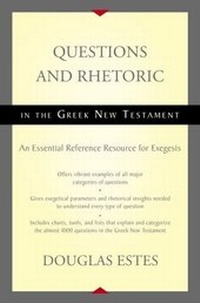
Questions and Rhetoric in the Greek New Testament
Description

While there are almost 1000 questions in the Greek New Testament, many commentators, pastors, and students skip over the questions for more 'theological' verses or worse they convert questions into statements to mine them for what they are saying theologically. However, this is not the way questions in the Greek New Testament work, and it overlooks the rhetorical importance of questions and how they were used in the ancient world.
Questions and Rhetoric in the Greek New Testament is a helpful and thorough examination of questions in the Greek New Testament, seen from the standpoint of grammatical, semantic, and linguistic analysis, with special emphasis on their rhetorical effects. It includes charts, tools, and lists that explain and categorize the almost 1000 questions in the Greek New Testament. Thus, the user is able to go to the section in the book dealing with the type of question they are studying and find the exegetical parameters needed to understand that question.
Questions and Rhetoric in the Greek New Testament offers vibrant examples of all the major categories of questions to aid the reader in grasping how questions work in the Greek New Testament. Special emphasis is given to the way questions persuade and influence readers of the Greek New Testament.
More details
Other editions
Additional editions
Person
Douglas Estes is Assistant Professor of New Testament and Practical Theology and DMin Program Director at South University-Columbia. He received his PhD in Theology from the University of Nottingham, UK, and completed a Post Doc at the Dominican Biblical Institute. He has written or edited six books, as well as numerous essays, articles and reviews. He has served as an adjunct professor at Phoenix Seminary and Western Seminary, and has sixteen years of pastoral ministry experience.
Content
- Cover Page
- Title Page
- Copyright Page
- Dedication
- Contents
- Expanded Table of Contents
- Abbreviations
- Preface
- 1. Introduction
- A. The Question of Questions
- B. The Use of Questions
- C. Questions In the GNT
- D. How to Use This Book
- 2. The Basics of Question Formation
- A. The Parts of Language
- B. Questions and Syntax
- 1. Sentence Formation
- 2. Sentence Function
- 3. Word Order
- 4. Punctuation
- 5. Mood
- 6. Reducibility of Questions
- 7. Particles
- 8. Polarity
- 9. Negation
- 10. ?-Words
- 11. Fronting
- 12. Indirect Questions
- C. Questions and Semantics
- 1. Force
- 2. Bias
- 3. Asking and Saying
- 4. Informational Quality
- 5. Rhetorical Quality
- 6. EGH Principle
- 7. Predicaments
- D. Questions and Pragmatics
- 1. Intonation
- 2. Prosody
- 3. Presupposition
- 4. Implicature
- 5. Genre
- 6. Discourse
- 7. Turn-Taking
- 8. Dialogue
- 9. Rhetorical-Shift Principle
- E. Answers
- 3. Questions Driven By Syntax
- A. Polar Questions
- B. Variable Questions
- C. Alternative Questions
- D. Set Questions
- E. Composite Questions
- 1. Conjunctive Questions
- 2. Disjunctive Questions
- 3. Conditional Questions
- 4. Sluices
- 4. Questions Driven By Semantics
- A. Open Questions
- B. Speculative Questions
- C. Lyric Questions
- D. Deliberative Questions
- E. Aporetic Questions
- F. Sequence Questions
- G. Proof Questions
- H. Means Questions
- I. Indexical Questions
- J. Endoxical Questions
- K. Phatic Questions
- L. Test Questions
- M. Inapposite Questions
- N. Riddle Questions
- O. Dilemma Questions
- P. Counterfactual Questions
- Q. Decision Questions
- R. Confirmation Questions
- S. Request Questions
- T. Negative Polar Questions
- U. Biased Questions
- V. Loaded Questions
- W. Leading Questions
- 5. Questions Driven By Pragmatics
- A. First-Turn Questions
- 1. Governing Questions
- 2. Expository Questions
- B. Second-Turn Questions
- 1. Opposing-Turn Questions
- 2. Focus-Shifting Questions
- 3. Echo Questions
- 4. Repair Questions
- C. Middle-Position Questions
- D. Question Strings
- 1. Double Questions
- 2. Multiple Questions
- 6. The Function of Questions In the Greek New Testament
- A. Narrative Function
- B. Dramatic Function
- C. Rhetorical Function
- D. Dialectical Function
- E. Concluding Thoughts
- Appendix: Semantic Types of Questions
- Glossary
- Bibliography
- Scripture Index
- Ancient Literature Index
- Greek Word Index
- Subject Index
- Modern Author Index
