

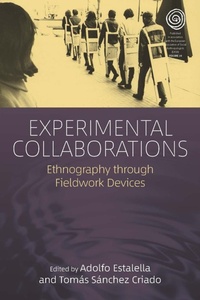
Experimental Collaborations
Description

In the accounts compiled in this book, ethnography occurs through processes of material and social interventions that turn the field into a site for epistemic collaboration. Through creative interventions that unfold what we term as "fieldwork devices"-such as coproduced books, the circulation of repurposed data, co-organized events, authorization protocols, relational frictions, and social rhythms-anthropologists engage with their counterparts in the field in the construction of joint anthropological problematizations. In these situations, the traditional tropes of the fieldwork encounter (i.e. immersion and distance) give way to a narrative of intervention, where the aesthetics of collaboration in the production of knowledge substitutes or intermingles with participant observation. Building on this, the book proposes the concept of "experimental collaborations" to describe and conceptualize this distinctive ethnographic modality.
More details
Other editions
Additional editions

Persons
Adolfo Estalella is Assistant Professor in Social Anthropology at the Department of Social Anthropology and Social Psychology, Complutense University of Madrid. His research focuses on the investigation of grassroots urbanism and digital cultures.
Content
List of Illustrations
Acknowledgements
Foreword: Collaboration Mode 3: A Found Condition of Anthropological Field Research Today... and What Might Be Made of It
George E. Marcus
Introduction: Experimental Collaborations
Tomás Sánchez Criado and Adolfo Estalella
Chapter 1. Experimenting with Data: 'Collaboration' as Method and Practice in an Interdisciplinary Public Health Project
Emma Garnett
Chapter 2. The 'Research Traineeship': The Ups and Downs of Para-siting Ethnography
Maria Schiller
Chapter 3. Finding One's Rhythm: A 'Tour de Force' of Fieldwork on the Road with a Band
Anna Lisa Ramella
Chapter 4. Idiotic Encounters: Experimenting with Collaborations Between Ethnography and Design
Andrea Gaspar
Chapter 5. Fieldwork as Interface: Digital Technologies, Moral Worlds and Zones of Encounter
Karen Waltorp
Chapter 6. Thrown into Collaboration: An Ethnography of Transcript Authorization
Alexandra Kasatkina, Zinaida Vasilyeva, and Roman Khandozhko
Chapter 7. A Cultural Cyclotron: Ethnography, Art Experiments, and a Challenge of Moving Towards the Collaborative in Rural Poland
Tomasz Rakowski
Chapter 8. Making Fieldwork Public: Repurposing Ethnography as a Hosting Platform in Hackney Wick, London
Isaac Marrero-Guillamón
Afterword: Refiguring Collaboration and Experimentation
Sarah Pink
Index
