

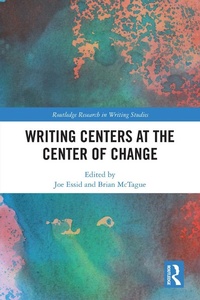
Writing Centers at the Center of Change
1st Edition
Published on 9. September 2019
238 pages
978-0-429-75715-0 (ISBN)
Description

Writing Centers at the Center of Change looks at how eleven centers, internationally, adapted to change at their institutions, during a decade when their very success has become a valued commodity in a larger struggle for resources on many campuses.
Bringing together both US and international perspectives, this volume offers solutions for adapting to change in the world of writing centers, ranging from the logistical to the pedagogical, and even to the existential. Each author discusses the origins, appropriate responses, and partners to seek when change comes from within a school or outside it. Chapters document new programs being formed under changing circumstances, and suggest ways to navigate professional or pedagogical changes that may undermine the hard work of more than four decades of writing-center professionals.
The book's audience includes writing center and learning-commons administrators, university librarians, deans, department chairs affiliated with writing centers. It will also be useful for graduate students in composition, rhetoric, and academic writing.
Bringing together both US and international perspectives, this volume offers solutions for adapting to change in the world of writing centers, ranging from the logistical to the pedagogical, and even to the existential. Each author discusses the origins, appropriate responses, and partners to seek when change comes from within a school or outside it. Chapters document new programs being formed under changing circumstances, and suggest ways to navigate professional or pedagogical changes that may undermine the hard work of more than four decades of writing-center professionals.
The book's audience includes writing center and learning-commons administrators, university librarians, deans, department chairs affiliated with writing centers. It will also be useful for graduate students in composition, rhetoric, and academic writing.
Reviews / Votes
"Essid and McTague's edited collection is more than just a how-to guide to solving writing center challenges with new spaces or initiatives - although it certainly does that. Instead, the rich and diverse collection of voices represented here showcases the bright and creative future of peer-based, collaborative learning. A must for any writing center director." - Scott Whiddon, Transylvania University, USA"Perhaps one of the great unchanging truths about writing centers is that they are always changing. Through intimate glimpses at writing centers from across the globe, this collection not only illuminates the pressures generated by change but also helps us recognize how to use change to propel our writing centers and our work forward." --Mary Lou Odom, Director of the Writing Center and Writing Across the Curriculum Kennesaw State University, USA
More details
Series
Edition
1. Auflage
Language
English
Place of publication
London
United Kingdom
Publishing group
Taylor & Francis Ltd
Target group
College/higher education
ISBN-13
978-0-429-75715-0 (9780429757150)
Copyright in bibliographic data and cover images is held by Nielsen Book Services Limited or by the publishers or by their respective licensors: all rights reserved.
Schweitzer Classification
Other editions
Additional editions
Joe Essid | Brian McTague
Writing Centers at the Center of Change
Book
09/2021
1st Edition
Routledge
€67.10
Shipment within 10-20 days
Joe Essid | Brian McTague
Writing Centers at the Center of Change
Book
09/2019
1st Edition
Routledge
€207.60
Shipment within 10-20 days
Persons
Joe Essid, University of Richmond, studies the role of writing centers in curriculum development and the transition to college writing. He co-edited Identity and Leadership in Virtual Communities: Establishing Credibility & Influence. Hershey, PA: IGI Global, 2013. His articles have appeared in Kairos, Writing Lab Newsletter, and Educause Quarterly.
Brian McTague has been the director of the Virginia Commonwealth University Writing Center since 2013. His pedagogical interests include reflective and creative academic writing, teaching writing to non-traditional students, such as those with learning differences, and making writing education accessible to all, including via the community writing center model.
Brian McTague has been the director of the Virginia Commonwealth University Writing Center since 2013. His pedagogical interests include reflective and creative academic writing, teaching writing to non-traditional students, such as those with learning differences, and making writing education accessible to all, including via the community writing center model.
Content
I: New or Reimagined Spaces Chapter One: Sharing Space and Finding Common Ground: A Practical Guide to Creating Effective Writing Center/Library Partnerships Chapter Two: The Writing Center Speaks Up: On Dissonance, Collaboration, and Harmonization With the Learning Commons Chorus Chapter Three: Online Tutoring: From Writing Center to Virtual Education Hub II: New Missions Chapter Four: The Writing Center in The Writing Program - Peer Tutoring Across Disciplines And Languages Chapter Five: At the Centre of Changing Contexts: A Writing for Life Centre Chapter Six: Black in the Writing Center: Race, Representation and the Post-Racial Lie Chapter Seven: Making Good on the Promise: A Community College in Virginia Collaborates with a Technical Secondary School in Buenos Aires, Argentina to Grow Student Success III: Contested Missions, Contested Spaces Chapter Eight: I Feel the Earth Move Under My Feet Chapter Nine: When The Story Of The University Changes - What Happens To The Mission Of The Writing Center? Chapter Ten: From Writing Center to Writing Program? Transdisciplinarity as a Means to Institutional Credibility and Support Chapter Eleven: Negotiating the Complexities of Being A Part of and Apart From
