

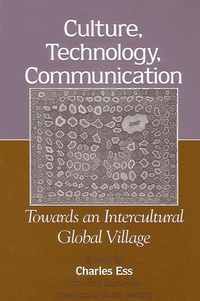
Culture, Technology, Communication
Description

Stability and success in our electronic global village increasingly depends on the complex interactions of culture, communication, and technology. This book offers both theoretical approaches and case studies of these interactions from diverse cultural domains, including Europe, the Middle East, Asia, and the United States. This global perspective helps to counteract the Anglo-American presumptions that have dominated discussion and literature on computer-mediated communication (CMC) technologies. The contributors uncover and challenge the culture-bound values and communicative preferences inherent in CMC technologies-including values and preferences related to gender-and also document non-Western examples of implementing these technologies in ways that catalyze global communication while preserving and enhancing local cultures. Taken together, these essays articulate the interdisciplinary foundations and practical models necessary to design and use CMC technologies in ways that help us to avoid the choice between a global but culturally homogenous "McWorld" and fragmented local cultures whose identities are preserved only in their opposition to globalization.
Charles Ess is Professor of Philosophy and Religion and Director of the Center for Interdisciplinary Studies, Drury University, and editor of Philosophical Perspectives on Computer-Mediated Communication, also published by SUNY Press. Fay Sudweeks is Senior Lecturer in Information Systems at Murdoch University.
More details
Other editions
Additional editions
Person
Charles Ess is Professor of Philosophy and Religion and Director of the Center for Interdisciplinary Studies, Drury University, and editor of Philosophical Perspectives on Computer-Mediated Communication, also published by SUNY Press. Fay Sudweeks is Senior Lecturer in Information Systems at Murdoch University.
Content
Foreword
Acknowledgments
Introduction: What's Culture Got to Do with It? Cultural Collisions in the Electronic Global Village, Creative Interferences, and the Rise of Culturally-Mediated Computing
Charles Ess
I. Theoretical Approaches:
Postmodernism, Habermas, Luhmann, Hofstede
Understanding Micropolis and Compunity
Steve Jones
Electronic Networks and Civil Society: Reflections on Structural Changes in the Public Sphere
Barbara Becker and Josef Wehner
National Level Culture and Global Diffusion: The Case of the Internet
Carleen F. Maitland and Johannes M. Bauer
II. Theory/Praxis
a. Europe
New Kids in the Net: Deutschsprachige Philosophie elektronish
Herbert Hrachovec
Cultural Attitudes toward Technology and Communication: A Study in the "Multi-cultural" Environment of Switzerland
Lucienne Rey
b. Gender/Gender and Muslim World
Diversity in On-Line Discussions: A Study of Cultural and Gender Differences in Listservs
Concetta Stewart, Stella F. Shields, Nandini Sen
New Technologies, Old Culture: A Look at Women, Gender, and the Internet in Kuwait
Deborah Wheeler
c. East-West/East
Preserving Communication Context: Virtual Workspace and Interpersonal Space in Japanese CSCW
Lorna Heaton
Internet Discourse and the Habitus of Korea's New Generation
Sunny Yoon
"Culture," Computer Literacy, and the Media in Creating Public Attitudes toward CMC in Japan and Korea
Robert J. Fouser
III. Cultural Collisions and Creative Interferences on the (Silk) Road to the Global Village: India and Thailand
Language, Power, and Software
Kenneth Keniston
Global Culture, Local Cultures, and the Internet: The Thai Example
Soraj Hongladarom
Contriibutors
Index
