

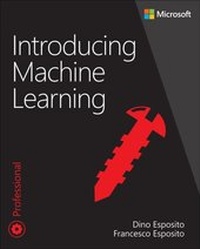
Introducing Machine Learning
1st Edition
Published on 10. March 2021
400 pages
978-0-13-558838-3 (ISBN)
Description

Master machine learning concepts and develop real-world solutions
Machine learning offers immense opportunities, and Introducing Machine Learning delivers practical knowledge to make the most of them. Dino and Francesco Esposito start with a quick overview of the foundations of artificial intelligence and the basic steps of any machine learning project. Next, they introduce Microsoft's powerful ML.NET library, including capabilities for data processing, training, and evaluation. They present families of algorithms that can be trained to solve real-life problems, as well as deep learning techniques utilizing neural networks. The authors conclude by introducing valuable runtime services available through the Azure cloud platform and consider the long-term business vision for machine learning.
? 14-time Microsoft MVP Dino Esposito and Francesco Esposito help you
? Explore what's known about how humans learn and how intelligent software is built
? Discover which problems machine learning can address
? Understand the machine learning pipeline: the steps leading to a deliverable model
? Use AutoML to automatically select the best pipeline for any problem and dataset
? Master ML.NET, implement its pipeline, and apply its tasks and algorithms
? Explore the mathematical foundations of machine learning
? Make predictions, improve decision-making, and apply probabilistic methods
? Group data via classification and clustering
? Learn the fundamentals of deep learning, including neural network design
? Leverage AI cloud services to build better real-world solutions faster
About This Book
? For professionals who want to build machine learning applications: both developers who need data science skills and data scientists who need relevant programming skills
? Includes examples of machine learning coding scenarios built using the ML.NET library
Machine learning offers immense opportunities, and Introducing Machine Learning delivers practical knowledge to make the most of them. Dino and Francesco Esposito start with a quick overview of the foundations of artificial intelligence and the basic steps of any machine learning project. Next, they introduce Microsoft's powerful ML.NET library, including capabilities for data processing, training, and evaluation. They present families of algorithms that can be trained to solve real-life problems, as well as deep learning techniques utilizing neural networks. The authors conclude by introducing valuable runtime services available through the Azure cloud platform and consider the long-term business vision for machine learning.
? 14-time Microsoft MVP Dino Esposito and Francesco Esposito help you
? Explore what's known about how humans learn and how intelligent software is built
? Discover which problems machine learning can address
? Understand the machine learning pipeline: the steps leading to a deliverable model
? Use AutoML to automatically select the best pipeline for any problem and dataset
? Master ML.NET, implement its pipeline, and apply its tasks and algorithms
? Explore the mathematical foundations of machine learning
? Make predictions, improve decision-making, and apply probabilistic methods
? Group data via classification and clustering
? Learn the fundamentals of deep learning, including neural network design
? Leverage AI cloud services to build better real-world solutions faster
About This Book
? For professionals who want to build machine learning applications: both developers who need data science skills and data scientists who need relevant programming skills
? Includes examples of machine learning coding scenarios built using the ML.NET library
All prices
More details
Series
Edition
1. Auflage
Language
English
Place of publication
Boston
United States
Publishing group
Pearson Education (US)
Target group
Professional and scholarly
File size
10,76 MB
ISBN-13
978-0-13-558838-3 (9780135588383)
Copyright in bibliographic data and cover images is held by Nielsen Book Services Limited or by the publishers or by their respective licensors: all rights reserved.
Schweitzer Classification
Other editions
Additional editions
Dino Esposito | Francesco Esposito
Introducing Machine Learning
Book
05/2020
1st Edition
Addison Wesley
€31.99
Shipment within 15-20 days
Persons
Dino Esposito: If I look back, I count more 20 books authored and 1000+ articles in a 25-year-long career. I've been writing the "Cutting Edge" column for MSDN Magazine month after month for 22 consecutive years. It is commonly recognized that such books and articles have helped the professional growth of thousands of .NET and ASP.NET developers and software architects worldwide.
After I escaped a dreadful COBOL project, in 1992 I started as a C developer, and since then, I have witnessed MFC and ATL, COM and DCOM, the debut of .NET, the rise and fall of Silverlight, and the ups and downs of various architectural patterns. In 1995 I led a team of five dreamers who actually deployed things that today we would call Google Photos and Shuttershock-desktop applications capable of dealing with photos stored in a virtual place that nobody had called the cloud yet. Since 2003 I have written Microsoft Press books about ASP.NET and also authored the bestseller Microsoft .NET: Architecting Applications for the Enterprise. I have a few successful Pluralsight courses on .NET architecture, ASP.NET MVC UI, and, recently, ML.NET. As architect of most of the backoffice applications that keep the professional tennis world tour running, I've been focusing on renewable energy, IoT, and artificial intelligence for the past two years as the corporate digital strategist at BaxEnergy.
You can get in touch with me through https://youbiquitous.net or twitter.com/despos, or you can connect to my LinkedIn network.
Francesco Esposito: I was 12 or so in the early days of the Windows Phone launch, and I absolutely wanted one of those devices in my hands. I could have asked Dad or Mom to buy it, but I didn't know how they would react. As a normal teenager, I had exactly zero chance of having someone buy it for me. So, I found out I was quite good at making sense of programming languages and impressed some folks at Microsoft enough to have a device to test. A Windows Phone was only the beginning; then came my insane passion for iOS and, later, the shortcuts of C#.
The current part of my life began when I graduated from high school, one year earlier than expected. By the way, only 0.006 percent of students do that in Italy. I felt as powerful as a semi-god and enrolled in mathematics. I failed my first exams, and the shock put me at work day and night on ASP.NET as a self punishment. I founded my small software company, Youbiquitous, and began living on my own money. In 2017, my innate love for mathematics was resurrected and put me back on track with studies and led me to take the plunge in financial investments and machine learning.
This book, then, is the natural consequence of the end of my childhood. I wanted to give something back to my dad and help him make sense of the deep mathematics behind neural networks and algorithms. By the way, I have a dream: developing a supertheory of intelligence that would mathematically explore why the artificial intelligence of today works and where we can go further.
You can get in touch with me at https://youbiquitous.net.
After I escaped a dreadful COBOL project, in 1992 I started as a C developer, and since then, I have witnessed MFC and ATL, COM and DCOM, the debut of .NET, the rise and fall of Silverlight, and the ups and downs of various architectural patterns. In 1995 I led a team of five dreamers who actually deployed things that today we would call Google Photos and Shuttershock-desktop applications capable of dealing with photos stored in a virtual place that nobody had called the cloud yet. Since 2003 I have written Microsoft Press books about ASP.NET and also authored the bestseller Microsoft .NET: Architecting Applications for the Enterprise. I have a few successful Pluralsight courses on .NET architecture, ASP.NET MVC UI, and, recently, ML.NET. As architect of most of the backoffice applications that keep the professional tennis world tour running, I've been focusing on renewable energy, IoT, and artificial intelligence for the past two years as the corporate digital strategist at BaxEnergy.
You can get in touch with me through https://youbiquitous.net or twitter.com/despos, or you can connect to my LinkedIn network.
Francesco Esposito: I was 12 or so in the early days of the Windows Phone launch, and I absolutely wanted one of those devices in my hands. I could have asked Dad or Mom to buy it, but I didn't know how they would react. As a normal teenager, I had exactly zero chance of having someone buy it for me. So, I found out I was quite good at making sense of programming languages and impressed some folks at Microsoft enough to have a device to test. A Windows Phone was only the beginning; then came my insane passion for iOS and, later, the shortcuts of C#.
The current part of my life began when I graduated from high school, one year earlier than expected. By the way, only 0.006 percent of students do that in Italy. I felt as powerful as a semi-god and enrolled in mathematics. I failed my first exams, and the shock put me at work day and night on ASP.NET as a self punishment. I founded my small software company, Youbiquitous, and began living on my own money. In 2017, my innate love for mathematics was resurrected and put me back on track with studies and led me to take the plunge in financial investments and machine learning.
This book, then, is the natural consequence of the end of my childhood. I wanted to give something back to my dad and help him make sense of the deep mathematics behind neural networks and algorithms. By the way, I have a dream: developing a supertheory of intelligence that would mathematically explore why the artificial intelligence of today works and where we can go further.
You can get in touch with me at https://youbiquitous.net.
Content
Chapter 1 How Humans Learn
Chapter 2 Intelligent Software
Chapter 3 Mapping Problems and Algorithms
Chapter 4 General Steps for a Machine Learning Solution
Chapter 5 The Data Factor
Chapter 6 The .NET Way
Chapter 7 Implementing the ML.NET Pipeline
Chapter 8 ML.NET Tasks and Algorithms
Chapter 9 Math Foundations of Machine Learning
Chapter 10 Metrics of Machine Learning
Chapter 11 How to Make Simple Predictions: Linear Regression
Chapter 12 How to Make Complex Predictions and Decisions: Trees
Chapter 13 How to Make Better Decisions: Ensemble Methods
Chapter 14 Probabilistic Methods: Naive Bayes
Chapter 15 How to Group Data: Classification and Clustering
Chapter 16 Feed-Forward Neural Networks
Chapter 17 Design of a Neural Network
Chapter 18 Other Types of Neural Networks
Chapter 19 Sentiment Analysis: An End-to-End Solution
Chapter 20 AI Cloud Services for the Real World
Chapter 21 The Business Perception of AI
Chapter 2 Intelligent Software
Chapter 3 Mapping Problems and Algorithms
Chapter 4 General Steps for a Machine Learning Solution
Chapter 5 The Data Factor
Chapter 6 The .NET Way
Chapter 7 Implementing the ML.NET Pipeline
Chapter 8 ML.NET Tasks and Algorithms
Chapter 9 Math Foundations of Machine Learning
Chapter 10 Metrics of Machine Learning
Chapter 11 How to Make Simple Predictions: Linear Regression
Chapter 12 How to Make Complex Predictions and Decisions: Trees
Chapter 13 How to Make Better Decisions: Ensemble Methods
Chapter 14 Probabilistic Methods: Naive Bayes
Chapter 15 How to Group Data: Classification and Clustering
Chapter 16 Feed-Forward Neural Networks
Chapter 17 Design of a Neural Network
Chapter 18 Other Types of Neural Networks
Chapter 19 Sentiment Analysis: An End-to-End Solution
Chapter 20 AI Cloud Services for the Real World
Chapter 21 The Business Perception of AI
