

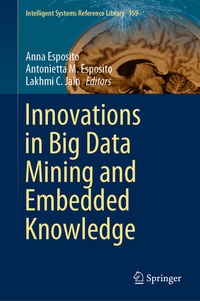
Innovations in Big Data Mining and Embedded Knowledge
Description

This book addresses the usefulness of knowledge discovery through data mining. With this aim, contributors from different fields propose concrete problems and applications showing how data mining and discovering embedded knowledge from raw data can be beneficial to social organizations, domestic spheres, and ICT markets.
Data mining or knowledge discovery in databases (KDD) has received increasing interest due to its focus on transforming large amounts of data into novel, valid, useful, and structured knowledge by detecting concealed patterns and relationships.
The concept of knowledge is broad and speculative and has promoted epistemological debates in western philosophies. The intensified interest in knowledge management and data mining stems from the difficulty in identifying computational models able to approximate human behaviors and abilities in resolving organizational, social, and physical problems. Current ICT interfaces are not yet adequately advanced to support and simulate the abilities of physicians, teachers, assistants or housekeepers in domestic spheres. And unlike in industrial contexts where abilities are routinely applied, the domestic world is continuously changing and unpredictable. There are challenging questions in this field: Can knowledge locked in conventions, rules of conduct, common sense, ethics, emotions, laws, cultures, and experiences be mined from data? Is it acceptable for automatic systems displaying emotional behaviors to govern complex interactions based solely on the mining of large volumes of data?
Discussing multidisciplinary themes, the book proposes computational models able to approximate, to a certain degree, human behaviors and abilities in resolving organizational, social, and physical problems.
The innovations presented are of primary importance for:
a. The academic research community
b. The ICT market
c. Ph.D. students and early stage researchers
d. Schools, hospitals, rehabilitation and assisted-living centers
e. Representatives from multimedia industries and standardization bodies
Reviews / Votes
"Presenting the problems as well as solutions in a lucid manner makes this book unique. . As for the presentation, the book is the most readable and its narration is lively. Overall, this is a good book that could benefit big data mining researchers, practitioners, and anyone who wants to learn something about big data mining and embedded knowledge. Above all the book fulfils its purpose of making innovations in embedded knowledge applicable in a very efficient manner." (Jhimli Adhikari, Intelligent Decision Technologies, Vol. 15, 2021)
More details
Other editions
Additional editions
Content
Designing a Recommender System for Touristic Activities in a Big Data as a Service Platform.- A Scalable, Transparent Meta-Learning Paradigm for Big Data Applications.- Towards Addressing the Limitations of Educational Policy based on International Large-scale Assessment Data with Castoriadean Magmas.- What do Prospective Students Want? An Observational Study of Preferences About Subject of Study in Higher Education.- Speech Pause Patterns in Collaborative Dialogs.
