

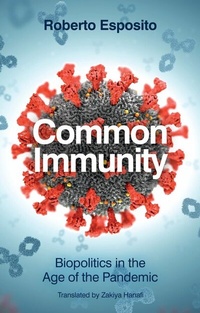
Common Immunity
Description

To understand the ambivalent effects of this development, it is necessary to go back to its modern genesis, when the languages of law, politics, and medicine began to merge into the biopolitical regime we have been living under for some time. This regime places a high priority on immunization and security: no security is more important than health security. The Covid-19 pandemic has taken the dynamic of immunization to a new level: for the first time in history, we see societies seeking to achieve generalized immunity in their entire populations through vaccination. This allows us to glimpse the possibility of a "common immunity" that strengthens the relation between community and immunity. The dramatic tensions we have experienced in recent years between security and freedom, norm and exception, power and existence, all refer to the complex relationship between community and immunity, the decisive features of which are reconstructed in this book.
Building on the prescient argument originally developed two decades ago in Immunitas, Roberto Esposito demonstrates in this new book how the pandemic and our responses to it have brought into sharp relief the fundamental biopolitical conditions of our contemporary societies.
More details
Other editions
Additional editions
Persons
Zakiya Hanafi is an independent scholar based in Seattle, Washington.
Content
i. Contaminations
ii. Auto-"Immunitarian" Democracy
iii. In the Time of Biopolitics
iv. Philosophies of Immunity
v. Pandemic Policies
Notes
1
Contaminations
1
My research on this topic began with the assumption that "community" and "immunity" are so tightly bound together that they can never be thought of separately. Although I wrote individual books on each concept - titled respectively Communitas1 and Immunitas2 - I approached them from the perspective of their original relationship. In reality, even to speak of a "relationship" may be reductive of a more intrinsic connection, which points instead to a kind of contradictory copresence. Community and immunity are two sides of a single semantic block, which acquires meaning precisely from their tension. This semantic inextricability is made evident, on the etymological plane as well, by their shared lemma - the Latin polysemous noun munus, with its meanings "obligation," "burden," and "duty," but also "gift." From it derive both communitas and immunitas - the former directly and affirmatively, the latter in a negative or privative form. While members of a communitas - which, in its broadest application, embraces all human beings - share a donative obligation toward others, those who declare themselves, or are declared, immunes ("free from") are exempt from it. Their only relationship with communitas is through exemption: as Latin dictionaries tell us, the immune are those who are exempt a muneribus - from the obligations (munera) that others take on. But, rather than focusing on exemption from munus in order to grasp the most distinctive meaning of immunitas, we do better to look at the fundamental contrast between it and communitas: according to the same dictionaries, he who does not perform the offices that omnibus communia sunt - "are common to everyone" - is said to be immune. So, more than being free from the burden of munus, immune signifies not being common: someone who is immune breaks the donative circuit implicit in communitas, relating to it as a negative relates to a positive. Immunitas is expressed only in relation to that which it negates or from which it removes itself. If there were no pre-existing, common munus to honor - no collective commitment to fulfil - there would be no possibility of exoneration either. To place oneself in a situation of distinction or privilege, one must necessarily presuppose a general condition from which to detach oneself. If there were no common bond to be released from, the very meaning of immunity would be lost.
When we emphasize immunity's negative character, however, we should not attribute it solely to the fundamental contrast with community but also, as noted earlier, to its negative mode of action. From this point of view, alongside the juridical meaning of exemption from a particular law, we must also turn to the biomedical sense of the word, namely protection from an infectious disease. As we know, in the phenomenon of natural or acquired immunity, the practice of vaccination involves incorporating a fragment of the illness that we want to protect ourselves from: the presence of the antigen is what activates the biological organism's protective antibodies. Recalling the ambivalent meaning of the ancient pharmakon, we might say that the medicine is mixed with the poison, consumed in a dosage compatible with the body's health. Here again we see the productive role of negation, used sustainably to confront a greater negative: death. The western philosophical tradition has invented countless variations of the negative, of which Hegel's dialectic is the best known. But perhaps none has a richer semantic profile than the enigmatic figure of the katechon, which is used by Paul the Apostle in his letters and, not surprisingly, reappears with various meanings throughout modern and contemporary political theology. Like the immune process, the katechon is the shield, the brake that resists the supreme evil - the apocalypse - not by directly opposing it but, on the contrary, by incorporating and holding it in itself. This explains its intrinsic connection with the immune dispositif. Like the katechon, the latter, too, has a negative mode of action. Actually it is doubly negative: posited already as the reverse of communitas, it cares for the community not directly but by using a portion of the evil from which it seeks to save it. This is how immunity turns out to be inextricably bound to its opposite. It exists only in relation to the community, which it protects and contradicts at the same time.
But this is only the first side of the issue; it must be completed by the other, inverse and complementary side. Just as, logically, there can be no immunity without community, in the same way, historically, there can be no community without immunity. To understand this interdependence, we must return to the original meaning of communitas as a reciprocal gift. As a purely donative relationship, it is formed not by subjects united through the same belonging but, on the contrary, by what puts their respective identities at risk. From this point of view, understood in its most universal mode, communitas is different from, and actually opposite to, the identity-making communities associated with today's neocommunitarianism. Unlike them, it relates not so much to something owned - a property - as to an expropriation, a lack of what is one's own or "proper." This makes it elusive theoretically - and even more so historically: a community of this sort is incapable of existing, hence the need to relate it to an immune dispositif that, by denying an unlimited opening for it, makes it historically possible and recognizable. For this lack of substance, this "nothing in common," to manifest itself in reality, it must be partially filled up by its opposite. This means that, once the concept of communitas, in itself undifferentiated, is plunged into historical reality, it always requires some form of immunization that allows it to endure in time. Without an immune system to defend it, no body politic could survive any more than a human body the dangers that threaten it from within and from without.
When Ferdinand Tönnies opposed community to society3 as ideal types of social groups, in reality he inferred community from society, as its negative form. That kind of community was simply a society conceived of in reverse. In the historical reality, all societies are immunized to a greater or lesser degree. For good reason, the community he described had all the closed and defensive characteristics of immunity. In effect there is no such thing as communities without immune mechanisms; without them they would not survive the test of time. In this sense, far from being a simple opposite, immunization is the destiny or precondition of every community. Whatever one may wish for, historical communities are always determined by boundaries, external and internal: external, to distinguish them from other communities, and internal, to structure their population in groups based on different ranks, power, and wealth. No society, even the most homogeneous, has known absolute parity between its members, which is why immunization is not a subjective option for any body politic but rather a structural given. It cuts through the community along lines of inclusion and exclusion that, by qualifying its members socially and politically, make them different from one another.
For this reason, the copresence of community and immunity is essentially problematic. In essence it contradicts the meaning of each, understood in its purity. The idea that immunization constitutes the historical mode of every community is at odds with the original meaning of community as an undifferentiated opening, pressing it hard against its opposite. To this inevitable antinomy we owe the tension that courses through every community, exposing it to continuous conflict over the ways and forms of its immunization. Immunization takes on different gradations, which distinguish different societies. No society, except a totalitarian one, is ever entirely immunized. Their degree of immunization depends on external events and internal power relations. Politics can also be defined as the activity that regulates - intensifies or mitigates - the immunization processes in various social environments. To be realistic, it must assume that the immune process is inevitable; and it must seek to mitigate it as much as possible. Only by knowing the limit that runs through a community can politics limit that limit still further, thereby preventing the immune dispositif from breaking the common bond and drifting toward an autoimmune tendency. There is always a limit point, a threshold, beyond which the immune process, inward- and outward-facing, tends to grow until it disrupts the equilibrium with its own common measure, giving rise to something similar to an autoimmune disease. When viewed from this angle, community and immunity are impossible to conceive of outside the aporetic node that their copresence creates.
2
In the first book I wrote on immunity, which the present one develops, I highlighted the fruitfulness of the immune paradigm in defining biopolitics. It fills in the gap between the words "life" and "politics" that Foucault had left open to some extent - a point...
