

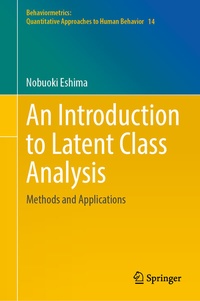
An Introduction to Latent Class Analysis
Description

This book provides methods and applications of latent class analysis, and the following topics are taken up in the focus of discussion: basic latent structure models in a framework of generalized linear models, exploratory latent class analysis, latent class analysis with ordered latent classes, a latent class model approach for analyzing learning structures, the latent Markov analysis for longitudinal data, and path analysis with latent class models. The maximum likelihood estimation procedures for latent class models are constructed via the expectation-maximization (EM) algorithm, and along with it, latent profile and latent trait models are also treated. Entropy-based discussions for latent class models are given as advanced approaches, for example, comparison of latent classes in a latent class cluster model, assessing latent class models, path analysis, and so on. In observing human behaviors and responses to various stimuli and test items, it is valid to assume they are dominated by certain factors. This book plays a significant role in introducing latent structure analysis to not only young researchers and students studying behavioral sciences, but also to those investigating other fields of scientific research.
More details
Other editions
Additional editions
Person
Nobuoki Eshima was born in Fukuoka, Japan, in 1957. He was received B.Sc. and D.Sc. degrees in Mathematics from Kyushu University, Fukuoka, Japan, in 1980 and 1993, respectively. In 1993, he joined Department of Statistics, Faculty of General Education, Nagasaki University, as Associate Professor. In 1996, he joined Department of Medical Information Analysis, Faculty of Medicine, Oita Medical University, as Professor. In 2016, he joined Center for Educational Outreach and Admissions, Kyoto University, as Professor. In 2021, he was granted the title of Emeritus Professor of Oita University, and from 2021, he is Guest Professor of Faculty of Medicine, Kurume University.
