

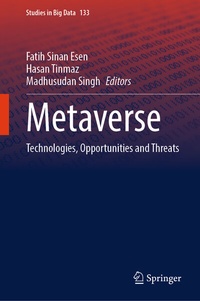
Metaverse
Description

This book has a multidisciplinary approach to Metaverse studies and the relevance of Metaverse with the current and popular topics that concern society and how it will change them in the future. In addition, academic texts are included since not much scientific content is available in this field. In short, there are sections in the book that everyone will find useful. Most importantly, the topics are grouped under four main parts. The first is the Introduction, where the main issues are explained. In the second section-Technical Topics, the technological infrastructure of the subject is explained, followed by section three where the social and human dimensions of Metaverse are explained. The fourth and final section is on Industrial Applications.
More details
Other editions
Additional editions
Persons
Dr. Fatih Sinan Esen received his undergraduate degree in Computer Engineering from Bilkent University in 2006. He completed his master's (MBA) in Istanbul Bilgi University. He obtained his doctoral degree from Gazi University, Department of Business Administration. He is currently working on his second Ph.D. in the field of artificial intelligence and natural language processing (NLP) at Ankara University, Computer Engineering Department. He works on national/international monitoring of information and communication technologies (ICT), policy development, and coordination of national strategies. His research interests are in the areas of computer literacy, research methods, expert systems, and artificial neural networks.
Hasan Tinmaz completed his undergraduate studies at Middle East Technical University (Ankara, Turkiye) in the Faculty of Education, Computer Education Department in 2001. He graduated from the same university's Graduate Program in Curriculum and Instruction in 2004. After completing his doctoral studies with a thesis on the uses, gratification, and integration of social media in Middle East Technical University's Computer Education and Instructional Technologies program, he currently works as an assistant professor in the AI & Big Data department of Endicott College of International Studies at Woosong University (Daejeon, South Korea). His research areas include social media, educational technology, curriculum and instruction design, technology management, psychological and sociological issues in technology, technology planning, Industry 4.0, artificial intelligence, and Metaverse.Dr. Madhusudan Singh received his M. Tech. degree in software engineering from the Indian Institute of Information Technology, Allahabad (IIIT-A), and Ph.D. in Ubiquitous IT from Dongseo University, Busan, South Korea, in 2012, after which he worked as Senior Research Engineer at Samsung Display, followed by Research Professor, Yonsei Institute of Convergences Technology, Yonsei University, South Korea. He was also Assistant Professor in the Dept. of AI and Big Data at Woosong University, South Korea. Currently, he is working as Assistant Professor in the Department of Management (IT/Cybersecurity Track) in the College of Engineering, Technology Management, (ETM) at Oregon Institute of Technology (Oregon Tech) University, Oregon, USA. His research interests include Quantum Computing, Blockchain Technology, Metaverse Data Security, AI, Data Science, Information Security, and HCI.
Content
Introduction.- Technologies.- Social Topics.- Industrial Applications.
