

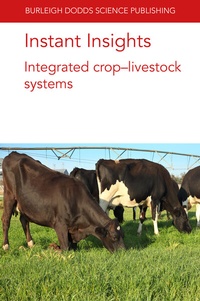
Instant Insights: Integrated Crop-Livestock Systems
Published on 15. June 2021
172 pages
978-1-80146-160-3 (ISBN)
Description

This collection features four peer-reviewed literature reviews on integrated crop-livestock systems in agriculture.
The first chapter reviews the use of integrated crop-livestock systems to achieve balance in organic animal farming. The chapter focusses primarily on the use of agroforestry systems, their potential environmental and economic benefits, as well as how they contribute to animal health and welfare.
The second chapter examines the different state-of-the-art integrated crop-livestock systems in various eco-regions worldwide under Conservation Agriculture. As a world leader in the adoption of integrated crop-livestock systems, a substantial part of the chapter is dedicated to the research and adoption of these systems in Brazil.
The third chapter illustrates how crop-livestock systems contribute to improving global food security and diversifying the diets of smallholder livelihoods. The chapter explores the climate resilience of these systems and the mitigation strategies developed and implemented by farmers to deal with climate variability.
The final chapter discusses the development of whole-farm system models to understand the complexity of integrated crop-livestock systems. The chapter assesses the key processes governing interactions between farm components and provides two examples of common whole-farm model applications from contrasting environments to demonstrate this.
The first chapter reviews the use of integrated crop-livestock systems to achieve balance in organic animal farming. The chapter focusses primarily on the use of agroforestry systems, their potential environmental and economic benefits, as well as how they contribute to animal health and welfare.
The second chapter examines the different state-of-the-art integrated crop-livestock systems in various eco-regions worldwide under Conservation Agriculture. As a world leader in the adoption of integrated crop-livestock systems, a substantial part of the chapter is dedicated to the research and adoption of these systems in Brazil.
The third chapter illustrates how crop-livestock systems contribute to improving global food security and diversifying the diets of smallholder livelihoods. The chapter explores the climate resilience of these systems and the mitigation strategies developed and implemented by farmers to deal with climate variability.
The final chapter discusses the development of whole-farm system models to understand the complexity of integrated crop-livestock systems. The chapter assesses the key processes governing interactions between farm components and provides two examples of common whole-farm model applications from contrasting environments to demonstrate this.
More details
Series
Language
English
Place of publication
Cambridge
United Kingdom
Target group
College/higher education
Professional and scholarly
Illustrations
Color tables, photos and figures
File size
9,76 MB
ISBN-13
978-1-80146-160-3 (9781801461603)
DOI
10.19103/9781801461603
Copyright in bibliographic data and cover images is held by Nielsen Book Services Limited or by the publishers or by their respective licensors: all rights reserved.
Schweitzer Classification
Other editions
Additional editions
Alfredo J. Escribano | J. Ryschawy | Lindsay Whistance
Instant Insights: Integrated Crop-Livestock Systems
Integrated crop-livestock systems
Book
06/2021
Burleigh Dodds Science Publishing Limited
€69.40
Shipment within 3-4 weeks
Persons
Dr Lindsay Whistance is Senior Livestock Researcher at the Organic Research Centre in the UK. She is internationally known for her research on farm animal behaviour, health, welfare and nutrition in organic agriculture.
Content
Chapter 1 - Integrated crop/livestock systems with agroforestry to improve organic animal farming: A. J. Escribano, Nutrion Internacional, Spain; J. Ryschawy, University of Toulouse, France; and L. K. Whistance, The Organic Research Centre, UK; 1 Introduction 2 Types of ICLS 3 Environmental and economic benefits of ICLS 4 Agroforestry as an ICLS 5 Animals in agroforestry systems 6 Trees as a source of nutrition and medicine 7 Challenges in integrated livestock and forestry systems 8 Conclusion 9 Where to look for further information 10 References
Chapter 2 - Integration of crop-livestock in Conservation Agriculture systems: John N. Landers, Independent Consultant, Brazil; Pedro Luiz de Freitas, Embrapa Solos, Brazil; Luiz Carlos Balbino, Embrapa Cerrados, Brazil; Julio Cesar Salton, Embrapa Agropecuaria Oeste, Brazil; and Robelio Leandro Marchao, Embrapa Cerrados, Brazil; 1 Introduction 2 Basic principles of integrated crop-livestock systems in CA 3 Basic principles of ley farming 4 Integrated crop-livestock management (ICL-CA) systems: ley farming systems 5 Systems involving forestry (ICL-CA(F)) 6 Non-ley integrated farming systems 7 Area integration systems 8 Interactions in integrated crop-livestock systems 9 Adoption of ICL-CA and ICL-CA(F) systems 10 Policy considerations 11 References
Chapter 3 - The contribution of integrated crop-livestock systems in combatting climate change and improving resilience in agricultural production to achieve food security: Mark van Wijk and James Hammond, International Livestock Research Institute, Kenya; Simon Fraval, International Livestock Research Institute, Kenya and Wageningen University, The Netherlands; Jannike Wichern, Wageningen University, The Netherlands; Randall Ritzema, Olivet Nazarene University, USA; and Ben Henderson, Natural Resources Policy, Organisation for Economic Co-operation and Development (OECD), France; 1 Introduction 2 A short overview of analyses and approaches focussing on climate change and mixed crop-livestock systems 3 Agricultural production, consumption, sale and food security 4 Current methods used by farmers in mixed crop-livestock systems to deal with climate variability 5 Possible methods of assessing climate change adaptation options 6 Conclusion 7 Where to look for further information 8 References
Chapter 4 - Integrating livestock production into whole-farm system models of mixed crop-livestock systems: Katrien Descheemaeker, Wageningen University and Research, The Netherlands; and Lindsay Bell, CSIRO Agriculture Flagship, Australia; 1 Introduction 2 Key features of crop-livestock systems 3 Dynamic simulation models of whole-farm systems including livestock 4 Crop-livestock model applications 5 Conclusion 6 References
Chapter 2 - Integration of crop-livestock in Conservation Agriculture systems: John N. Landers, Independent Consultant, Brazil; Pedro Luiz de Freitas, Embrapa Solos, Brazil; Luiz Carlos Balbino, Embrapa Cerrados, Brazil; Julio Cesar Salton, Embrapa Agropecuaria Oeste, Brazil; and Robelio Leandro Marchao, Embrapa Cerrados, Brazil; 1 Introduction 2 Basic principles of integrated crop-livestock systems in CA 3 Basic principles of ley farming 4 Integrated crop-livestock management (ICL-CA) systems: ley farming systems 5 Systems involving forestry (ICL-CA(F)) 6 Non-ley integrated farming systems 7 Area integration systems 8 Interactions in integrated crop-livestock systems 9 Adoption of ICL-CA and ICL-CA(F) systems 10 Policy considerations 11 References
Chapter 3 - The contribution of integrated crop-livestock systems in combatting climate change and improving resilience in agricultural production to achieve food security: Mark van Wijk and James Hammond, International Livestock Research Institute, Kenya; Simon Fraval, International Livestock Research Institute, Kenya and Wageningen University, The Netherlands; Jannike Wichern, Wageningen University, The Netherlands; Randall Ritzema, Olivet Nazarene University, USA; and Ben Henderson, Natural Resources Policy, Organisation for Economic Co-operation and Development (OECD), France; 1 Introduction 2 A short overview of analyses and approaches focussing on climate change and mixed crop-livestock systems 3 Agricultural production, consumption, sale and food security 4 Current methods used by farmers in mixed crop-livestock systems to deal with climate variability 5 Possible methods of assessing climate change adaptation options 6 Conclusion 7 Where to look for further information 8 References
Chapter 4 - Integrating livestock production into whole-farm system models of mixed crop-livestock systems: Katrien Descheemaeker, Wageningen University and Research, The Netherlands; and Lindsay Bell, CSIRO Agriculture Flagship, Australia; 1 Introduction 2 Key features of crop-livestock systems 3 Dynamic simulation models of whole-farm systems including livestock 4 Crop-livestock model applications 5 Conclusion 6 References
