

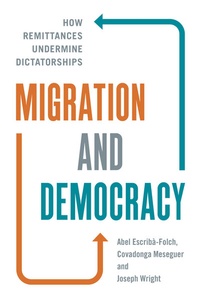
Migration and Democracy
How Remittances Undermine Dictatorships
1st Edition
Published on 31. January 2022
320 pages
978-0-691-22305-6 (ISBN)
Description

How remittances-money sent by workers back to their home countries-support democratic expansion
In the growing body of work on democracy, little attention has been paid to its links with migration. Migration and Democracy focuses on the effects of worker remittances-money sent by migrants back to their home countries-and how these resources shape political action in the Global South. Remittances are not only the largest source of foreign income in most autocratic countries, but also, in contrast to foreign aid or international investment, flow directly to citizens. As a result, they provide resources that make political opposition possible, and they decrease government dependency, undermining the patronage strategies underpinning authoritarianism.
The authors discuss how international migration produces a decentralized flow of income that generally circumvents governments to reach citizens who act as democratizing agents. Documenting why dictatorships fall and how this process has changed in the last three decades, the authors show that remittances increase the likelihood of protest and reduce electoral support for authoritarian incumbents.
Combining global macroanalysis with microdata and case studies of Senegal and Cambodia, Migration and Democracy demonstrates how remittances-and the movement of people from authoritarian nations to higher-income countries-foster democracy and its expansion.
In the growing body of work on democracy, little attention has been paid to its links with migration. Migration and Democracy focuses on the effects of worker remittances-money sent by migrants back to their home countries-and how these resources shape political action in the Global South. Remittances are not only the largest source of foreign income in most autocratic countries, but also, in contrast to foreign aid or international investment, flow directly to citizens. As a result, they provide resources that make political opposition possible, and they decrease government dependency, undermining the patronage strategies underpinning authoritarianism.
The authors discuss how international migration produces a decentralized flow of income that generally circumvents governments to reach citizens who act as democratizing agents. Documenting why dictatorships fall and how this process has changed in the last three decades, the authors show that remittances increase the likelihood of protest and reduce electoral support for authoritarian incumbents.
Combining global macroanalysis with microdata and case studies of Senegal and Cambodia, Migration and Democracy demonstrates how remittances-and the movement of people from authoritarian nations to higher-income countries-foster democracy and its expansion.
More details
Other editions
Additional editions
Abel Escriba-Folch | Joseph Wright | Covadonga Meseguer
Migration and Democracy
How Remittances Undermine Dictatorships
Book
01/2022
Princeton University Press
€32.00
Article not available at the moment
Abel Escriba-Folch | Joseph Wright | Covadonga Meseguer
Migration and Democracy
How Remittances Undermine Dictatorships
Book
01/2022
Princeton University Press
€117.61
Article not available at the moment
Persons
Abel Escribà-Folch is associate professor of political science at Universitat Pompeu Fabra. Covadonga Meseguer is associate professor of international political economy at the ICADE Business School. She is the author of Learning, Policy Making and Market Reforms. Joseph Wright is professor of political science at Pennsylvania State University. Escribà-Folch and Wright are the coauthors of Foreign Pressure and the Politics of Autocratic Survival.
Content
- Cover
- Contents
- List of Illustrations and Tables
- Preface
- Acknowledgements
- 1. Introduction
- 1.1. Globalization, Migration, and Political Change
- 1.1.1. Existing Theories: Migration and Democracy
- 1.1.2. Foreign Income Inflows and Autocratic Rule
- 1.1.3. Remittances in the Global South
- 1.2. Previewing the Argument
- 1.3. Plan of the Book
- 2. Migration and Repertoires of Contention: How Remittances Undermine Dictatorship
- 2.1. Citizens as Agents of Change
- 2.2. Global Forces and Democratization
- 2.2.1. How International Forces Shape Authoritarian Survival
- 2.2.2. Remittances as a Global Force for Bottom-Up Democratization
- 2.3. Remittances and Democratization: What Comes after Exit?
- 2.3.1. Remittances Sustain Dictatorship: Repression, Patronage, and Grievance
- 2.3.2. How Exit Funds Voice and Weakens Loyalty
- 2.4. Refining the Theoretical Mechanisms: Political Preferences and Poverty
- 2.4.1. Protest
- 2.4.2. Voting
- 2.4.3. Political Context and Political Behavior
- 2.5. Conclusion
- 3. Remittances, Revenue, and Government Spending in Dictatorships
- 3.1. Remittances, State Resources, and Authoritarian Stability
- 3.1.1. The Revenue Effect
- 3.1.2. The Substitution Effect
- 3.1.3. Taxation and the Demand for Democracy
- 3.2. Do Remittances Increase Government Revenue in Dictatorships?
- 3.3. Remittances and Government Spending
- 3.3.1. Government Health Spending and Military Spending
- 3.3.2. Do Remittances Boost Petrol Subsidies?
- 3.4. Remittances and Repression
- 3.4.1. Do Remittances Enhance Violent Repression in Dictatorships?
- 3.4.2. Do Remittances Harm Civil Liberties and Political Rights?
- 3.5. Conclusion
- 4. Remittances Fund Opponents
- 4.1. Remitted Income and the Global Rise in Protest
- 4.1.1. Anti-Government Protest
- 4.1.2. Pro-Government Mobilization
- 4.2. How Remittances Boost Protests
- 4.2.1. Capturing Political Preferences: Opposition and Regime Strongholds
- 4.2.2. Testing the Micro-Logic Linking Remittances to Protest
- 4.2.3. Remittances, Poverty, and Protest
- 4.3. Conclusion
- 4.4. Appendix: Measuring Pro-Government Areas
- 4.4.1. Vote Choice and Non-Response
- 4.4.2. External Validity
- 5. Remittances Demobilize Supporters
- 5.1. Remittances and the Electoral Fate of Ruling Parties
- 5.1.1. Ruling Party Vote Share
- 5.1.2. The Turnout Contest
- 5.2. How Remittances Cut Clientelistic Ties to the Ruling Party
- 5.2.1. Testing the Micro-Logic of Remittances and Turnout
- 5.2.2. Remittances, Poverty, and Turnout
- 5.2.3. Remittances, Political Preferences, and Turnout in Swing Districts
- 5.2.4. An AlternativeMeasure of Government Support
- 5.3. Conclusion
- 6. Remittances and Democratization
- 6.1. Closing the Resource Gap
- 6.2. Remittances, Voting, and Protests in Senegal and Cambodia
- 6.2.1. Senegal
- 6.2.2. Cambodia
- 6.2.3. Conclusion
- 6.3. Meso-Level Analysis: Remittances, Civil Society, and Opposition Party Strength
- 6.4. Macro-Level Analysis: Remittances and Democratic Transitions
- 6.5. Remittances and Democratic Transition in The Gambia
- 6.6. Conclusion
- 7. Social Remittances and Financial Remittances
- 7.1. Social Remittances: Mechanisms and Evidence
- 7.2. Political Remittances and Destination Regime Type
- 7.3. Remittances from Migrants Residing in Democratic and Autocratic Countries
- 7.3.1. Remittances Flows from Democratic and Autocratic Origins
- 7.3.2. Revisiting the Macro-Evidence
- 7.4. Does Political Discussion Mediate or Moderate How Remittances Shape Behavior?
- 7.4.1. Political Discussion as a Mediator
- 7.4.2. Political Discussion as an Amplifier
- 7.5. Conclusion
- 7.6. Appendix: Measuring Remittances by Origin
- 8. Conclusion
- 8.1. Remittances and the Ethics of Migration Policy
- 8.1.1. Emigration
- 8.1.2. Immigration policy
- 8.2. Immigration as Democracy Promotion
- 8.3. Do Remittances Fund Anti-Incumbent Politics?
- 8.3.1. Intra-European Migration and the Rise of Populist Parties
- 8.3.2. Remittances and Democracy in India
- 8.4. What Does This Mean for Globalization?
- 8.4.1. How Migration Differs from Trade and Investment Liberalization
- 8.4.2. Political Implications for the Next Wave of Globalization
- Notes
- References
- Index
