

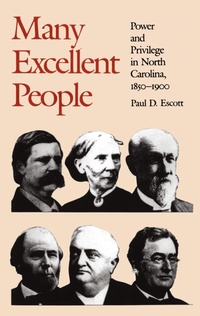
Many Excellent People
Description

Many Excellent People examines the nature of North Carolina’s social system, particularly race and class relations, power, and inequality, during the last half of the nineteenth century. Paul Escott portrays North Carolina’s major social groups, focusing on the elite, the ordinary white farmers or workers, and the blacks, and analyzes their attitudes, social structure, and power relationships. Quoting frequently from a remarkable array of letters, journals, diaries, and other primary sources, he shows vividly the impact of the Civil War, Emancipation, Reconstruction, Populism, and the rise of the New South industrialism on southern society. Working within the new social history and using detailed analyses of five representative counties, wartime violence, Ku Klux Klan membership, stock-law legislation, and textile mill records, Escott reaches telling conclusions on the interplay of race, class, and politics. Despite fundamental political and economic reforms, Escott argues, North Carolina’s social system remained as hierarchical and undemocratic in 1900 as it had been in 1850.
More details
Other editions
Additional editions
Person
Paul D. Escott is Reynolds Professor of history and dean of the Undergraduate College of Arts and Sciences at Wake Forest University. His books include After Secession, Slavery Remembered, A People and A Nation, and North Carolina Yeoman.
Content
- Cover Page
- Many Excellent People
- Copyright Page
- Dedication
- Contents
- Illustrations
- Preface
- Acknowledgments
- 1 The Idea of a Republic Versus Democracy
- 2 An Unpopular War and Poverty
- 3 Internal War
- 4 Reconstruction: Resistance to White Democracy
- 5 Reconstruction: The Battle Against Black Freedom
- 6 Change and Repression, 1868-1878
- 7 Unstable Dominance in a "New" South
- 8 Leaders of the New South
- 9 Workers in the New South
- 10 Democratic Challenge, Undemocratic Solution
- Afterword
- Notes
- Selected Bibliography
- Index
