
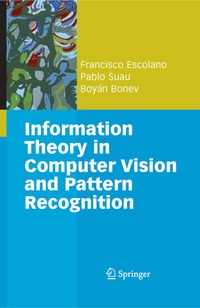
Information Theory in Computer Vision and Pattern Recognition
Description
Alles über E-Books | Antworten auf Fragen rund um E-Books, Kopierschutz und Dateiformate finden Sie in unserem Info- & Hilfebereich.
Information theory has proved to be effective for solving many computer vision and pattern recognition (CVPR) problems (such as image matching, clustering and segmentation, saliency detection, feature selection, optimal classifier design and many others). Nowadays, researchers are widely bringing information theory elements to the CVPR arena. Among these elements there are measures (entropy, mutual information.), principles (maximum entropy, minimax entropy.) and theories (rate distortion theory, method of types.).
This book explores and introduces the latter elements through an incremental complexity approach at the same time where CVPR problems are formulated and the most representative algorithms are presented. Interesting connections between information theory principles when applied to different problems are highlighted, seeking a comprehensive research roadmap. The result is a novel tool both for CVPR and machine learning researchers, and contributes to across-fertilization of both areas.
More details
Other editions
Additional editions

Persons
Content
System requirements
File format: PDF
Copy protection: Watermark-DRM (Digital Rights Management)
System requirements:
- Computer (Windows; MacOS X; Linux): Use the free software Adobe Reader, Adobe Digital Editions, or any other PDF viewer of your choice (see eBook Help).
- Tablet/Smartphone (Android; iOS): Install the free app Adobe Digital Editions or another reading app for eBooks, e.g., PocketBook (see eBook Help).
- E-reader: Bookeen, Kobo, Pocketbook, Sony, Tolino and many more (only limited: Kindle).
The file format PDF always displays a book page identically on any hardware. This makes PDF suitable for complex layouts such as those used in textbooks and reference books (images, tables, columns, footnotes). Unfortunately, on the small screens of e-readers or smartphones, PDFs are rather annoying, requiring too much scrolling.
This eBook uses Watermark-DRM, a „soft” copy protection. This means that there are no technical restrictions to prevent illegal distribution. However, there is a personalised watermark embedded in the eBook that can be used to identify the purchaser of the eBook in the event of misuse and to provide evidence for legal purposes.
For more information, see our eBook Help page.