

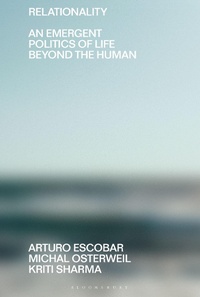
Relationality
An Emergent Politics of Life Beyond the Human
1st Edition
Published on 16. May 2024
232 pages
978-1-350-22599-2 (ISBN)
Description

This important new book argues that at the root of the contemporary crisis of climate, energy, food, inequality, and meaning is a certain core presupposition that structures the ways in which we live, think, act and design: the assumption of dualism, or the fundamental separateness of things.
The authors contend that the key to constructing livable worlds lies in the cultivation of ways of knowing and acting based on a profound awareness of the fundamental interdependence of everything that exists - what they refer to as relationality. This shift in paradigm is necessary for healing our bodies, ecosystems, cities, and the planet at large.
The book follows two interwoven threads of argumentation: on the one hand, it explains and exemplifies the modes of operation and the dire consequences of non-relational living; on the other, it elucidates the nature of relationality and explores how it is embodied in transformative practices in multiple spheres of life.
The authors provide an instructive account of the philosophical, scientific, social, and political sources of relational theory and action, with the aim of illuminating the transition from living within seemingly ineluctable 'toxic loops' of unrelational living (based on ontological dualism), to living within 'relational weaves' which we might co-create with multiple human and nonhuman others.
The authors contend that the key to constructing livable worlds lies in the cultivation of ways of knowing and acting based on a profound awareness of the fundamental interdependence of everything that exists - what they refer to as relationality. This shift in paradigm is necessary for healing our bodies, ecosystems, cities, and the planet at large.
The book follows two interwoven threads of argumentation: on the one hand, it explains and exemplifies the modes of operation and the dire consequences of non-relational living; on the other, it elucidates the nature of relationality and explores how it is embodied in transformative practices in multiple spheres of life.
The authors provide an instructive account of the philosophical, scientific, social, and political sources of relational theory and action, with the aim of illuminating the transition from living within seemingly ineluctable 'toxic loops' of unrelational living (based on ontological dualism), to living within 'relational weaves' which we might co-create with multiple human and nonhuman others.
More details
Series
Edition
1. Auflage
Language
English
Place of publication
London
United Kingdom
Publishing group
Bloomsbury Publishing PLC
Target group
College/higher education
ISBN-13
978-1-350-22599-2 (9781350225992)
Copyright in bibliographic data and cover images is held by Nielsen Book Services Limited or by the publishers or by their respective licensors: all rights reserved.
Schweitzer Classification
Other editions
Additional editions
Arturo Escobar | Michal Osterweil | Kriti Sharma
Relationality
An Emergent Politics of Life Beyond the Human
Book
06/2024
Bloomsbury Visual Arts
€20.00
Shipment within 15-20 days
Persons
Arturo Escobar is Kenan Distinguished Professor of Anthropology Emeritus, University of North Carolina, Chapel Hill, USA, and Adjunct Professor of the PhD programs in Design and Creation (Universidad de Caldas, Manizales, Colombia) and in Environmental Sciences (Unversidad del Valle, Cali). His main interests are political ecology, ontological design, and the anthropology of globalization, social movements, and technoscience. He is the author of Designs for the Pluriverse (2018), and is engaged in transition design projects in Colombia.
Michal Osterweil is Teaching Associate Professor in Global Studies at the University of North Carolina, USA. She is also a radical homemaker and community actionist. Her main areas of interest are social movements, new theories/imaginaries of social change and the intersection of knowledge production, epistemology and change work.
Kriti Sharma is Postdoctoral Scholar in microbial ecology in the division of Geology and Planetary Sciences at the California Institute of Technology, USA. She is the author of Interdependence: Biology and Beyond (2015). Her main interests are microbiology and microbial ecology, philosophy and social sciences of biology, and ontology and metaphysics.
Michal Osterweil is Teaching Associate Professor in Global Studies at the University of North Carolina, USA. She is also a radical homemaker and community actionist. Her main areas of interest are social movements, new theories/imaginaries of social change and the intersection of knowledge production, epistemology and change work.
Kriti Sharma is Postdoctoral Scholar in microbial ecology in the division of Geology and Planetary Sciences at the California Institute of Technology, USA. She is the author of Interdependence: Biology and Beyond (2015). Her main interests are microbiology and microbial ecology, philosophy and social sciences of biology, and ontology and metaphysics.
Content
Introduction: Coming Up against the Nonrelational
1. Rethinking and Reweaving the Web of Life: Relationality in Four Dimensions
2. The Epistemological and Political Failures and Promises of Theories of Relationality
3. Sources and practices for Relational Living
4. The Political Activation of Relationality
5. Designing Relationally: Enacting Pluriversal Forms of World-making
Conclusion: Making (a Relational) Reality into a Reality
1. Rethinking and Reweaving the Web of Life: Relationality in Four Dimensions
2. The Epistemological and Political Failures and Promises of Theories of Relationality
3. Sources and practices for Relational Living
4. The Political Activation of Relationality
5. Designing Relationally: Enacting Pluriversal Forms of World-making
Conclusion: Making (a Relational) Reality into a Reality
