

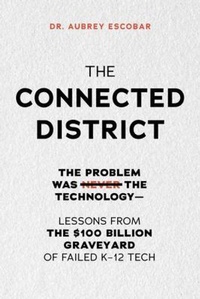
THE CONNECTED DISTRICT
Description

The problem was never the technology. It was leadership.
Every year, K-12 districts invest billions of dollars in digital tools-learning management systems, adaptive platforms, AI-powered applications, and one-to-one device initiatives. And yet, study after study shows that 60-80 percent of educational technology initiatives fail to meet their intended goals. Platforms are abandoned. Licenses expire unused. Teachers grow skeptical. Trust erodes.
Why?
Because we keep trying to solve adaptive, human problems with technical solutions.
In The Connected District, Dr. Aubrey Escobar draws on more than two decades of experience as a classroom teacher, school administrator, edtech executive, and researcher to confront the hard truth behind the $100 billion graveyard of failed K-12 technology initiatives. The issue is not the quality of the tools. It is the capacity of institutions to lead change.
Grounded in research on transformational leadership and informed by real-world case studies, this book provides a practical, evidence-based framework for leading digital transformation successfully in today's post-pandemic, AI-accelerated educational landscape.
At the heart of the book are four essential leadership pillars:
. Build Trust - Establish psychological safety and credibility before launching change.
. Cast Vision - Articulate a compelling, student-centered purpose that moves beyond buzzwords.
. Foster Innovation - Create safe spaces for experimentation instead of compliance mandates.
. Support Individuals - Differentiate support so educators can grow without burnout.
Dr. Escobar unpacks why compliance-driven rollouts fail, how pandemic-era technology trauma reshaped teacher and student relationships with digital tools, and why AI adoption presents not just a technical challenge but a governance and accountability challenge for modern districts.
More than a critique, The Connected District is a working playbook. Each chapter includes diagnostic tools, reflection prompts, and workshop guides that leadership teams can immediately apply. Whether you are:
- A superintendent navigating district-wide implementation
- A principal leading instructional change
- A chief technology or academic officer managing resources
- A doctoral student preparing for educational leadership
- Or a faculty member teaching digital transformation or change management
This book equips you to move beyond managing technology and toward building institutions capable of adapting.
Digital transformation is not a software problem. It is a leadership problem.
The districts that thrive in the coming decade will not be those with the newest tools, but those with the strongest leadership architecture-institutions that can face disruption without fracturing, and innovate without losing their moral center.
The graveyard of failed initiatives is full.
It's time to cultivate something better.
More details
Person
Content
TABLE OF CONTENTS
Preface ................................................. 7
Introduction: The $100 Billion Graveyard ................. 11
PART 1: UNDERSTANDING FAILURE
Chapter 1: The Anatomy of Failure-Why Good Tech Fails in the Industrial-Age School ................. 19
Chapter 2: Decoding the Human Element-The Psychology of Resistance in the Data Age ................. 61
PART 2: THE FOUR PILLARS OF TRANSFORMATIONAL LEADERSHIP-YOUR BLUEPRINT FOR SUCCESS
Chapter 3: Pillar 1-Build Trust (Idealized Influence) ................. 101
Chapter 4: Pillar 2-Cast Vision (Inspirational Motivation) ................. 125
Chapter 5: Pillar 3-Foster Innovation (Intellectual Stimulation) ................. 147
Chapter 6: Pillar 4-Support Individuals (Individualized Consideration) ................. 203
PART 3: THE LEADER'S PLAYBOOK (FROM THEORY TO ACTION)
Chapter 7: Making the Case and Securing Resources-From Vision to Budget Line Item ................. 241
Chapter 8: Managing the Messy Middle-The Leader as Chief Barrier Remover ................. 273
Chapter 9: Making It Stick-Sustaining and Scaling Change ................. 315
Conclusion: From Graveyard to Garden ................. 383
Appendix: Professional Development Facilitation Guide ................. 397
References ................. 405
