

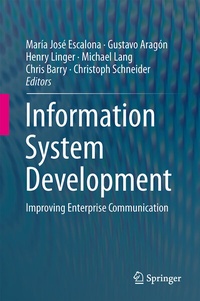
Information System Development
Description

Information System Development-Improving Enterprise Communication are the collected proceedings of the 22 nd International Conference on Information Systems Development: Improving Enterprise Communication-ISD 2013 Conference, held in Seville, Spain. It follows in the tradition of previous conferences in the series in exploring the connections between industry, research and education.
These proceedings represent ongoing reflections within the academic community on established information systems topics and emerging concepts, approaches and ideas. It is hoped that the papers herein contribute towards disseminating research and improving practice.
The conference tracks highlighted at the 22 nd International Conference on Information Systems Development (ISD 2013) were:
- Applications
- Data and Ontologies
- End Users
- Enterprise Evolution
- Industrial cases in ISD
- Intelligent Business Process Management
- Model Driven Engineering in ISD
- New Technologies
- Process Management
- Quality
More details
Other editions
Additional editions
Persons
María José Escalona IWT2 Research Group Department of Computer Languages and Systems University of Seville Av. Reina Mercedes S/N 41012 Seville, Spain
Gustavo Aragón IWT2 Research Group FIDETIA University of Seville Av. Reina Mercedes S/N 41012 Seville, Spain
Henry Linger Faculty of Information Technology Monash University P.O. Box 197 Caulfield East, VIC 3145 Australia
Michael Lang Business Information Systems Group Cairnes School of Business & Economics National University of Ireland Galway University Road Galway, Ireland
Chris Barry Business Information Systems Group Cairnes School of Business & Economics National University of Ireland Galway University Road Galway, Ireland
Christoph Schneider City University of Hong Kong 83 Tat Chee Avenue Kowloon Hong Kong
Content
Measuring Business-IT Alignment, framework development and case study results.- Collaborative Health Informatics: A Multidisciplinary Approach.- Understanding Feasibility Study Approach for Packaged Software Implementation by SMEs.- Towards P Systems based Approach for Evolutionary Enterprise Application.- Data-Oriented Declarative Language for Optimizing Business Processes.- A Set of Practices for the Development of Data- Centric Information Systems.- Towards An Ontology of SoS Interoperability: Proposition of a SoS Interoperability Framework and a SoS Conceptual Interoperability Model.- Involving End-Users in the Design of a Domain-Specific Language for the Genetic Domain.- Improving information system interoperability in social sector through advanced metadata.- Using Process-level Use Case Diagrams to Infer the Business Motivation Model with a RUPbased Approach.- Towards Elimination of Testing Debt in Outsourced IS Development Projects - a View from the Client Side.- From Traditional Practices To A Learning Community: A Knowledge Management Approach To Support Learning In Food Hazard Identification.- Coordinating the Enterprise Modelling Effort by Means of an Entrepreneurial Goal Hierarchy.- Merger and Acquisition Preparedness Building: An Enterprise Architecture Perspective.- Starting building a IT policy: a quest to IT success.- Design within Complex Environments: Collaborative Engineering in the aerospace industry.- Understanding Contradictions in Enterprise System Implementations: A case for Stakeholder Theory.- Company Process Support by Software Systems: Research in Small Software Companies in the Czech Republic.- An Integrated Information Systems Success Model: A Case Study of an Australian Hospital.- Identifying Essential and Optional Decision Constructs in On-line Transactional Processes.- Ontology and SOA based data mining to business process optimization.- Data-Aware Conformance Checking for Declarative Business Process Models.- Taxonomyof anomalies in business process models.- An Automated Approach for Architectural Model Transformations.- A Discrete-Event Simulation Metamodel for obtaining Simulation Models from Business Process Models.- A Pattern-Based and Model-Driven Approach for Deriving IT System Functional Models from Annotated Business Models.- Applying testing techniques to software process assessment: A model-based perspective.- A Model-Based Approach to Develop Self-Adaptive Data Visualizations.- A Language Oriented Extension to Toulmin's Argumentation Model for Conceptual Modelling.- Architecture Derivation in Product Line Development through Model Transformations.- Collaborative Modeling through the Integration of Heterogeneous Modeling Languages.- Positing a Factorial Model for Consumer Trust in Mobile Payments.- Multipoint Web Real-Time Communication.- Affecting Decision-Makers' Attention through Mobile BI - Implications for Mobile BI Design Process.- Generating a REST Service Layer from a Legacy System.- Effective and Considerate Change Notifications in Multidisciplinary Engineering Projects.- Using Agile methods for infrastructure projects: A practical experience.- The Uncertainties Management Framework: Eliminating Uncertainties from the Process.- Towards the Development of a Complex Adaptive Project Environment Assessment Tool.- ISO2: A New Breath for the Joint Development of IS and ISO 9001 Management Systems.- Incremental and Adaptive Software Systems Development of Natural Language Applications.- UCL-Universal Constraint Language.
