

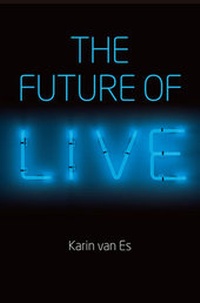
The Future of Live
Description

In this book, Karin van Es develops a comprehensive understanding of liveness today, and clarifies the stakes surrounding the category of the live . She argues that liveness is the product of a dynamic interaction between media institutions, technologies and users. In doing so, she challenges earlier conceptions of the notion, which tended to focus on either one of these contributors to its construction.
By analyzing the live in four different cases a live streaming platform, an online music collaboration website, an example of social TV, and a social networking site van Es explores the operation of the category and pinpoints the conditions under which it comes into being. The analysis is the starting point for a broader reflection on the relation between broadcast and social media.
More details
Other editions
Additional editions
Person
Content
Preface vi
Acknowledgments viii
1 Introduction 1
2 Constellations of Liveness 18
3 Liveness and Institutionalization 35
4 "Live" as an Evaluative Category 64
5 Social TV and the Multiplicity of the Live 83
6 Social Media's New Relation to the Live 123
Conclusions 152
Notes 163
Resources 173
References 176
Index 190
Contents
2
Constellations of Liveness
As briefly touched on in the introduction, Nick Couldry, in the final chapter of Media Rituals: A Critical Approach (2003), speculates whether the internet and digital technologies make categories such as the live redundant. This thought is prompted by the observation that the new opportunities for production and consumption offered by these technologies might weaken the media's power: the concentration, that is, of symbolic power in the central broadcast media, which allows the media to construct social reality. According to Couldry, liveness is a "media ritual category" that helps to legitimize and maintain the uneven distribution of symbolic power. Over a decade later, we can say that while the internet has helped to change the relation between media institutions and users, it has not fragmented symbolic power but has instead given rise to new concentrations of power (namely in social media).
Couldry's analysis notwithstanding, it is not surprising that liveness has not only remained relevant but has found new forms. Yet as explained in the previous chapter, prevailing academic assumptions and perspectives fail to capture new forms of the live. In this chapter, I develop an approach to liveness that acknowledges that institutions, technologies, and users all play a part in constructing it. I respond to approaches to the live that treat it-reductively-as either a property of technology, an affective experience, or a manifestation of industry rhetoric. The chapter introduces a methodological tool for analyzing articulations of the live and, furthermore, provides a theoretical framework for understanding the live in relation to media power (and, also, user participation).
Media Power and the "Live"
Couldry's work on liveness resulted from his attempt to answer the question of why people place such value on media output. He argues that the media
provide an essential flow of information and meanings, that enable the generation of new discursive resources at a societal level, both through factual information and through media fictions, such as soaps, which may focus important social debates.
(2000, 51)
This is the "symbolic power of the media," and it concerns how "media are involved in our fantasies, our self-images, and our descriptions of reality" (Couldry 2000, 21). To provide evidence of media power, Couldry analyzed how people act and talk when encountering sites of media production (e.g., film locations, the sets of TV shows, and the like). Here he noticed that people adhere to formal boundaries between everyday space and media space, and between what is "in" the media (and therefore of greater significance) and what is "outside."
In his conceptualization of symbolic power, Couldry is specifically critical of what he calls the "weak concept" developed by John B. Thompson (1995). For Thompson, symbolic power is simply the ability
to intervene in the course of events, to influence the actions of others and indeed to create events, by means of the production and transmission of symbolic forms.
(1995, 17)
Couldry favors Bourdieu's "strong concept" of symbolic power, because it acknowledges that some concentrations of power are so intense that they come to dominate the whole social landscape. This power, then, is a general power-rather than a local one-that constructs social reality as such. Moreover, it is so pervasive that it is "misrecognized" and thereby legitimized by those subjected to it, who conceal its arbitrariness in the process (Couldry 2004). This set of ideas he refers to as "the myth of the mediated center."4 Simply put, the myth concerns the idea that there is such a thing as the center of society, and that the media represent privileged access to that center. To explain how this concentration of symbolic power in media institutions is maintained, Couldry developed a new approach to media studies, "the media ritual approach." He takes media rituals to be the actions organized around key media-related categories such as liveness, reality, celebrity, and so forth. These categories have different reference points to explain why the media are necessary. The live, for instance, suggests that media matter more because they show society's current social reality. So although the myth is established by institutional structures, it is reproduced locally through what people say and do in relation to the media. People, in other words, actively help perpetuate the myth. And since the myth is reproduced on a more general level, there may be skepticism on a local level.
Couldry's main goal, in the early 2000s, was to develop a theory that helped explain media power-not liveness. He focused, therefore, on explaining media power and how liveness contributed to its reproduction, rather than on providing the means to investigate how liveness is constructed. His definition of liveness was developed in relation to broadcast media, at a time when their symbolic power was largely undisputed. As new forms of liveness emerged based on the internet and digital technologies, they seemed to challenge this concentration of symbolic power. In theory, multiple centers for the production and consumption of symbolic content were made possible since more people had relatively cheap access to media production tools and distribution platforms. However, this is not how the situation played out. Social media became the new beneficiaries of a concentration of symbolic power, and they made a claim, like the broadcast media before them, to speak for "us" (Couldry 2014, 619). In 2014 Couldry explored this new configuration as representing a new myth, "the myth of us," which concerns how gatherings on social media are seen as a natural form of collectivity-to the benefit of the bottom line of these platforms. In light of this development in the evolving media landscape, the continued relevance and even intensification of the investment in the category of the live make sense.
In this book, my goal is to understand what constitutes liveness, when liveness is and how liveness operates.5 I would argue, however, that my efforts also contribute to a better understanding of media power, particularly in the social media era. In this context, I disagree with Couldry on the value of Thompson's insights on the workings of power, which in my view should not be discounted-even if certain concentrations of power in the media require that one refer to Bourdieu's work instead. For instance, Thompson's insistence that the different forms of power (he distinguishes four: economic, political, coercive, and symbolic) overlap and shift is a valuable consideration.6 This makes explicit that symbolic power is connected to other forms of power and cannot be neatly disentangled from it.
When analyzing the particular constellations of liveness of the cases dealt with in this book, I am not attached to a specific function of liveness in advance, nor do I want to fall back on an existing definition built around a particular communication model. Rather, analyzing these constellations will allow me to reformulate the definition of liveness, taking inspiration from the particular situations that apply in each case.
My approach to liveness, then, is distinct from those of others in three main ways. First, my principal aim is to explore the live concept as such: to lay bare how liveness is constructed around and through media platforms. Specifically, I see liveness as a socio-technical construction, a product of a chain of social and technical elements. Second, my approach appreciates that there are multiple constructions of the live, each of which should be valued for its specificity. Analytically speaking, this requires that media platforms should be put to closer scrutiny, and not clustered into generalized groups such as those producing "online liveness" (Couldry 2004) or "digital liveness" (Auslander 2012). Finally, I assume that liveness is subject to a variety of tensions: struggles over its meaning among the different actors involved in its construction. Studying such tensions helps to understand the (changing) relations between media institutions and users around media content.
User Participation in the Social Media Era
More than once I have already claimed that the social media era introduces new forms of liveness, but what is "the social media era"? By "social media era" I refer to the period after the dotcom-bubble bust of 2000-2001, a period which has seen an enormous increase in user-generated content and online sharing. This was facilitated by, but is not reducible to, the emergence of social media. Since then, social media are increasingly taken to be replacing broadcast media as the dominant media forms in everyday life.
"Social media," here, refers to
a group of Internet-based applications that build on the ideological and technological foundations of Web 2.0, and that allow the creation and exchange of user-generated content.
(Kaplan and Haenlein 2010, 61)
It was in the wake of the dotcom-bubble bust, at a 2004 conference organized by O'Reilly Media and MediaLive International, that the notion of "Web 2.0" was first explored (O'Reilly 2012).7 In...
