

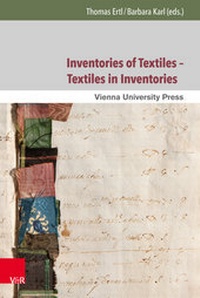
Inventories of Textiles - Textiles in Inventories
Studies on Late Medieval and Early Modern Material Culture
1st Edition
Published on 12. June 2017
245 pages
978-3-8470-0392-2 (ISBN)
Description

From pope to farmer: textiles and their histories
More details
Other editions
Additional editions
Thomas Ertl | Barbara Karl
Inventories of Textiles - Textiles in Inventories
Studies on Late Medieval and Early Modern Material Culture
Book
06/2017
1st Edition
Brill Deutschland
€55.00
Shipment within 7-9 days
Persons
Author
Prof. Dr. Thomas Ertl lehrt Wirtschafts- und Sozialgeschichte des Mittelalters an der Universität Wien. Einer seiner Forschungsschwerpunkte sind Textilien, ihre Produktion und ihre Verwendung im Mittelalter.
Dr. Barbara Karl ist Kuratorin der Sammlung des Textilmuseums St.Gallen (CH). Der Schwerpunkt ihrer Forschungen und Publikationen widmet sich Textilien und Sammlungsgeschichte vor dem Hintergrund des intranationalen kulturellen Austauschs der frühen Neuzeit bis ins 19. Jahrhundert.
Editor
Prof. Dr. Thomas Ertl lehrt Wirtschafts- und Sozialgeschichte des Mittelalters an der Universität Wien. Einer seiner Forschungsschwerpunkte sind Textilien, ihre Produktion und ihre Verwendung im Mittelalter.
Dr. Barbara Karl ist Kuratorin der Sammlung des Textilmuseums St.Gallen (CH). Der Schwerpunkt ihrer Forschungen und Publikationen widmet sich Textilien und Sammlungsgeschichte vor dem Hintergrund des intranationalen kulturellen Austauschs der frühen Neuzeit bis ins 19. Jahrhundert.
Contributions
Prof. Dr. Thomas Ertl lehrt Wirtschafts- und Sozialgeschichte des Mittelalters an der Universität Wien. Einer seiner Forschungsschwerpunkte sind Textilien, ihre Produktion und ihre Verwendung im Mittelalter.
Dr. Barbara Karl ist Kuratorin der Sammlung des Textilmuseums St.Gallen (CH). Der Schwerpunkt ihrer Forschungen und Publikationen widmet sich Textilien und Sammlungsgeschichte vor dem Hintergrund des intranationalen kulturellen Austauschs der frühen Neuzeit bis ins 19. Jahrhundert.
Consultant editor
Prof. Dr. Heinz Fassmann ist Direktor des Instituts für Stadt- und Regionalforschung und Vizerektor für Forschung und Internationales an der Universität Wien.
Content
- Intro
- Title Page
- Copyright
- Table of Contents
- Body
- Preface
- Thomas Ertl and Barbara Karl: Introduction - Inventories of Textiles / Textiles in Inventories
- Our Interest
- Questioning the Inventories
- Textiles
- Christiane Elster: Inventories and Textiles of the Papal Treasury around the Year 1300: Concepts of Papal Representation in Written and Material Media
- Introducing the Pontifical Treasury and its Documentation in the Inventories
- Aspects of Material Discourse in the Textile Entries of the Inventories
- 1. The Repeated Notices of Provenance
- 2. The Composite Objects, Comprised of Materials from Various Provenances
- Material Discourse and Political Claims of the Papacy
- Conclusion
- Thomas Ertl: The Bishop of Freising Visits His Estates (1316-1320): Conrad III. Sendlinger and his Inventories
- Conclusion
- Sarah-Grace Heller: Revisiting the Inventories of Artois: Fashion, Status, and Taste at the Court of Mahaut, c. 1307-1310
- Mahaut and Her Household
- Novelty and Rates of Wardrobe Renewal, 1307-1310
- Personal Choice and Distinction
- Making Personal Choices: The Shopping Process
- Conclusions
- Lisa Monnas: Reading English Royal Inventories: Furnishings and Clothing in the Inventory of King Henry V (r. 1413-1422)
- Furnishing Textiles
- Linens
- Clothes
- Conclusion
- Annemarie Stauffer: A Purchase List from the Court of Charles the Bold from 1473
- Introduction
- The source
- Style and cut of the clothes
- Types of fabric
- Colours and dyes
- Conclusion
- Appendix 1: Elements of dress
- Appendix 2: Textile qualities and colours
- Qualities and colours without single garments
- Richard Stapleford: Household Goods in the 1492 Inventory of the Estate of Lorenzo de' Medici
- Hedda Reindl-Kiel: The Empire of Fabrics: The Range of Fabrics in the Gift Traffic of the Ottomans
- Names and Terms of Ottoman Fabrics
- Primary Sources
- Chiara Buss: Half-tints in Italy in 1628: An Unusual Book of Samples from the Milan State Archives
- The Document
- Known Terms
- Unknown Terms
- Historical Context
- Checking Information from the Mostre
- New Colours: the Half-Tints
- Names of Half-Tints and their Meaning
- Avinato
- Beretino
- Camozzino
- Cavelino
- Colombino
- Color d'aria
- Lionato
- Zizzolino
- List of Archives
- List of Magazines
- Burkhard Pöttler: Clothing and Cloths in Styrian Probate Inventories of the Late 17th and 18th Centuries
- Introduction
- Characteristics of Styrian Probate Inventories
- Methodological Considerations
- Cloths and Materials
- Textiles in Domestic Contexts, Dress and Work Contexts
- Auctions
- Conclusion
- List of Archives and Primary Sources
- John Jordan and Gabi Schopf: Fictive Descriptions? Words, Textiles, and Inventories in Early Modern Switzerland
- Fabric and Materials
- Patterns
- Origins
- Conclusions
- Archival Primary Sources
- Printed Primary Sources
- Index of Names
- Index of Places
