

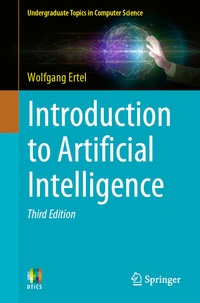
Introduction to Artificial Intelligence
Description

This accessible and engaging textbook presents a concise introduction to the exciting field of artificial intelligence (AI). The broad-ranging discussion covers the key subdisciplines within the field, describing practical algorithms and concrete applications in the areas of agents, logic, search, reasoning under uncertainty, machine learning, neural networks, and reinforcement learning. Fully revised and updated, this much-anticipated third edition also includes new material on deep learning.
Topics and features:
· Presents an application-focused and hands-on approach to learning, with supplementary teaching resources provided at an associated website
· Introduces convolutional neural networks as the currently most important type of deep learning networks with applications to image classification (NEW)
· Contains numerous study exercises and solutions, highlighted examples, definitions, theorems, and illustrative cartoons
· Reports on developments in deep learning, including applications of neural networks to large language models as used in state-of-the-art chatbots as well as to the generation of music and art (NEW)
· Includes chapters on predicate logic, PROLOG, heuristic search, probabilistic reasoning, machine learning and data mining, neural networks, and reinforcement learning
· Covers various classical machine learning algorithms and introduces important general concepts such as cross validation, data normalization, performance metrics and data augmentation (NEW)
· Includes a section on AI and society, discussing the implications of AI on topics such as employment and transportation
Ideal for foundation courses or modules on AI, this easy-to-read textbook offers an excellent overview of the field for students of computer science and other technical disciplines, requiring no more than a high-school level of knowledge of mathematics to understand the material.
Dr. Wolfgang Ertel is a professor at the Institute for Artificial Intelligence at the Ravensburg-Weingarten University of Applied Sciences, Germany.
Reviews / Votes
"The textbook benefits from numerous examples; summaries and exercises conclude every chapter ... . Also included are extensive references that represent a reliable starting point for the wide audience, from students to researchers, who would benefit from the structured overview of these fundamental theoretical aspects." (Irina Ioana Mohorianu, zbMATH 1555.68006, 2025)
More details
Other editions
Additional editions
Previous edition
Persons
Content
Introduction.- Propositional Logic.- First-order Predicate Logic.- Limitations of Logic.- Logic Programming with PROLOG.- Search, Games and Problem Solving.- Reasoning with Uncertainty.- Machine Learning and Data Mining.- Neural Networks.- Reinforcement Learning.- Solutions for the Exercises.
