

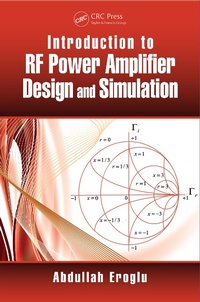
Introduction to RF Power Amplifier Design and Simulation
Published on 3. September 2018
449 pages
978-1-351-83118-5 (ISBN)
Description

Introduction to RF Power Amplifier Design and Simulation fills a gap in the existing literature by providing step-by-step guidance for the design of radio frequency (RF) power amplifiers, from analytical formulation to simulation, implementation, and measurement. Featuring numerous illustrations and examples of real-world engineering applications, this book:
Gives an overview of intermodulation and elaborates on the difference between linear and nonlinear amplifiers
Describes the high-frequency model and transient characteristics of metal-oxide-semiconductor field-effect transistors
Details active device modeling techniques for transistors and parasitic extraction methods for active devices
Explores network and scattering parameters, resonators, matching networks, and tools such as the Smith chart
Covers power-sensing devices including four-port directional couplers and new types of reflectometers
Presents RF filter designs for power amplifiers as well as application examples of special filter types
Demonstrates the use of computer-aided design (CAD) tools, implementing systematic design techniques
Blending theory with practice, Introduction to RF Power Amplifier Design and Simulation supplies engineers, researchers, and RF/microwave engineering students with a valuable resource for the creation of efficient, better-performing, low-profile, high-power RF amplifiers.
Gives an overview of intermodulation and elaborates on the difference between linear and nonlinear amplifiers
Describes the high-frequency model and transient characteristics of metal-oxide-semiconductor field-effect transistors
Details active device modeling techniques for transistors and parasitic extraction methods for active devices
Explores network and scattering parameters, resonators, matching networks, and tools such as the Smith chart
Covers power-sensing devices including four-port directional couplers and new types of reflectometers
Presents RF filter designs for power amplifiers as well as application examples of special filter types
Demonstrates the use of computer-aided design (CAD) tools, implementing systematic design techniques
Blending theory with practice, Introduction to RF Power Amplifier Design and Simulation supplies engineers, researchers, and RF/microwave engineering students with a valuable resource for the creation of efficient, better-performing, low-profile, high-power RF amplifiers.
Reviews / Votes
"Modern curriculum developments over the last decade, has tended towards favoring digital aspects of RF engineering, with the result that the difficult area of RF analog design has suffered subsequently. This book addresses this issue very clearly by using many design examples making a difficult subject much more accessible to students and professionals alike."-Paul Tobin, Dublin Institute of Technology
"A very comprehensive treatment with an excellent use of examples to explain the workings and theory of RF amplifiers."
-Tony Harris, Electronics & Innovation, Ltd.
"The author has many years of experience working in the RF industry as well as teaching the RF courses at IUPU Fort Wayne. This book is a culmination of his extensive work in the RF Power Amplifier. The book blends the theory with practice very well and presents the challenging subject in a clear and understandable manner. The treatment of the RF systems in this book makes it well suited to be the textbook for senior undergraduate or beginning graduate courses in RF Systems. It is also an excellent resource for practicing engineers."-Jay K. Lee, Syracuse University, Department of Electrical Engineering & Computer Science, New York
"The book is truly written for the RF power amplifier designer and students alike. The content is just at the right level, and the examples are very helpful and easy to apply to practical design work. The color graphs, charts, and pictures are excellent." -IEEE Microwave Magazine, May 2016
More details
Language
English
Place of publication
London
United Kingdom
Publishing group
Taylor & Francis Ltd
Target group
College/higher education
Product notice
Reflowable
Illustrations
25 Tables, black and white; 406 Illustrations, black and white
File size
21,24 MB
ISBN-13
978-1-351-83118-5 (9781351831185)
Copyright in bibliographic data and cover images is held by Nielsen Book Services Limited or by the publishers or by their respective licensors: all rights reserved.
Schweitzer Classification
Other editions
Additional editions
Abdullah Eroglu
Introduction to RF Power Amplifier Design and Simulation
Book
12/2020
1st Edition
CRC Press
€82.50
Shipment within 15-20 days
Abdullah Eroglu
Introduction to RF Power Amplifier Design and Simulation
Book
07/2015
1st Edition
CRC Press
€237.50
Article not available for order
Person
Abdullah Eroglu is a professor of electrical engineering at Indiana University-Purdue University Fort Wayne (IPFW), USA. He previously worked as a radio frequency (RF) senior design engineer at MKS Instruments, ENI Products, Rochester, New York, USA, and as a faculty fellow in the Fusion Energy Division of Oak Ridge National Laboratory, Tennessee, USA. He holds a M.Sc and Ph.D in electrical engineering from Syracuse University, New York, USA, and is a recipient of the 2013 IPFW Outstanding Researcher Award; 2012 IPFW Featured Faculty Award; 2011 Sigma Xi Researcher of the Year Award; 2010 IPFW College of Engineering, Technology, and Computer Science (ETCS) Excellence in Research Award; and 2004 Syracuse University Electrical Engineering and Computer Science Department Outstanding Graduate Student Award. Dr. Eroglu is the author of four books and has published more than 100 peer-reviewed journal and conference papers. He also serves as a reviewer and editorial board member for several journals.
Content
Radio Frequency Amplifier Basics. Radio Frequency Power Transistors. Transistor Modeling and Simulation. Resonator Networks for Amplifiers. Impedance Matching Networks. Couplers, Multistate Reflectometers, and RF Power Sensors for Amplifiers. Filter Design for RF Power Amplifiers. Computer Aided Design Tools for Amplifier Design and Implementation.
