

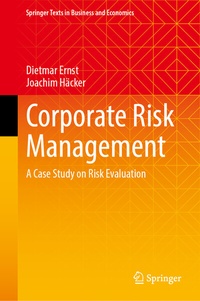
Corporate Risk Management
Description

In times of crisis, risk management is more important than ever. In addition, companies are obliged to identify, quantify and aggregate risks as part of a risk management system. Legal and auditing standards have set the framework for doing so. This book uses a case study to show 'step by step' how risks can be analyzed and quantified with the help of Microsoft Excel. The book begins with the graphical representation of risks and the calculation of risk parameters such as the value at risk. It subsequently aggregates different risks into an overall risk using Monte Carlo simulation. Hedging risks is also explained, and how non-hedgeable risks can be integrated into a business plan. The assessment of extreme risks is also addressed, as is the modeling of volatilities. The book is aimed at students of business administration with a focus on finance.
More details
Other editions
Additional editions
Persons
Dietmar Ernst is Professor of Corporate Finance at the International School of Finance at the University of Applied Sciences in Nürtingen (Germany). He is also the director of the European Institute of Quantitative Finance (EIQF). Dietmar Ernst worked for many years as an M&A consultant, private equity manager and company valuation specialist in various banks.
Joachim Hacker is Professor of Corporate Finance at the University of Applied Sciences Munich (Germany) and Adjunct Professor at the University of Louisville (USA). He is also Director of the European Institute of Quantitative Finance (EIQF). Prior to his academic career, Joachim Hacker was a Vice President at Rothschild in the Mergers & Acquisitions department in London and Frankfurt. He is also Chairman of the Advisory Board of several companies.
Content
General structure of the case study.- Course 1: Risk Analysis.- Course unit 1: Graphical representation of risks.- Course unit 2: Variance and standard deviation.- Course unit 3: Models for calculating volatility.- Course 2: Quantitative instruments in risk management.- Course unit 1: Different types of Value at Risk and Lower Partial Moments and Extreme Value Theory.- Course unit 2: Determination of portfolio risks.- Course Unit 3: Hedging of hedgeable risks and modelling of non-hedgeable risks.
