

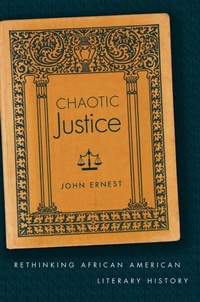
Chaotic Justice
Rethinking African American Literary History
Published on 15. November 2009
328 pages
978-0-8078-9850-5 (ISBN)
Description

What is African American about African American literature? Why identify it as a distinct tradition? John Ernest contends that too often scholars have relied on naïve concepts of race, superficial conceptions of African American history, and the marginalization of important strains of black scholarship. With this book, he creates a new and just retelling of African American literary history that neither ignores nor transcends racial history.
Ernest revisits the work of nineteenth-century writers and activists such as Henry “Box” Brown, Frederick Douglass, Harriet Wilson, William Wells Brown, and Sojourner Truth, demonstrating that their concepts of justice were far more radical than those imagined by most white sympathizers. He sheds light on the process of reading, publishing, studying, and historicizing this work during the twentieth century. Looking ahead to the future of the field, Ernest offers new principles of justice that grant fragmented histories, partial recoveries, and still-unprinted texts the same value as canonized works. His proposal is both a historically informed critique of the field and an invigorating challenge to present and future scholars.
Ernest revisits the work of nineteenth-century writers and activists such as Henry “Box” Brown, Frederick Douglass, Harriet Wilson, William Wells Brown, and Sojourner Truth, demonstrating that their concepts of justice were far more radical than those imagined by most white sympathizers. He sheds light on the process of reading, publishing, studying, and historicizing this work during the twentieth century. Looking ahead to the future of the field, Ernest offers new principles of justice that grant fragmented histories, partial recoveries, and still-unprinted texts the same value as canonized works. His proposal is both a historically informed critique of the field and an invigorating challenge to present and future scholars.
More details
Other editions
Additional editions
Book
11/2009
The University of North Carolina Press
€85.72
Article exhausted; check different version
Book
11/2009
The University of North Carolina Press
€39.00
Shipment within 15-20 days
Person
John Ernest is Eberly Family Distinguished Professor of American Literature at West Virginia University. He is author or editor of six books, including Liberation Historiography: African American Writers and the Challenge of History, 1794–1861 (UNC Press).
Content
- Intro
- Contents
- Acknowledgments
- INTRODUCTION: Loosed Canons: The Race for Literary History
- CHAPTER ONE: Representing Chaos and Reading Race
- CHAPTER TWO: Truth Stranger than Fiction: African American Identity and (Auto) Biography
- CHAPTER THREE: The Shortest Point between Two Lines: Writing African Americans into American Literary History
- CHAPTER FOUR: Choreographing Chaos: African American Literature in Time and Space
- CHAPTER FIVE: The Story at the End of the Story: African American Literature and the Civil War
- CONCLUSION: Covenants and Communities: The Demands of African American Literature
- Notes
- Bibliography
- Index
- A
- B
- C
- D
- E
- F
- G
- H
- I
- J
- K
- L
- M
- N
- O
- P
- R
- S
- T
- U
- V
- W
- Y
- Z
