

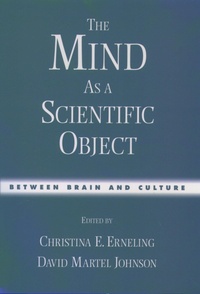
The Mind As a Scientific Object
Between Brain and Culture
1st Edition
Published on 13. January 2005
564 pages
978-0-19-534999-3 (ISBN)
Description

What holds together the various fields that are supposed to consititute the general intellectual discipline that people now call cognitive science? In this book, Erneling and Johnson identify two problems with defining this discipline. First, some theorists identify the common subject matter as the mind, but scientists and philosophers have not been able to agree on any single, satisfactory answer to the question of what the mind is. Second, those who speculate about the general characteristics that belong to cognitive science tend to assume that all the particular fields falling under the rubric--psychology, linguistics, biology, and son on--are of roughly equal value in their ability to shed light on the nature of mind. This book argues that all the cognitive science disciplines are not equally able to provide answers to ontological questions about the mind, but rather that only neurophysiology and cultural psychology are suited to answer these questions. However, since the cultural account of mind has long been ignored in favor of the neurophysiological account, Erneling and Johnson bring together contributions that focus especially on different versions of the cultural account of the mind.
More details
Other editions
Additional editions
Christina E. Erneling | David Martel Johnson
The Mind as a Scientific Object
Between brain and culture
Book
02/2005
Oxford University Press Inc
€197.40
Shipment within 15-20 days
Content
- Intro
- Contents
- Contributors
- Introduction: Can Cognitive Science Locate and Provide a Correct Account of the Mind's Center? Progress Toward the Literal
- I: Where Are We at Present, and How Did We Get There?
- Introduction
- 1 The Relevance of the Philosophy of Psychology to a Science of Psychology
- 2 Mind as a Scientific Object: A Historical-Philosophical Exploration
- 3 The Emergence of Minds in Space and Time
- 4 Is the Mind a Scientific Object of Study? Lessons from History
- II: Is the Study of Mind Continuous with the Rest of Science?
- Introduction
- 5 Psychology as Engineering
- 6 Epistemic Dualism
- 7 Mind, Brain, and Culture
- 8 Chalmers's Naturalistic Dualism: The Irrelevance of the Mind-Body Problem to the Scientific Study of Consciousness
- 9 Emergence and Efficacy
- III: Eliminative Materialism: Sound or Mistaken?
- Introduction
- 10 A Particularly Compelling Refutation of Eliminative Materialism
- 11 Commonsense Refutations of Eliminativism
- 12 What Does It Take to Be a True Believer? Against the Opulent Ideology of Eliminative Materialism
- 13 Connectionism and the Propositional Attitudes
- IV: Is "Mind" Just Another Name for the Brain and What the Brain Does?
- Introduction
- 14 All in the Interest of Time: On the Problem of Speed and Cognition
- 15 Can There Be a Cognitive Neuroscience of Central Cognitive Systems?
- 16 The Cognitive Neuroscience Laboratory: A Framework for the Science of Mind
- 17 Gall's Legacy Revisited: Decomposition and Localization in Cognitive Neuroscience
- V: Does Evolution Provide a Key to the Scientific Study of Mind?
- Introduction
- 18 The Detachment of Thought
- 19 The Mind as an Object of Scientific Study
- 20 The Significance of Ape Language Research
- 21 I Object: Mind and Brain as Darwinian Things
- VI: Is the Mind a Cultural Entity?
- Introduction
- 22 Ignace Meyerson and Cultural Psychology
- 23 Strong Culturalism
- 24 The Text of the Mind
- VII: Rationality: Cultural or Natural?
- Introduction
- 25 Beyond the Mind-Body Problem
- 26 Workshop Rationality, Dogmatism, and Models of the Mind
- 27 Is Cognitive Development Equivalent to Scientific Development?
- 28 Mind, Brain, and the Upper Paleolithic
- 29 Afterword: Between Brain and Culture-The Diversity of Mind
- Citation Index
- A
- B
- C
- D
- E
- F
- G
- H
- I
- J
- K
- L
- M
- N
- O
- P
- Q
- R
- S
- T
- V
- W
- Y
- Z
- Subject Index
- A
- B
- C
- D
- E
- F
- G
- H
- I
- J
- K
- L
- M
- N
- O
- P
- Q
- R
- S
- T
- U
- V
- W
- Z
