

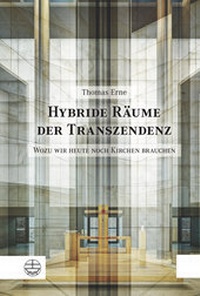
Hybride Räume der Transzendenz
Wozu wir heute noch Kirchen brauchen. Studien zu einer postsäkularen Theorie des Kirchenbaus
1st Edition
Published in July 2017
248 pages
978-3-374-04833-5 (ISBN)
Description

Kirchen sind der Ort, an dem sich sonntags eine christliche Gemeinde zum Gottesdienst versammelt. Gleichzeitig besucht jedes Jahr ein Millionenpublikum die Kirchen, um unabhängig von den Gottesdiensten einfach die besondere Atmosphäre der Räume zu erleben. Die religiöse Erfahrung der Transzendenz, die ein Gemeindemitglied in der Liturgie des Gottesdienstes erlebt, wird so überlagert von den ästhetischen Erfahrungen, die ein Besucher im Kirchenraum macht. Kirchen sind hybride Räume der Transzendenz. Es kann dort ein charmanter Übergang von ästhetischer zu religiöser Transzendenz stattfinden. Es kann aber auch ein Grenzkonflikt entstehen, wenn sich Religion und Kunst voneinander abgrenzen. Beides, Kontinuität und Diskontinuität, gleitende Übergange und harte Brüche eröffnet eine Kirche, sofern es in ihr Transzendenz im Plural gibt als Ereignis der Kunst und als Ereignis der Liturgie. Für diese Erfahrung hybrider Formen der Transzendenz brauchen wir auch heute noch Kirchen. Das ist die Leitthese dieses Buches.
[Hybrid Spaces of Transcendence. Why We Still Need Churches Today. Studies on the Post-Secular Theory of Church Architecture]
Churches are visited frequently for their architectural impact and not only out of explicitly religious interest. They can be hybrid spaces and combine urban event culture (aesthetic transcendence) and a religious experience. Likewise, non-religious buildings of architectural interest can also support a form of spiritual contemplation, evoking or reinventing a religious effect. Both forms of reception convey a mutual need for self-transcendence, this transformation being achieved by religious and/or aesthetic means.
Bringing these different ways in which spaces are perceived together, various (church) interiors and art events are referred to: Art - in its individuality, as an enhancement to a room or as a complete installation provides, by means of its exceptional appeal, the possibility to extend perception, thereby is an aesthetic experience of transcendence of oneself.
[Hybrid Spaces of Transcendence. Why We Still Need Churches Today. Studies on the Post-Secular Theory of Church Architecture]
Churches are visited frequently for their architectural impact and not only out of explicitly religious interest. They can be hybrid spaces and combine urban event culture (aesthetic transcendence) and a religious experience. Likewise, non-religious buildings of architectural interest can also support a form of spiritual contemplation, evoking or reinventing a religious effect. Both forms of reception convey a mutual need for self-transcendence, this transformation being achieved by religious and/or aesthetic means.
Bringing these different ways in which spaces are perceived together, various (church) interiors and art events are referred to: Art - in its individuality, as an enhancement to a room or as a complete installation provides, by means of its exceptional appeal, the possibility to extend perception, thereby is an aesthetic experience of transcendence of oneself.
More details
Other editions
Additional editions
Thomas Erne
Hybride Räume der Transzendenz
Wozu wir heute noch Kirchen brauchen. Studien zu einer postsäkularen Theorie des Kirchenbaus
E-Book
07/2017
1st Edition
Evangelische Verlagsanstalt
€13.99
Available for download
Thomas Erne
Hybride Räume der Transzendenz
Wozu wir heute noch Kirchen brauchen. Studien zu einer postsäkularen Theorie des Kirchenbaus
Book
05/2017
1st Edition
Evangelische Verlagsanstalt
€34.00
Article exhausted; check different version
Person
Author
Thomas Erne, Dr. theol., Jahrgang 1956, studierte Theologie in Tübingen und parallel dazu Schulmusik an der Hochschule für Musik und Darstellende Kunst in Stuttgart. Seit 2007 ist er Direktor des EKD-Institut für Kirchenbau und kirchliche Kunst der Gegenwart und Professor für Praktische Theologie mit Schwerpunkt religiöse Ästhetik und Kommunikation an der Philipps-Universität Marburg.
Content
- Cover
- Titel
- Impressum
- Inhalt
- A Einleitung
- 1. Eine nahezu ideal typische Szene
- 2. Der Weg zu einem postsäkularen Kirchenbau
- 3. Transzendenz im Plural
- 4. Was ist ein Hybridraum der Transzendenz?
- a) Schweben
- b) Religionshybride
- c) Intrinsische Selbstrelativierung
- d) Spiel mit Formen
- e) Selbsttranszendenz
- f) »Mangel an Mangel«? Zur Kritik an der Hybridisierung kultureller Formen
- g) Gemischte Gefu¨hle
- B Auf dem Weg zu einem postsäkularen Kirchenbau
- 1. Liturgie und Sakralität im nachsakralen Kirchenbau der Moderne
- a) Zur Fragestellung
- b) Liturgischer Funktionalismus - Cornelius Gurlitt
- c) Ernu¨chterte Heiligkeit - Martin Elsaesser
- d) Sakralität des Entzugs - Rudolf Schwarz
- e) Liturgisch-sakrale Hybridbildung - Otto Bartning
- f) Nachsakrale Gemeindezentren - Peter Lehrecke und Helmut Striffler
- Ökumenisches Gemeindezentrum Baunatal - Peter Lehrecke
- Ev. Gemeindezentrum Du¨ren-Birkesfeld - Helmut Striffler
- g) Sakralität aus Kunst? - Le Corbusier und Marie-Alain Couturier
- 2. Kirche als autonomes Baukunstwerk
- a) Ist christliche Kunst in der Moderne möglich?
- b) Autonome Baukunst als lebendiger Ausdruck der Liturgie
- 3. Nachsakraler und postsäkularer Kirchenbau
- a) Woran der nachsakrale Kirchenbau scheitert
- b) Formen postsäkularer Auratisierung
- c) Ästhetische Kontemplation und sakrales Erleben
- C Hybridräume der Transzendenz
- 1. Wie Kirchen heute erlebt werden
- a) Kirche - ein Versammlungsraum der Gemeinde (domus ecclesiae)
- b) Konjunktur des Kirchenbesuchs
- c) Kirche - ein Raum der Daseinsweitung
- Unangemessenheit
- Akustische Ansprache
- Licht
- Konstruktion
- Orientierung
- d) Alternative Orte der Daseinsweitung
- Fußballstadien
- Kino
- Arbeitsplatz
- Museum
- 2. Wozu wir heute noch Kirchen brauchen
- a) Domus ecclesiae
- b) Domus hominis spiritualis et aesthetici
- c) Vernetzte Kirchen
- 3. Kirchen umbauen
- a) Kirchenzentrum: Lutherkirche Frankfurt und Rosenbergkirche Stuttgart
- b) Funktionserweiterung: Swiss Church London
- c) Kolumbarium: Erfurt und Osnabru¨ck
- d) Wanderkirche: »Travel slow« in Mecklenburg
- e) Ku¨nstler-Kirche: Stuttgart, Berlin und Goldscheuer
- AtelierKirche - Thomas Putze
- Getrennte Welten - James Turrell in Philadelphia und Berlin
- Doppelte Heimat - Stefan Strumbel in der katholischen Kirche in Goldscheuer
- D Das Bild in Hybridräumen der Transzendenz
- 1. Präsenz und Repräsentation - Zur Fragestellung
- 2. Ikonische Präsenz Christi
- 3. Luther - Rezeption statt Präsenz
- 4. Zwingli und Calvin - Religiöse Kritik der Präsenz
- 5. Martin Seel - Simultanes Erscheinen
- 6. Michael Moxter - All at once?
- 7. Präsenz im Vollzug - Liturgy-Specific Art
- a) Performance und Liturgie
- b) Performativierung der Kunst
- c) Site-Specific Art
- d) Das Geheimnis liegt im Ereignis
- E Die Zukunft der Kirche im Zeitalter der Medien - ein Ausblick
- Dank
- Literatur
- Kataloge und Filme
- Zeitungsartikel, Interviews, Blogs
- Internetseiten
- Erwähnte Kirchen
- Namensregister
