

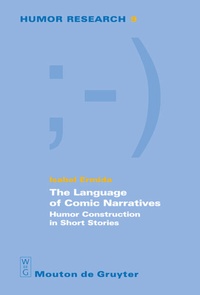
The Language of Comic Narratives
Description

The book offers a comprehensive account of how humor works in short stories, by presenting a model of narrative comedy that is pragmatically as well as semantically, grammatically and stylistically informed. It is the first study to combine a sequential analysis of the comic short story with a hierarchical one, merging together horizontal and vertical narratological perspectives in a systematic way. The book covers the main areas of linguistic analysis and is deliberately interdisciplinary, using input from philosophy, sociology and psychology so as to touch upon the nature, motivations and functions of humor as a cognitive phenomenon in a social context. Crucially, The Language of Comic Narratives combines a scholarly approach with a careful explanation of key terms and concepts, making it accessible to researchers and students, as well as non-specialists. Moreover, it reviews a broad range of historical critical data by examining the source texts, and it provides many humorous examples, from jokes to extracts from comic narratives. Thus, it seeks to anchor theory in specific texts, and also to show that many linguistic mechanisms of humor are common to jokes and longer, literary comic narratives. The book tests the model of humorous narratives on a set of comic short stories by British and American writers, ranging from Evelyn Waugh and Dorothy Parker, through Graham Greene and Corey Ford, to David Lodge and Woody Allen. The validity of the model is confirmed through a subsequent discussion of apparent counter-examples.
More details
Other editions
Additional editions
Person
Content
2 - Contents [Seite 5]
3 - List of tables and figures [Seite 9]
4 - Foreword [Seite 11]
5 - Chapter 1. The concept of humor: history, scope and issues [Seite 13]
6 - Chapter 2. Linguistic resources of humor [Seite 53]
7 - Chapter 3. Humor as a textual genre: from jokes to comic narratives [Seite 95]
8 - Chapter 4. Structural principles of narrative humor [Seite 125]
9 - Chapter 5. Pragmatics of the humorous narrative [Seite 143]
10 - Chapter 6. A model of humorous narratives [Seite 183]
11 - Chapter 7. Extending the analysis [Seite 219]
12 - Backmatter [Seite 249]
