

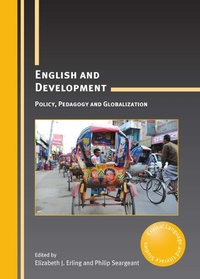
English and Development
Policy, Pedagogy and Globalization
Published on 16. May 2013
296 pages
978-1-84769-948-0 (ISBN)
Description

This book investigates the relationship between English and personal and national development, as this is both discursively promoted (particularly through language policy) and practically realized in developing societies. It addresses the effects that the increased use of English and the promotion of English-language education are having in developmental contexts, and their impact on broader educational issues, on local language ecologies and on questions of cultural identity. It investigates these issues by drawing together a series of original examinations and case studies by a range of leading scholars working in this burgeoning field. The chapters focus on a variety of contexts from around the world, and the volume as a whole surveys and critiques the positioning and influence of English as a catalyst for development in the 21st century.
Reviews / Votes
'English and Development: Policy, Pedagogy and Globalization' makes an important contribution to the growing field of language and development. The issues raised - including stakeholders' attitudes to English; English and identity; the economic roles of English; and English as a medium of instruction and of testing - are all examined in development contexts. A particularly useful feature of the book is the variety of methodologies which contributors employ. -- Hywel Coleman, University of Leeds, UK This valuable and useful collection offers varied, insightful studies of English language education, language policies and language practices as they are affected by the interlinked dynamics of politics, pedagogies, economics and societal inequalities in multilingual Asian and African settings. The book will enrich discussions amongst educators, applied and sociolinguists and policy researchers with regard to the complex, uneven and heterogeneous relationships between English and social development. -- Mastin Prinsloo, University of Cape Town, South Africa This collection of essays provides useful material to highlight key questions regarding the English language and its links to, and impact on, development and pedagogical issues. Readers should come away with a better idea of the complexities that lie behind such questions, their intricate relationship with the different contexts mentioned, and their possible connections with other geographical areas and related fields in the study of language in society. -- Josep Soler-Carbonell, University of Tartu * Linguist List 25.2301 *More details
Series
Language
English
Place of publication
Bristol
United Kingdom
Publishing group
Channel View Publications Ltd
Target group
Professional and scholarly
ISBN-13
978-1-84769-948-0 (9781847699480)
Copyright in bibliographic data and cover images is held by Nielsen Book Services Limited or by the publishers or by their respective licensors: all rights reserved.
Schweitzer Classification
Other editions
Additional editions
Book
05/2013
Multilingual Matters
€46.50
Shipment within 10-20 days
Persons
Elizabeth J. Erling is Lecturer of International Teacher Education at the Open University and her research explores topics in world Englishes, language policy, teacher professional development and English for academic purposes. She has published papers in journals such as World Englishes, English Today, Language Policy and Innovations in Language Learning and Teaching.
Philip Seargeant is Senior Lecturer in Applied Linguistics in the Centre for Language and Communication, The Open University. He is author of The Idea of English in Japan (Multilingual Matters, 2009) and Exploring World Englishes (Routledge), and editor of English in Japan in the Era of Globalization (Palgrave Macmillan, 2011) and English in the World: History, Diversity, Change (Routledge, 2012, with Joan Swann).
Philip Seargeant is Senior Lecturer in Applied Linguistics in the Centre for Language and Communication, The Open University. He is author of The Idea of English in Japan (Multilingual Matters, 2009) and Exploring World Englishes (Routledge), and editor of English in Japan in the Era of Globalization (Palgrave Macmillan, 2011) and English in the World: History, Diversity, Change (Routledge, 2012, with Joan Swann).
Content
Introduction - English and development in a global world: Philip Seargeant and Elizabeth J. Erling
Chapter 1 - English, development and education: Charting the tensions: Gibson Ferguson
Chapter 2 - The political economy of English language and development: English vs. national and local languages in developing countries: Naz Rassool
Chapter 3 - Political perspectives on language policies and development in Africa: Eddie Williams
Chapter 4 - Grassroots attitudes to English as a language for international development in Bangladesh: Elizabeth J. Erling, M. Obaidul Hamid and Philip Seargeant
Chapter 5 - The relationship between English-medium instruction and examining and social and economic development: A Sub-Saharan case study: Pauline Rea-Dickins, Zuleikha Kombo Khamis and Federica Olivero
Chapter 6 - Proficiency in English as a key to development? Helping teachers to help learners to succeed: Martin Wedell
Chapter 7 - An invitation to the feast: Voice and choice in English as a lingua franca: Tom Bartlett
Chapter 8 - HIV/AIDS education, digital literacy, and English language learning in Uganda: Bonny Norton, Shelley Jones and Daniel Ahimbisibwe
Chapter 9 - Language policy in Singapore: Singlish, national development and globalization: Lionel Wee
Chapter 10 - English, scientific publishing and participation in the global knowledge economy: Theresa Lillis and Mary Jane Curry
Chapter 11 - Language in economic development: Is English special and is linguistic fragmentation bad?: Jean-Louis Arcand and Francois Grin
Chapter 1 - English, development and education: Charting the tensions: Gibson Ferguson
Chapter 2 - The political economy of English language and development: English vs. national and local languages in developing countries: Naz Rassool
Chapter 3 - Political perspectives on language policies and development in Africa: Eddie Williams
Chapter 4 - Grassroots attitudes to English as a language for international development in Bangladesh: Elizabeth J. Erling, M. Obaidul Hamid and Philip Seargeant
Chapter 5 - The relationship between English-medium instruction and examining and social and economic development: A Sub-Saharan case study: Pauline Rea-Dickins, Zuleikha Kombo Khamis and Federica Olivero
Chapter 6 - Proficiency in English as a key to development? Helping teachers to help learners to succeed: Martin Wedell
Chapter 7 - An invitation to the feast: Voice and choice in English as a lingua franca: Tom Bartlett
Chapter 8 - HIV/AIDS education, digital literacy, and English language learning in Uganda: Bonny Norton, Shelley Jones and Daniel Ahimbisibwe
Chapter 9 - Language policy in Singapore: Singlish, national development and globalization: Lionel Wee
Chapter 10 - English, scientific publishing and participation in the global knowledge economy: Theresa Lillis and Mary Jane Curry
Chapter 11 - Language in economic development: Is English special and is linguistic fragmentation bad?: Jean-Louis Arcand and Francois Grin
