

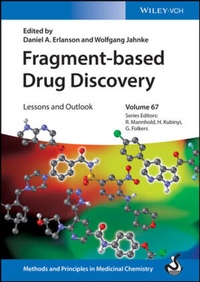
Fragment-based Drug Discovery
Lessons and Outlook
1st Edition
Published on 4. December 2015
528 pages
978-3-527-68361-1 (ISBN)
Description

The secret of success in drug discovery written by the pioneers in the field with unrivaled experience in fragment-based methods.
In this handbook, the first-hand knowledge imparted by the world's leading experts provides a comprehensive overview of current methods and applications of fragment-based discovery. The first part discusses basic considerations concerning when to use such methods, how to select targets, and how to build libraries in the chemical fragment space. The second part describes established, novel, and emerging techniques for fragment screening, including empirical as well as computational approaches, while also discussing such special cases as complex target systems and covalent inhibitors. The third and final part presents a number of successful real-world studies from recent and on-going drug discovery projects relating to a variety of target classes, from kinases and phosphatases to beta-secretase and epigenetic targets.
With its discussion of future developments and potential novel applications, this will remain a valuable reference source for years to come.
In this handbook, the first-hand knowledge imparted by the world's leading experts provides a comprehensive overview of current methods and applications of fragment-based discovery. The first part discusses basic considerations concerning when to use such methods, how to select targets, and how to build libraries in the chemical fragment space. The second part describes established, novel, and emerging techniques for fragment screening, including empirical as well as computational approaches, while also discussing such special cases as complex target systems and covalent inhibitors. The third and final part presents a number of successful real-world studies from recent and on-going drug discovery projects relating to a variety of target classes, from kinases and phosphatases to beta-secretase and epigenetic targets.
With its discussion of future developments and potential novel applications, this will remain a valuable reference source for years to come.
More details
Other editions
Additional editions
Book
01/2016
1st Edition
Wiley-VCH
€175.00
Shipment within 5-7 days
Daniel A. Erlanson | Wolfgang Jahnke
Fragment-based Drug Discovery - Lessons and Outlook
Software
01/2016
Wiley-VCH
€214.78
No shipping information available
Persons
Daniel A. Erlanson is the co-founder and President of Carmot Therapeutics, Inc., which is developing fragment-based approaches to address unmet needs in drug discovery. Prior to Carmot, Dr. Erlanson worked in medicinal chemistry and technology development at Sunesis Pharmaceuticals, which he joined at the company's inception. Before Sunesis, he was an NIH postdoctoral fellow with Dr. James A. Wells at Genentech. Dr. Erlanson earned his Ph.D. in chemistry from Harvard University in the laboratory of Gregory L. Verdine and his BA in chemistry from Carleton College. He edits a blog devoted to fragment-based drug discovery, Practical Fragments.
Wolfgang Jahnke is a Director and Leading Scientist at the Novartis Institutes for Biomedical Research in Basel, Switzerland. His major interests are Structural Biophysics and Fragment-based Drug Discovery. He has received several honors, among them the Industrial Investigator Award from the Swiss Chemical Society, and several Novartis-internal Awards. Dr. Jahnke received his PhD from the TU München, working with Horst Kessler on the development and application of novel NMR methods. Prior to joining Novartis, he worked with Peter Wright at the Scripps Research Institute in La Jolla.
Wolfgang Jahnke is a Director and Leading Scientist at the Novartis Institutes for Biomedical Research in Basel, Switzerland. His major interests are Structural Biophysics and Fragment-based Drug Discovery. He has received several honors, among them the Industrial Investigator Award from the Swiss Chemical Society, and several Novartis-internal Awards. Dr. Jahnke received his PhD from the TU München, working with Horst Kessler on the development and application of novel NMR methods. Prior to joining Novartis, he worked with Peter Wright at the Scripps Research Institute in La Jolla.
Content
PART I: The Concept of Fragment-based Drug Discovery
# 01 The Role of Fragment-Based Approaches in Lead Finding
# 02 Selecting the Right Targets for FBDD
# 03 Enumeration of Chemical Fragment Space
# 04 Ligand Efficiency Metrics and their Use in Fragment Optimizations
PART II: Methods and Approaches for Fragment-based Drug Discovery
# 05 Strategies for Fragment Library Design
# 06 The Synthesis of Biophysical Methods In Support of Robust Fragment-Based Lead Discovery
# 07 Differential Scanning Fluorimetry as Part of a Biophysical Screening Cascade
# 08 Emerging Technologies for Fragment Screening
# 09 Computational Methods to Support Fragment Based Drug Discovery
# 10 Making FBDD Work in Academia
# 11 Site-Directed Fragment Discovery for Allostery
# 12 Fragment Screening in Complex Systems
# 13 Protein-Templated Fragment Ligation Methods: Emerging Technologies in Fragment-Based Drug Discovery
PART III: Successes from Fragment-based Drug Discovery
# 14 BACE Inhibitors
# 15 Epigenetics and Fragment Based Drug Discovery
# 16 Discovery of Inhibitors of Protein-Protein Interactions Using Fragment-Based Methods
# 17 Fragment-Based Discovery of Inhibitors of Lactate Dehydrogenase A
# 18 FBDD Applications to Kinase Drug Hunting
# 19 An Integrated Approach for Fragment Based Lead Discovery: Virtual, NMR and High-Throughput Screening Combined with Structure Guided Design. Application to the Aspartyl Protease Renin
# 01 The Role of Fragment-Based Approaches in Lead Finding
# 02 Selecting the Right Targets for FBDD
# 03 Enumeration of Chemical Fragment Space
# 04 Ligand Efficiency Metrics and their Use in Fragment Optimizations
PART II: Methods and Approaches for Fragment-based Drug Discovery
# 05 Strategies for Fragment Library Design
# 06 The Synthesis of Biophysical Methods In Support of Robust Fragment-Based Lead Discovery
# 07 Differential Scanning Fluorimetry as Part of a Biophysical Screening Cascade
# 08 Emerging Technologies for Fragment Screening
# 09 Computational Methods to Support Fragment Based Drug Discovery
# 10 Making FBDD Work in Academia
# 11 Site-Directed Fragment Discovery for Allostery
# 12 Fragment Screening in Complex Systems
# 13 Protein-Templated Fragment Ligation Methods: Emerging Technologies in Fragment-Based Drug Discovery
PART III: Successes from Fragment-based Drug Discovery
# 14 BACE Inhibitors
# 15 Epigenetics and Fragment Based Drug Discovery
# 16 Discovery of Inhibitors of Protein-Protein Interactions Using Fragment-Based Methods
# 17 Fragment-Based Discovery of Inhibitors of Lactate Dehydrogenase A
# 18 FBDD Applications to Kinase Drug Hunting
# 19 An Integrated Approach for Fragment Based Lead Discovery: Virtual, NMR and High-Throughput Screening Combined with Structure Guided Design. Application to the Aspartyl Protease Renin
