

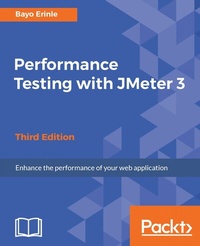
Performance Testing with JMeter 3
Enhance the performance of your web application
3rd Edition
Published on 8. July 2025
166 pages
978-1-78728-321-3 (ISBN)
Description

A practical guide to help you understand the ability of Apache JMeter to load and performance test various server types in a more efficient way.
Key Features
Use JMeter to create and run tests to improve the performance of your webpages and applications
Learn to build a test plan for your websites and analyze the results
Unleash the power of various features and changes introduced in Apache JMeter 3.0
Book DescriptionJMeter is a Java application designed to load and test performance for web application. JMeter extends to improve the functioning of various other static and dynamic resources. This book is a great starting point to learn about JMeter. It covers the new features introduced with JMeter 3 and enables you to dive deep into the new techniques needed for measuring your website performance. The book starts with the basics of performance testing and guides you through recording your first test scenario, before diving deeper into JMeter. You will also learn how to configure JMeter and browsers to help record test plans. Moving on, you will learn how to capture form submission in JMeter, dive into managing sessions with JMeter and see how to leverage some of the components provided by JMeter to handle web application HTTP sessions. You will also learn how JMeter can help monitor tests in real-time. Further, you will go in depth into distributed testing and see how to leverage the capabilities of JMeter to accomplish this. You will get acquainted with some tips and best practices with regard to performance testing. By the end of the book, you will have learned how to take full advantage of the real power behind Apache JMeter.What you will learn
See why performance testing is necessary and learn how to set up JMeter
Record and test with JMeter
Handle various form inputs in JMeter and parse results during testing
Manage user sessions in web applications in the context of a JMeter test
Monitor JMeter results in real time
Perform distributed testing with JMeter
Get acquainted with helpful tips and best practices for working with JMeter
Who this book is forThis book is for software professionals who want to understand and improve the performance of their applications with Apache JMeter.
Key Features
Use JMeter to create and run tests to improve the performance of your webpages and applications
Learn to build a test plan for your websites and analyze the results
Unleash the power of various features and changes introduced in Apache JMeter 3.0
Book DescriptionJMeter is a Java application designed to load and test performance for web application. JMeter extends to improve the functioning of various other static and dynamic resources. This book is a great starting point to learn about JMeter. It covers the new features introduced with JMeter 3 and enables you to dive deep into the new techniques needed for measuring your website performance. The book starts with the basics of performance testing and guides you through recording your first test scenario, before diving deeper into JMeter. You will also learn how to configure JMeter and browsers to help record test plans. Moving on, you will learn how to capture form submission in JMeter, dive into managing sessions with JMeter and see how to leverage some of the components provided by JMeter to handle web application HTTP sessions. You will also learn how JMeter can help monitor tests in real-time. Further, you will go in depth into distributed testing and see how to leverage the capabilities of JMeter to accomplish this. You will get acquainted with some tips and best practices with regard to performance testing. By the end of the book, you will have learned how to take full advantage of the real power behind Apache JMeter.What you will learn
See why performance testing is necessary and learn how to set up JMeter
Record and test with JMeter
Handle various form inputs in JMeter and parse results during testing
Manage user sessions in web applications in the context of a JMeter test
Monitor JMeter results in real time
Perform distributed testing with JMeter
Get acquainted with helpful tips and best practices for working with JMeter
Who this book is forThis book is for software professionals who want to understand and improve the performance of their applications with Apache JMeter.
More details
Edition
3rd Revised edition
Language
English
Place of publication
Birmingham
United Kingdom
Target group
Professional and scholarly
US School Grade: College Graduate Student
Edition type
Revised edition
File size
4,10 MB
ISBN-13
978-1-78728-321-3 (9781787283213)
Copyright in bibliographic data and cover images is held by Nielsen Book Services Limited or by the publishers or by their respective licensors: all rights reserved.
Schweitzer Classification
Other editions
Additional editions
Bayo Erinle
Performance Testing with JMeter 3
Book
07/2017
Packt Publishing
€44.90
Shipment within 3-4 weeks
Person
Erinle Bayo :
? Proficient Java developer with more than 11 years experience ? Skilled at defining the architecture for stand-alone, distributed, two tier, three tier or multi tier applications ? Productive and creative both as a software developer and analyst ? Extensive practical hands-on experience in developing, designing, maintaining and recapturing object oriented applications ? Effective working alone or as a cooperative team member ? Adapting new technologies and developments in creating quality products for customers Bayo Erinle is a senior software engineer with over nine years' experience in designing, developing, testing, and architecting software. He has worked in various spectrums of the IT field, including government, finance, and health care. As a result, he has been involved in the planning, development, implementation, integration, and testing of numerous applications, including multi-tiered, standalone, distributed, and cloud-based applications. He is always intrigued by new technology and enjoys learning new things. He currently resides in Maryland, US, and when he is not hacking away at some new technology, he enjoys spending time with his wife Nimota and their three children, Mayowa, Durotimi, and Fisayo.
? Proficient Java developer with more than 11 years experience ? Skilled at defining the architecture for stand-alone, distributed, two tier, three tier or multi tier applications ? Productive and creative both as a software developer and analyst ? Extensive practical hands-on experience in developing, designing, maintaining and recapturing object oriented applications ? Effective working alone or as a cooperative team member ? Adapting new technologies and developments in creating quality products for customers Bayo Erinle is a senior software engineer with over nine years' experience in designing, developing, testing, and architecting software. He has worked in various spectrums of the IT field, including government, finance, and health care. As a result, he has been involved in the planning, development, implementation, integration, and testing of numerous applications, including multi-tiered, standalone, distributed, and cloud-based applications. He is always intrigued by new technology and enjoys learning new things. He currently resides in Maryland, US, and when he is not hacking away at some new technology, he enjoys spending time with his wife Nimota and their three children, Mayowa, Durotimi, and Fisayo.
Content
Table of Contents
Performance Testing Fundamentals
Recording Your First Test
Submitting Forms
Managing Sessions
Monitoring tests in real time
Distributed Testing
Helpful Tips- Part 1
Helpful Tips- Part 2
Performance Testing Fundamentals
Recording Your First Test
Submitting Forms
Managing Sessions
Monitoring tests in real time
Distributed Testing
Helpful Tips- Part 1
Helpful Tips- Part 2
