

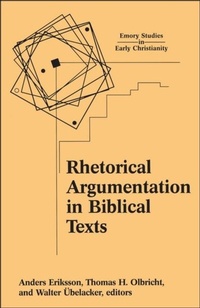
Rhetorical Argumentation in Biblical Texts
Essays from the Lund 2000 Conference
1st Edition
Published on 1. June 2002
456 pages
978-0-567-36619-1 (ISBN)
Description

In the latest volume in the Emory Studies in Early Christianity series, the contributors seek a better understanding of how various biblical authors present their arguments, support their claims, and attempt to persuade their readers.
A century ago the rhetorical analysis of texts focused on the study of rhetorical figures in texts (elocutio). In the mid-twentieth century, scholars such as James Muilenburg, Hans Dieter Betz, and Wilhelm Wuellner introduced biblical scholars to the illustrious tradition of rhetorical study. These scholars tended to focus on the arrangement of the texts themselves (dispositio).
During the last ten years, however, interpreters have increasingly studied the rhetorical argumentation in texts. The authors in this volume examine rhetorical argumentation in the Hebrew Bible, the Gospels, the Pauline letters, and the Book of Revelation, offering striking new readings of these materials.
Contributors include: J. David Hester (Amador), Center for Rhetoric and Hermeneutics; R. Dean Anderson, Valkenburg, The Netherlands; Harold W. Attridge, Yale Divinity School; L. Gregory Bloomquist, St. Paul University, Ottawa; Michael R. Cosby, Messiah College; Rodney K. Duke, Appalachian State University; Frans H. van Eemeren, University of Amsterdam; Anders Eriksson, Lund University; Alan J. Hauser, Appalachian State University; Roy R. Jeal, William and Catherine Booth College; Manfred Kraus, Eberhard-Karls-Universität, Tübingen; John W. Marshall, University of Toronto; Roland Meynet, Pontificia Università Gregoriana; Thomas H. Olbricht, Emeritus, Pepperdine University; Carol Poster, Florida State University; Rollin A. Ramsaran, Emmanuel School of Religion; Vernon K. Robbins, Emory University and University of Stellenbosch; Russell B. Sisson, Union College; Jerry L. Sumney, Lexington Theological Seminary; C. Jan Swearingen, Texas A & M; Lauri Thurén, Univeristy of Joensuu; Johan S. Vos, Vrije Universiteit; and Duane F. Watson, Malone College.
A century ago the rhetorical analysis of texts focused on the study of rhetorical figures in texts (elocutio). In the mid-twentieth century, scholars such as James Muilenburg, Hans Dieter Betz, and Wilhelm Wuellner introduced biblical scholars to the illustrious tradition of rhetorical study. These scholars tended to focus on the arrangement of the texts themselves (dispositio).
During the last ten years, however, interpreters have increasingly studied the rhetorical argumentation in texts. The authors in this volume examine rhetorical argumentation in the Hebrew Bible, the Gospels, the Pauline letters, and the Book of Revelation, offering striking new readings of these materials.
Contributors include: J. David Hester (Amador), Center for Rhetoric and Hermeneutics; R. Dean Anderson, Valkenburg, The Netherlands; Harold W. Attridge, Yale Divinity School; L. Gregory Bloomquist, St. Paul University, Ottawa; Michael R. Cosby, Messiah College; Rodney K. Duke, Appalachian State University; Frans H. van Eemeren, University of Amsterdam; Anders Eriksson, Lund University; Alan J. Hauser, Appalachian State University; Roy R. Jeal, William and Catherine Booth College; Manfred Kraus, Eberhard-Karls-Universität, Tübingen; John W. Marshall, University of Toronto; Roland Meynet, Pontificia Università Gregoriana; Thomas H. Olbricht, Emeritus, Pepperdine University; Carol Poster, Florida State University; Rollin A. Ramsaran, Emmanuel School of Religion; Vernon K. Robbins, Emory University and University of Stellenbosch; Russell B. Sisson, Union College; Jerry L. Sumney, Lexington Theological Seminary; C. Jan Swearingen, Texas A & M; Lauri Thurén, Univeristy of Joensuu; Johan S. Vos, Vrije Universiteit; and Duane F. Watson, Malone College.
More details
Series
Edition
1. Auflage
Language
English
Place of publication
New York
United States
Publishing group
Bloomsbury Publishing USA
Target group
Professional and scholarly
ISBN-13
978-0-567-36619-1 (9780567366191)
Copyright in bibliographic data and cover images is held by Nielsen Book Services Limited or by the publishers or by their respective licensors: all rights reserved.
Schweitzer Classification
Other editions
Additional editions
Anders Eriksson | Thomas H. Olbricht | Walter UEbelacker
Rhetorical Argumentation in Biblical Texts
Essays from the Lund 2000 Conference
Book
06/2002
Continuum International Publishing Group - Trinity
€126.60
Shipment within 3-4 weeks
Persons
Content
- Cover
- Contents
- Preface
- Abbreviations
- Contributors
- Introduction
- Part One: Rhetorical Argumentation and Method
- 1. Argumentation Theory: An Overview of Approaches and Research Themes
- 2. Argumentative Textures in Socio-Rhetorical Interpretation
- 3. The Use and Abuse of Lausberg in Biblical Studies
- 4. Is There Biblical Argumentation?
- Part Two: Historical Background
- 5. Theories and Practice of the Enthymeme in the First Centuries B.C.E. and C.E.
- 6. The Economy of Letter Writing in Graeco-Roman Antiquity
- Part Three: Rhetorical Argumentation in the Hebrew Bible
- 7. The Strategic Use of Enthymeme and Example in the Argumentation of the Books of Chronicles
- 8. Should Ahab Go to Battle or Not? Ambiguity as a Rhetorical Device in 1 Kings 22
- Part Four: Rhetorical Argumentation in the Gospels
- 9. The Role of the Audience in the Determination of Argumentation: The Gospel of Luke and the Acts of the Apostles
- 10. Instructions for "Broker" Apostles: A Socio-Rhetorical Analysis of Matthew's Mission Discourse
- 11. Argumentation in John 5
- 12. The Question at the Center: A Specific Device of Rhetorical Argumentation in Scripture
- Part Five: Rhetorical Argumentation in the Pauline Letters
- 13. "To Make the Weaker Argument Defeat the Stronger": Sophistical Argumentation in Paul's Letter to the Romans
- 14. The Tongues of Men: Understanding Greek Rhetorical Sources for Paul's Letters to the Romans and 1 Corinthians
- 15. Enthymemes in Pauline Argumentation: Reading between the Lines in 1 Corinthians
- 16. Paul's Boasting in 2 Corinthians 10-13 as Defense of His Honor: A Socio-Rhetorical Analysis
- 17. Re-reading 2 Corinthians: A Rhetorical Approach
- 18. Galatians: Red-Hot Rhetoric
- 19. Rhetorical Argumentation in the Letter to the Ephesians
- 20. Living and Dying, Living Is Dying (Philippians 1:21): Paul's Maxim and Exemplary Argumentation in Philippians
- 21. The Argument of Colossians
- Part Six: Rhetorical Argumentation in Hebrews
- 22. Anticipating and Presenting the Case for Christ as High Priest in Hebrews
- Part Seven: The Rhetoric of Apocalyptic and Romance
- 23. Revelation and Romance: Genre Bending in the Shepherd of Hermas and the Acts of Peter
- Bibliography
- Index of Ancient Texts
- Index of Subjects and Authors
- A
- B
- C
- D
- E
- F
- G
- H
- I
- J
- K
- L
- M
- N
- O
- P
- Q
- R
- S
- T
- U
- V
- W
