

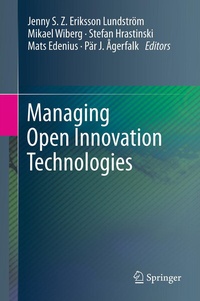
Managing Open Innovation Technologies
Description

Open innovation increases the profit of companies and organizations via the input and the adoption of new ideas that are transformed into new processes, products, and services. Yet, how do we ensure that adopters of such innovations focus on relevant problems and use appropriate methods? How should we manage open innovation technologies? How can we exploit distributed knowledge and inventions? And how can we promote them successfully on the market?
With valuable lessons to be learned from academic research and industrial experiences of e.g. Intel, Nokia, Philips Healthcare, small municipalities, e-learning platforms and user communities, this book focuses on some of the key dimensions of open innovation and open innovation technologies. It is divided into three themes: theme 1 deals with open innovation as it is in use today, including theoretical underpinnings and lessons from related research fields. Theme 2 analyzes the use of open innovation in organizations today in order to extract best practices. Theme 3 presents forward-looking theoretical research as well as practical future uses of open innovation. Each chapter addresses the particular topics by presenting experiences and results gained in real life projects and/or by empirical research, and clearly states its purpose and how readers are supposed to benefit from it.
Overall, the objectives of this book are to advance and disseminate research on systematic open innovation, and to make its results available to practitioners. Thus, the intended target audience includes the international academic community, industrial enterprises, and public authorities.Reviews / Votes
From the reviews:
"This book presents summaries of research on innovation that may help organizations advance their goals incrementally through innovative techniques. . best lends itself to a highly technical, research-focused audience. . Researchers and academic readers may find ideas in the book that are worth trying out or researching further." (Ilya Yakovlev, Computing Reviews, January, 2014)
More details
Other editions
Additional editions
Persons
Jenny Eriksson Lundström is Senior Researcher at NITA - the Swedish IT-User Centre - and Lecturer of Information Systems at the Department of Informatics and Media, Uppsala University, Sweden. For several years, she has been researching information technology and knowledge management, with a multidisciplinary perspective on IT and innovation.
Mats Edenius is a Professor of Information Systems in the Department of Informatics and Media at Uppsala University. His research interests lie within the areas of information technology and knowledge management.
Stefan Hrastinski is Associate Professor of Media Technology at KTH Royal Institute of Technology, Sweden. He is also affiliated with the Swedish IT-User Centre and the Department of Informatics and Media at Uppsala University. His main research interests are online learning, collaboration, and innovation in organizational and educational settings.
Mikael Wiberg is Full Professor in the Department of Informatics and Media at Uppsala University where he holds the chair in HCI - Human Computer Interaction. Prior to this position, Wiberg held a position as Research Director for the Umeå Institute of Design, Sweden.
Pär J. Ågerfalk is Full Professor in the Department of Informatics and Media at Uppsala University where he holds the Chair in Information Systems. He held prior positions at Örebro University, Lero, the Irish Software Engineering Research Centre, Jönköping International Business School, and the University of Limerick. His research interests include information systems development, open source software, and global software development.